

They’ve been among us for a while now. Tiny microbots that work together to fight disease, find a lost soldier, or even build a new structure have appeared in science fiction movies like Minority Report in the past. And, several companies, including IBM and HP, have shown how a few small robots can communicate with each other to complete a task.
Now, Harvard researchers have developed the kilobot, a tiny robot that costs just $14 to build and communicates using infrared. The main distinction: hundreds or even thousands of kilobots could perform complex tasks. In the future, these bots could set the stage for rapid prototyping assembly. Imagine thousands of kilobots building a bridge or even a skyscraper, or entering a warzone to find enemy installations and disable weapons one by one.
Mike Rubenstein is a postdoctoral fellow working in the Self-Organizing Systems Research Group at Harvard University. He explained that the tiny bots use two vibrating motor for locomotion, and communicate with other bots by sending an infrared light onto a surface — they know the location of other bots by reading the light intensity.
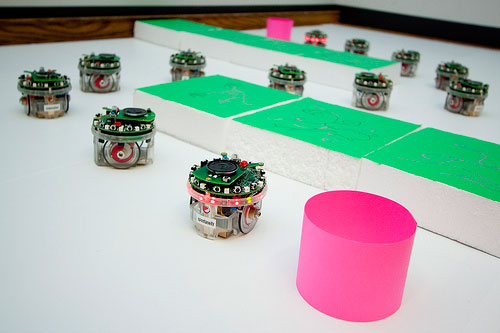 The main difference, he says, between some previous swarmbots and the kilobit, is that the new bots are genuine robots: They work together, but do not just follow a pre-determined route. They are more like a Roomba than an RC car that just follows the commands of an operator. With the Roomba, the bot has enough intelligence to monitor the environment looking for obstructions and using thousands of algorithms to find an optimal route.
“The main short-term application is for testing swarm algorithms on a large-scale robot system,” says Rubenstein. “We can program them to move and interact with neighboring robots. There are many behaviors possible, so far we have worked on foraging and exploration.”
Rubenstein says he can imagine a future scenario where the bots are used for military engagements. The team has already developed a roadmap, called Termes, for how kilobots could build a 3D structure. The team is working on a large-scale deployment for kilobots. Rubenstein also envisions the bots being used for education, what he calls “group vehicle navigation” and for environmental mapping — a technique that approximates what a region would look like after corrosion or after the effects of climate change.
Medical scenarios
Another example of massive swarmbot interaction involves so-called “ninja particles” that IBM is developing. These tiny polymer bots work like a cell in your body — they contain an electrical charge, and are attracted to infectious agents in the body like a magnet. Doctors could use ninja particles that work autonomously in the body to find a wound and start repairing damaged cells.
“Once these polymers come into contact with water in or on the body, they self-assemble into a nanostructure that is designed to target bacteria membranes based on electrostatic interaction and break through their cell membranes and walls. The physical nature of this action prevents bacteria from developing resistance to these nanoparticles,” says Jim Hedrick, a researcher at IBM.
“These agents prevent the bacteria from developing drug resistance by actually breaking through the bacterial cell wall and membrane, a fundamentally different mode of attack compared to traditional antibiotics,” Hedrick says. The swarm concept, similar to what Rubenstein is developing, means each individual polymer can’t accomplish the mission on its own but has to work with the other agents to fight an infection and alter cells in the body.
Interestingly, Hedrick says ninja particles could be used for commercial applications as well, not just in the medical field or in a research lab. He says the nanostructures could be built-in to hand-soap, deodorant, table wipes, and hand sanitizers to fight infections. They could also be used to fight major infections like tuberculosis and lung disease. Once the particles are programmed, they carry out their “mission” and then naturally dissolve.
Future scenarios
Rubenstein was hesitant to theorize about future kilobot scenarios. Yet, it’s easy to envision how swarmbots could become part of our everyday lives. Whether having thousands of bots building bridges, finding infections, or fighting our battles could lead to a microarmageddon is another question. Yet, the idea of sensors in physical objects is already a reality.
One example is the 94Fifty basketball, which sells for about $3,000. The ball contains a sensor that communicates with software to analyze a player’s shot. The software can be used to train new players on shooting mechanics, and the data can be used for an entire team to analyze how they play the game and how to improve their abilities. This “hive” analysis, already a reality, shows how embedded sensors can work together in a team.
Swarmbots use a similar concept: They could be embedded in physical objects, communicate with each other, and then report their activities back to a central server.
Thats particularly interesting in a battleground scenario. Swarmbots could work like the new iRobot 110 FirstLook, a rapid deployment bot you throw to the ground.
The bot can handle a 15-foot drop and is waterproof up to 3 feet. While not microbot size (each FirstLook is about ten inches long and weighs five pounds) they could work in a hive, similar to how programmers have designed a swarm of iRobot Roomba vacuums to clean large areas. We recently watched two Roombas work together to vacuum a room, avoiding each other and communicating to finish the cleaning job in half the time.
FirstLook bots already use infrared light to find routes in a battlefield. Even though they do not work autonomously and do not communicate with each other yet, it’s easy to envision how these kinds of bots could coordinate an exploratory mission in enemy territory.
Swarmbot drones could perform surveillance tasks as seen in the upcoming Ghost Recon: Future Soldier game by Ubisoft, providing reconnaissance that keeps soldiers safe. Of course, these future scenarios may seem like science-fiction. There are questions about the cost for each bot on the battlefield, and military officials have been reticent to use robots in combat situations because of the moral implications (humans have the ability to make better impulse decisions). Military bots are used primarily for surveying the battlefield today.
However, as with any robotics endeavor, that will change as the AI improves. Swarmbots could be programmed with a group failsafe that is stronger than an individual bot. They could be sent into a warzone to find wounded soldiers, repair vehicles, and even disable enemy weapons.
For now, swarmbot technology is firmly in an early development stage. The kilobot is the best example so far that demonstrates how a low-cost bot could perform simple tasks and work together in a horde. Whether this leads to a swarm of bots that can mow your grass, repair a fence, or build a tree fort in your backyard is still an unknown.


