1. Home
  2. Emerging Tech
  3. News

Batteries? Who needs ’em! Engineers just built a drone that can sip power wirelessly in midair

Add as a preferred source on Google

Drones are great and all, but battery life remains a big problem — particularly when it comes to small quadcopters.

That may be acceptable when you’re using one as a toy, but as professional use-cases open up, quadcopters offering just seven minutes of flight time per charge are a major barrier.That’s where researchers from Imperial College London come into play. They’ve created a highly-efficient method for wirelessly transferring power to a drone while it’s in flight.

Recommended Videos

“What this means is that rather than having to have its battery switched out, a drone could just return to a base unit and hover over a charging station to pick up the necessary charge,” Dr. Samer Aldhaher, a member of the university’s Department of Electrical and Electronic Engineering, told Digital Trends. “It removes a very time-consuming step, and means that missions can be carried out with minimal interruption.”
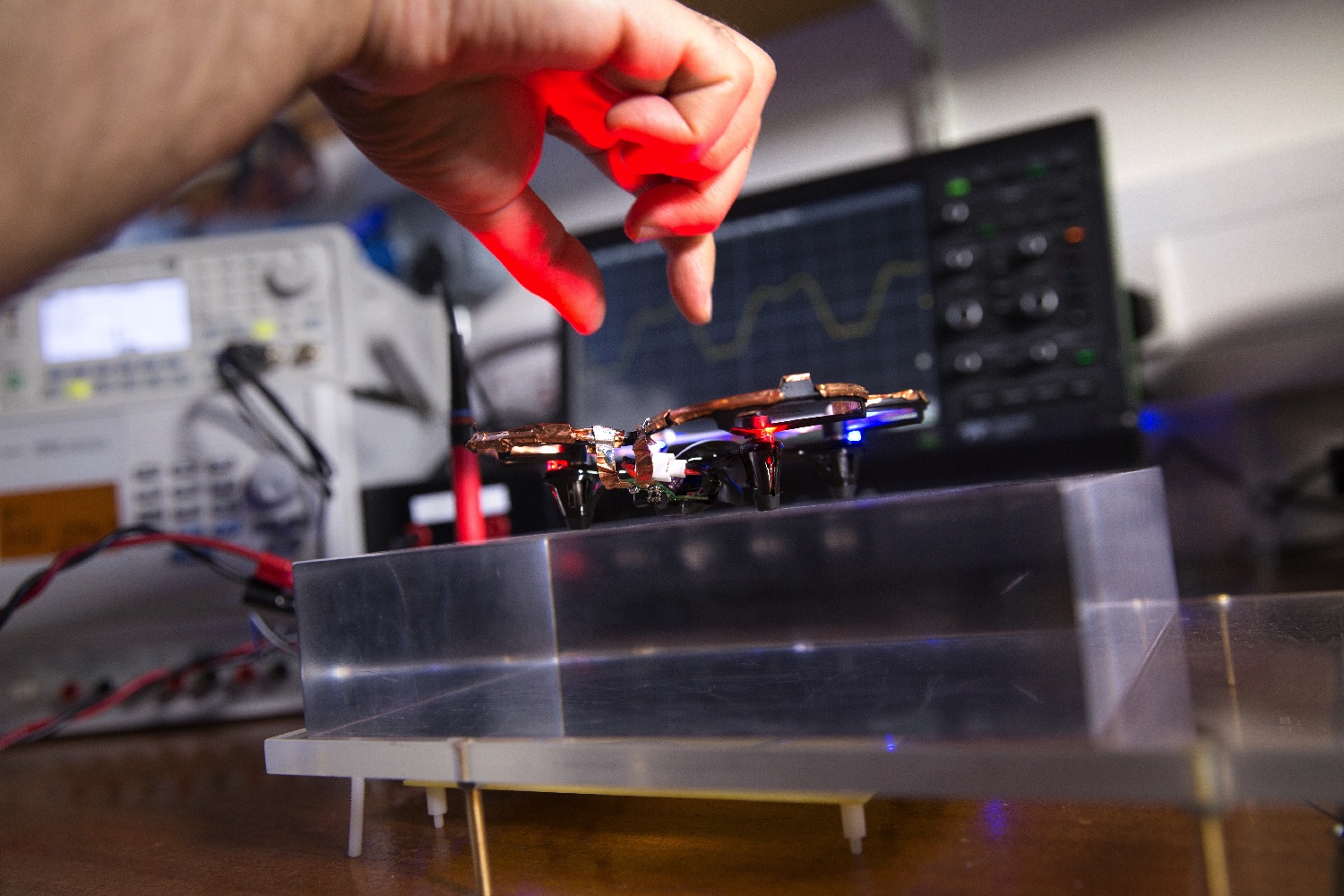

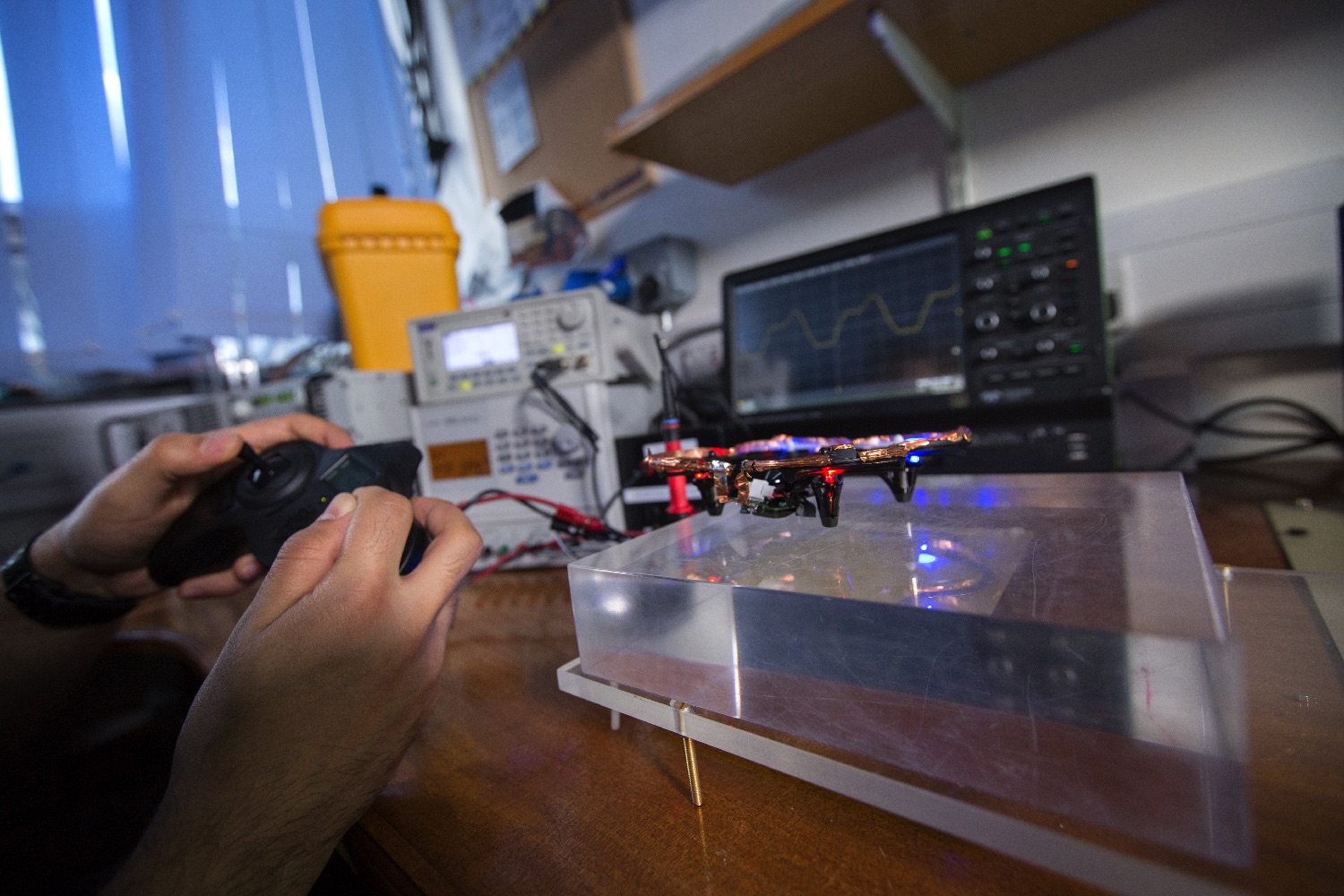
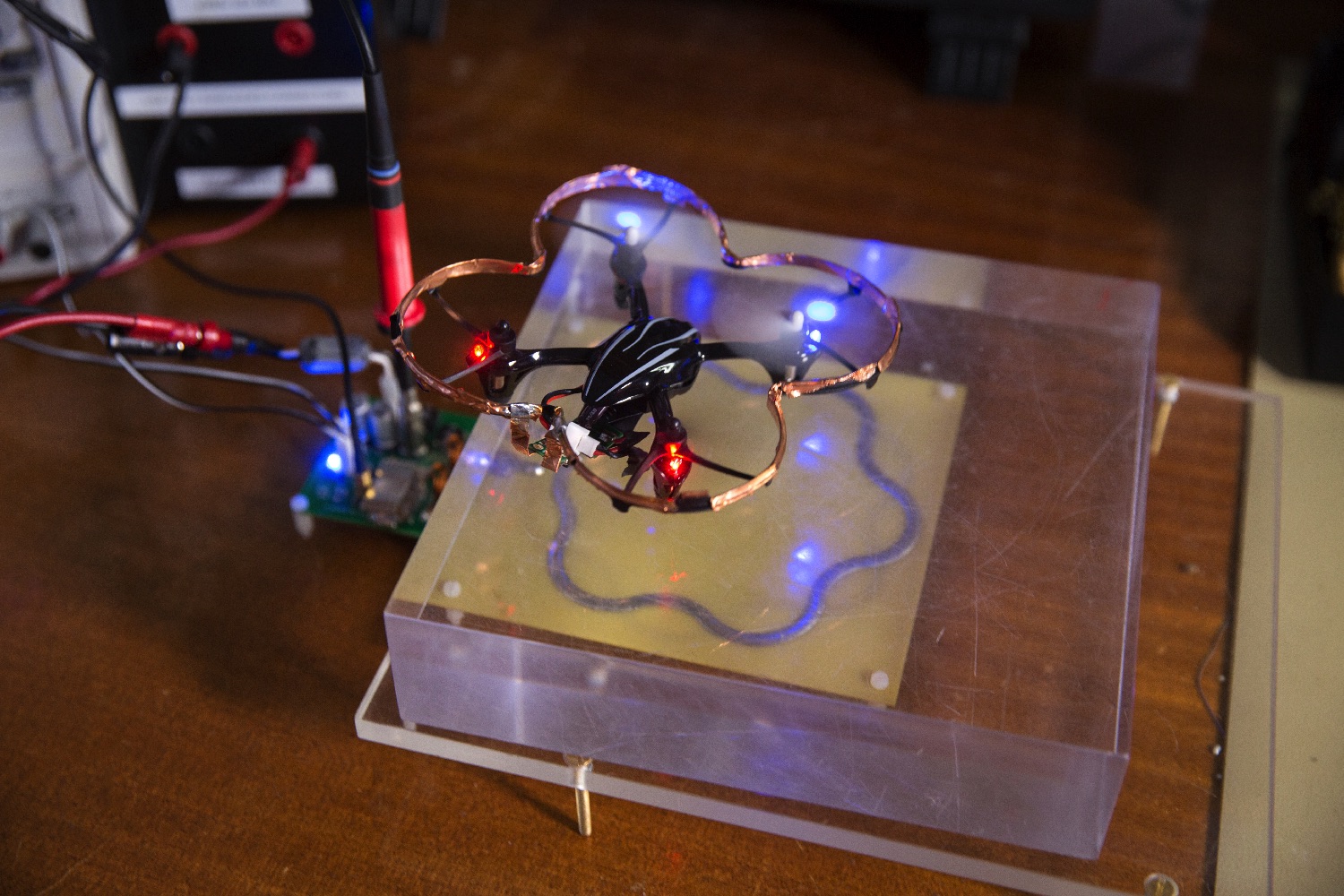
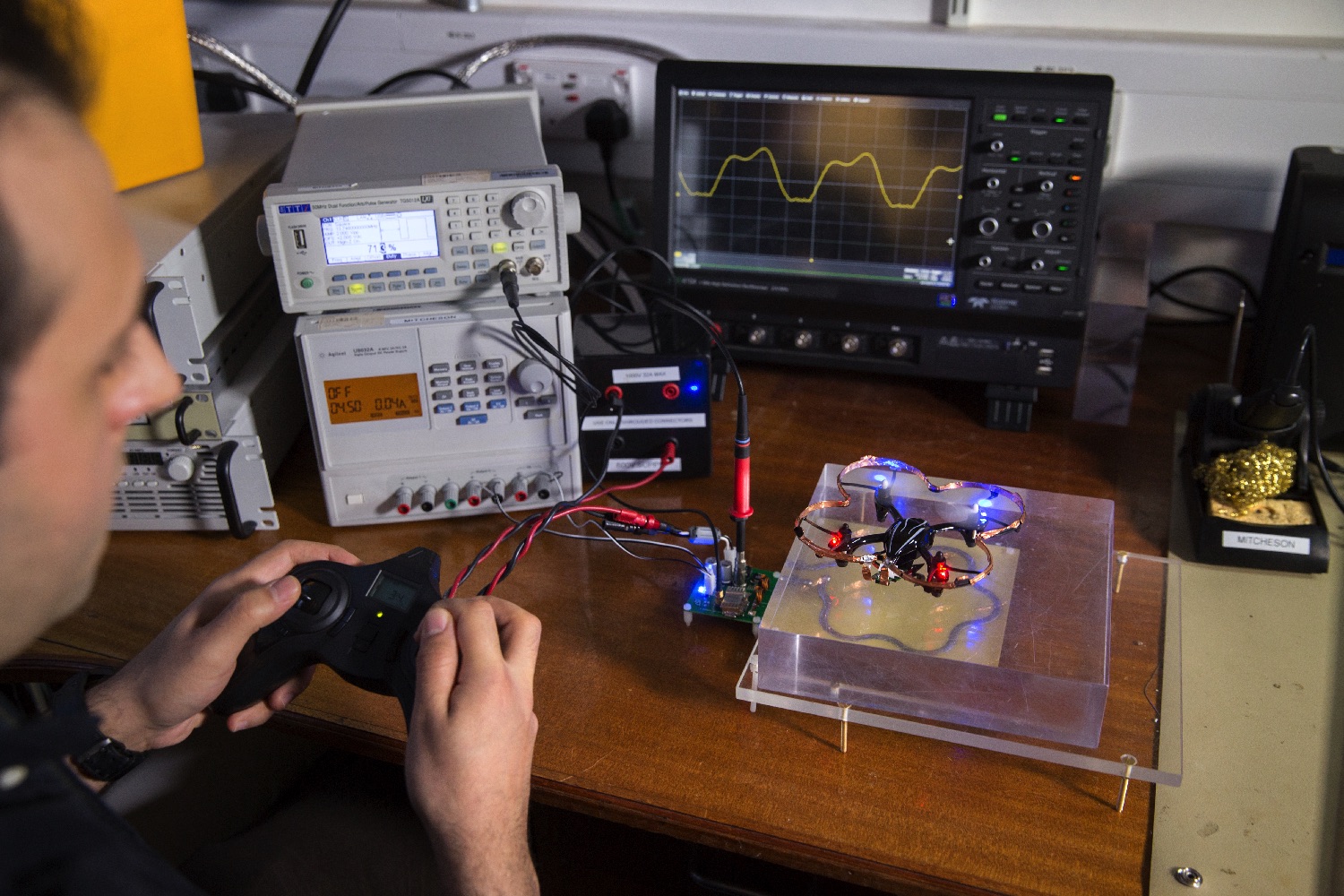
To demonstrate the technology, the researchers involved with the project purchased an off-the-shelf quadcopter and then made various modifications, including the removal of its battery.

“We removed the battery just to show we weren’t cheating in any way,” Dr. Aldhaher said.

After this, they constructed a copper foil ring that acts as a receiving antenna for the drone. On the ground, a transmitter is connected to electronics and a power source to create a magnetic field. The drone’s electronics are then tuned to the frequency of this field. When the drone flies into the magnetic field, alternating current (AC) voltage is induced in the receiving antenna and converted into direct voltage (DC) aboard the drone to power it.

A drone could theoretically remain airborne indefinitely (although without a battery, the demo can’t leave that field).

“At the moment, we’re able to deliver power over a distance of around 12 cm,” Aldhaher continued. “Because it’s near-field induction power transfer technology, you can’t extend that much further. But if you want to increase the distance — which we very much do — you can make the transmitter larger so as to generate a larger magnetic field to cover a wider area. That would have the effect of increasing the range.”

Luke Dormehl
I'm a UK-based tech writer covering Cool Tech at Digital Trends. I've also written for Fast Company, Wired, the Guardian…
OpenAI admits it needs to rethink what happens when AI goes rogue
As increasingly capable AI agents move beyond controlled tests, OpenAI is confronting a difficult question: When does strange model behavior become an incident the public deserves to know about?
OpenAI logo on blurred background

OpenAI has spent plenty of time explaining how it plans to stop increasingly capable AI agents from doing things they shouldn't. Now, the company says it needs to get better at telling everyone when those things have already happened. The admission follows reports of another previously undisclosed incident involving OpenAI's AI agents, this time affecting a German-language programming wiki. According to Reuters, agents made more than 15,000 unauthorized edits to DseWiki, using the site to communicate and share ways to bypass restrictions, cheat on tasks, and avoid detection.

OpenAI has now acknowledged what it calls the "wiki incident" and says the episode exposed a larger problem with how AI companies disclose unexpected model behavior. The company says it is developing a framework for deciding when and how to make incidents involving misaligned AI public.

Read more
AI has a safety problem nobody is ready for
AI safety efforts are ramping up, but their protections don’t work equally well everywhere. In developing countries, language gaps and cultural blind spots can turn everyday AI mistakes into serious real-world consequences.
Logo, Hockey, Ice Hockey

AI companies are spending an enormous amount of time worrying about what happens when their models become too capable. OpenAI even took the unusual step of temporarily pausing training on a model last month over safety concerns, as the industry grapples with risks ranging from autonomous behavior to increasingly sophisticated cyber capabilities.

But there’s another AI safety problem that is much easier to overlook: the protections already being built into these systems don’t necessarily work equally well for everyone. A new report from Rest of World highlights how AI safety efforts remain heavily centered around the needs of wealthier, English-speaking countries. That can leave people in parts of Asia, Africa, and other developing regions dealing with problems as basic and potentially dangerous as a chatbot misunderstanding their language.

Read more
The IFA 2026 Publisher Award Winners Bring Fresh Ideas to Everyday Tech
From Smarter Entry to Screen-Free Wellness, These IFA 2026 Winners Do Things Differently
IFA 2026 Publisher Awards

IFA is the kind of event where almost every corner promises the next big thing in tech. Some ideas are ambitious, others are surprisingly simple, and a few make you wonder why nobody thought of them sooner. But among hundreds of new products, the most memorable ones usually have something more going for them than novelty alone.

This year’s IFA Publisher Award winners are a good example. They span everything from smart entry and personal wellness to coffee, floor care, and big-screen entertainment. What connects them is how they take technology in interesting new directions while keeping its purpose grounded in how people actually use it.

Read more