
A match made in high-tech heaven was unveiled at South by Southwest (SXSW) when Icon, a revolutionary design and construction company, announced its partnership with New Story, a San Francisco-based nonprofit that invests in international housing solutions. Their goal: To deploy a 3D-printer capable of manufacturing an 800-square-foot house in under 24 hours for less than $5,000.
It’s an ambitious project but one that has a headstart; Icon also brought to SXSW a fully functional 3D-printed model that demonstrates how the company can in produce a low-cost, livable home designed to function with zero waste and work under constraints such as limited water, power, or labor. For its efforts, Icon won this year’s SXSW Accelerator “Pitch Event,” receiving $4,000 and vital exposure to potential investors and constituents in the housing market.
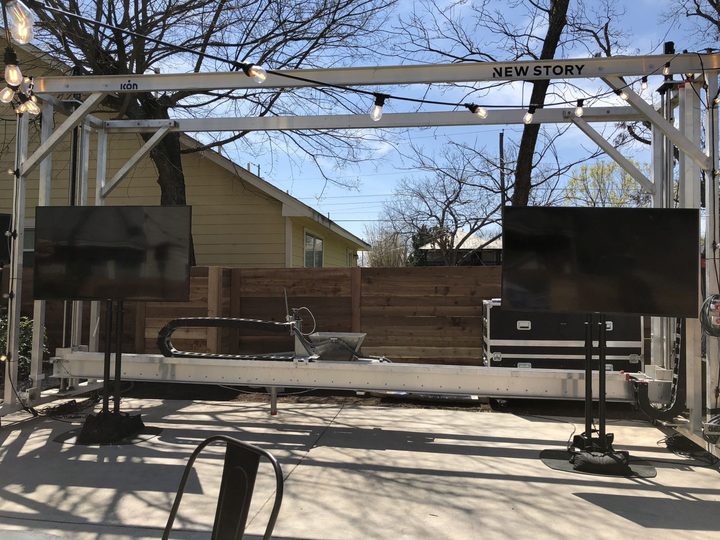
New Story is an ideal test platform for the new 3D-printing technology as it’s a non-profit that already has deep roots in communities in Mexico, Haiti, El Salvador, and Bolivia. In three years, the nonprofit has funded more than 1,300 homes for families in need at a cost of about $6,500. New Story, supported by Y Combinator and other backers, works on a model that guarantees all funds collected goes to build homes.
Following the conference, Icon intends to use the model as an office in its own backyard so it can experience what it’s like to spend long amounts of time in the space and tweak the design accordingly. Each house can be assembled by just two to four workers. New Story also insists on manufacturers using a concept known as “participatory design,” meaning that their “customers” have an active role in sharing their needs before a build, so everyone involved can solve real problems. New Story also uses a streamlined, non-invasive approach to evaluating each project so that each new community they raise is better than the last one.
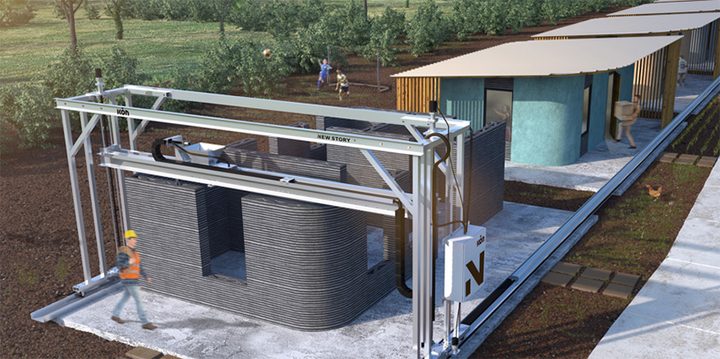
Using advanced robotics, cutting-edge materials and a proprietary software, Icon enables families to have options for different designs based on factors like terrain, climate, and family size. The actual “printer,” demonstrated at SXSW, is called the Vulcan and is built out of lightweight aluminum with a built-in backup generator.
Another challenge was developing a proprietary building mix using concrete that could be managed by the Vulcan but also suit New Story’s requirements, which include no exotic materials that might have to be imported. The mortar, which must be sourced from local materials, had to be thin enough to flow through the 3D printer but thick enough to support the building structure. The mix has to cure relatively quickly but if it cured too fast, the walls won’t fuse together properly. Heavy rain and challenges in cleaning slowed the company during its research and development phase.
Icon’s future goals are equally lofty. The manufacturer would like to develop robots capable of installing different assets like doors or windows, as well as drones that could spray-paint the exterior walls. It is also testing the Vulcan and other equipment to investigate the potential to print roofs as well. Eventually, Icon would also like to construct homes to alleviate the housing crisis in the United States.


