Lytro made a huge splash last year when it released a camera that could refocus after you’ve shot the image, although it’s an expensive niche product. But since then new technologies have been developed that would put a similar refocusing feature into smartphones. Nokia recently announced an app that would utilize software to achieve this “trick,” while Toshiba and DigitalOptics are creating refocusing camera modules. But now AppleInsider reports that Apple has just been awarded a patent for an adaptor that could enable future iPhone cameras to refocus.
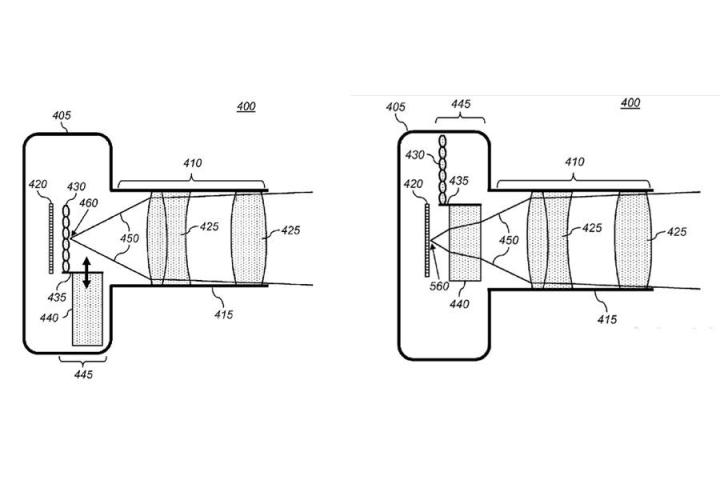
Unlike software and modules, Apple’s camera system is the closest to Lytro’s in technology. U.S. Patent No. 8,593,564, “Digital camera including refocusable imaging mode adaptor,” describes a light-field camera (plenoptic camera) that uses an array of microlenses. Unlike Lytro’s camera, which uses a fixed component, Apple is using an adaptor design instead. The adaptor, which is placed between the sensor and the lens element, can be operated in a non-refocusing high-resotion mode or a low-resolution refocusing mode; to do so, the adaptor moves back and forth, which Lytro’s camera system doesn’t do. After all the light information is captured by each microlens, software is then used to interpret that information for refocusing purposes.
The patent describes the hardware as a smartphone-like device that can make calls and connect to a wireless network, but it also describes a system that could be added onto an existing camera as an accessory. With the ability to shoot video, AppleInsider makes the point that the refocusing adaptor could also work for movies. Like all patents companies file, there’s no indication that the next iPhone would feature this camera. But, judging from Nokia’s and other recent announcements, it’s a big possibility.
Before you call out Apple for ripping off Lytro, you should know that Apple’s patent mentions Lytro’s camera as “prior art,” with Apple’s technology improving it in image quality and resolution. It’s also been reported that Lytro founder/inventor Ren Ng personally demonstrated the technology to Steve Jobs at his home. However, Lytro replaced Ng as CEO this year, had layoffs, and its camera hasn’t seen major changes except for a few new features. Its new CEO has promised a new breakthrough camera and recently secured new funding. so perhaps Lytro has already seen the writing on the wall that smartphones will soon take over Lytro’s magic, and is moving onto newer, hopefully cooler technologies.
(Via AppleInsider)
Editors' Recommendations
- Here’s how Apple could change your iPhone forever
- How to turn off the camera sound on an iPhone
- The iPhone 16 could wow us with a surprise camera upgrade
- How bad is a 2012 iPhone camera in 2023? Take a look for yourself
- This iPhone 15 and iPhone 14 camera test is closer than I expected