
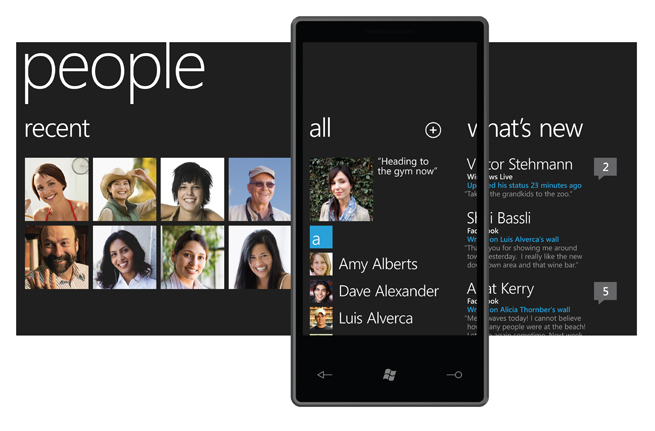
Microsoft is throwing the mobile technology equivalent of a Hail Mary, taking the wraps off a completely reworked mobile platform today at the Mobile Wold Congress in Barcelona. Dubbed Windows Phone 7 Series, the new platform isn’t just the next version of Windows Mobile: it’s a complete rewrite of Microsoft’s mobile operating system, featuring not only the enterprise-friendly features that will keep the devices in corporations and government, but extensive social networking capabilities, integration with Microsoft’s Zune and Xbox Live online services, and tight hardware specs that should (eventually) make the landscape for Windows mobile devices more uniform and consistent for consumers. And the first units are due to reach consumers in time for the holiday 2010 shopping season.
 “Windows Phone 7 Series marks a turning point toward phones that truly reflect the speed of people’s lives and their need to connect to other people and all kinds of seamless experiences,” said Microsoft CEO Steve Ballmer.
Windows Phone 7 Series will do away with Windows Mobile’s staid home screen and replace it with a series of live “tiles” that holistically keep users in touch with the friends, events, and tasks that matter the most to them. Users will also be able to create their own “hubs” on the phone that pull together information from on-board applications, the Internet, and services into a single, consistent view. Windows Phone 7 Series phones will ship with six pre-build hubs—people, pictures, games, music+video, marketplace, and Office—to get folks started with a 7 series device. The Games hub will make 7 series phones the first (and only) mobile devices to officially tie in with Xbox Live (pulling up avatars, gamer profiles, achievements and more), while the Music+Video hub will enable users to “turn their media experience into a social one” via Zune Social on a PC. We’re not quite sure what that means yet, but apparently 7 Series mobile devices music, video, and radio features draw heavily from the Zune HD. The Office hub will provide access to mobile versions of Microsoft’s mainstream Office applications, including Word and Excel along with Outlook, OneNote, and SharePoint Workspace.
Numerous device partners are already on board with Microsoft for the 7 series launch, including operators like AT&T, Orange, SFR, Spring, T-Mobile, Verizon, and Vodafone, along with equipment makers like Dell, HP, HTC, Samsung, Sony Ericsson, Toshiba, LG, Qualcomm, and Garmin-Asus.
Unlike previous Windows Mobile efforts, Microsoft seems to be taking a more commanding role in speccing out the hardware for 7 Series devices: 7 Series phones will reportedly be required to use particular processors running at a minimum speed, minimum memory requirements, and telling OEMs what kind of button configurations and screen sizes/resolutions their devices must have. And those buttons? One of them will be a dedicated Bing search button. No Google for you.
Microsoft is promising the first devices will be available by “holiday 2010″—which could mean any time from October to mid-December.
There’s little question that Microsoft’s Windows Phone 7 Series is an ambitious break with Windows Mobile, which has been languishing in the face of competition from the likes of RIM and Apple. However, customers may not be thrilled to wait another 8 to 11 months for Microsoft’s mobile OS to finally start to get serious about the consumer smartphone space…and it’s a sure thing that competitors will not be standing idly by in that time.


