  1. Home
  2. Mobile
  3. Legacy Archives

Security company transforms Android tablet into hacking machine

Add as a preferred source on Google
pwn-pad
Image used with permission by copyright holder

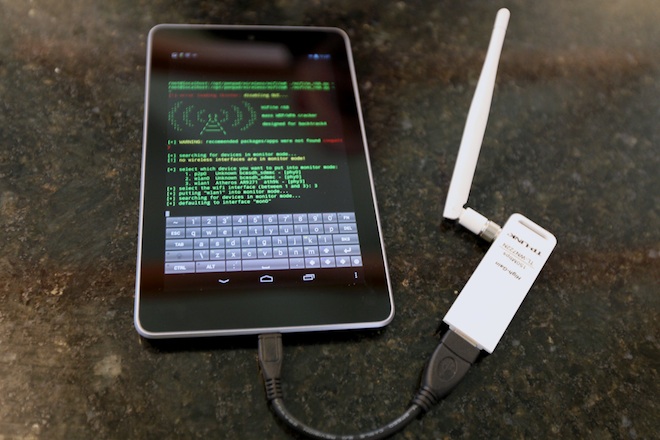
Hackers can rejoice and get ready to step up their mobile hacking skills. The folks at Wired report that security tools company Pwnie Express built a tablet, based on the Google Nexus 7 specs, that has a fully functioning hacking tool kit working over the Android operating system.

This isn’t the first time hacking tools have made their way onto Android devices, but Pwnie Express found a way to add some great new features, like getting tools such as Aircrack-ng and Kismet to work wirelessly.

Recommended Videos

Pwnie Express was able to get beyond the problem that Linux has working on wireless networks — the system doesn’t support the features that the hacking tools need to function — by plugging in a TP-Link wireless adaptor to the tablet, giving it 10 times the range.

The reason the company created this is not to actually hack systems, though it’s almost certain that some people will want to use it that way. Instead, it hopes to be a great new way for people to quickly and easily test out the security of their websites and find any flaws. While the same can be done with a laptop or desktop, the portability is the biggest benefit to using a tablet.

The tablets, named the Pwn Pad, are going to be introduced to the public at next week’s RSA security conference in San Francisco, and will retail for $800. Pwnie Express is also going to release the source code, allowing for hackers to install it onto other Android devices than the Pwn Pad.

Don’t expect to see the company do the same thing to the iPad. Apple isn’t a fan of people messing around with its devices, and it has already denied the company a bulk order they requested for this purpose.

Joshua Pramis
Spending a childhood engrossed in such technologically inspiring television shows like Voltron, Small Wonder, and Power…
The best phones in 2026: our 14 favorite smartphones right now
We tested phones across all price brackets so that you can make the best pick based on your needs and budget.
Google Pixel 10 Pro Fold vs Galaxy Z Fold 7 cameras

Choosing the right smartphone in 2026 is no easy task. Apple and Android manufacturers now have strong options at almost every price, while better cameras, longer battery life, improved software support, new AI features, and more refined foldable designs have made the market more competitive than ever. But picking one is not easy, especially if your budget is tight, or you are just legitimately concerned about getting the best value for your money and need a reliable daily driver for long-term usage.

We have tested and compared the leading smartphones available today, looking beyond the spec sheet to see how they actually perform in daily use. Camera quality, battery life, performance, display quality, software, design, and long-term value all play a part in our recommendations. Whether you are looking for a powerful flagship, a dependable budget phone, a compact device, or a foldable, this guide should help narrow down your choices.

Read more
Snapchat Planets Meaning: Order, Rankings, and How Friend Solar System Works
Snapchat Planets turns your best friends list into a solar system, and yes, your orbit says a lot
Snapchat Planets being shown on the Snapchat app on iPhone.

Snapchat+ includes several exclusive features, but few have generated as much curiosity as Snapchat Planets. Part of the app's Friend Solar System, it transforms your Best Friends list into a planetary ranking, assigning each of your top eight friends a planet based on how often you interact.

From Mercury, which represents your closest friend, to Neptune, which represents your eighth closest, the system offers a quick visual snapshot of your interactions. But what do the different planets actually mean, and how does Snapchat decide who gets which one?

Read more
How to use WhatsApp Web
We'll show you how to use WhatsApp on your desktop or laptop
WhatsApp Web

As one of the most popular messaging services, you’ve already heard of WhatsApp. From its humble beginnings in 2009—two years before Apple introduced iMessage—to its acquisition by Facebook (now Meta) in 2014, WhatsApp has become the dominant messaging platform around the globe.

In recent years, it's grown even more potent with new features like video messages, self-destructing voice messages, the ability to edit sent messages, and more. We even finally got an WhatsApp iPad app in May 2025.

Read more