
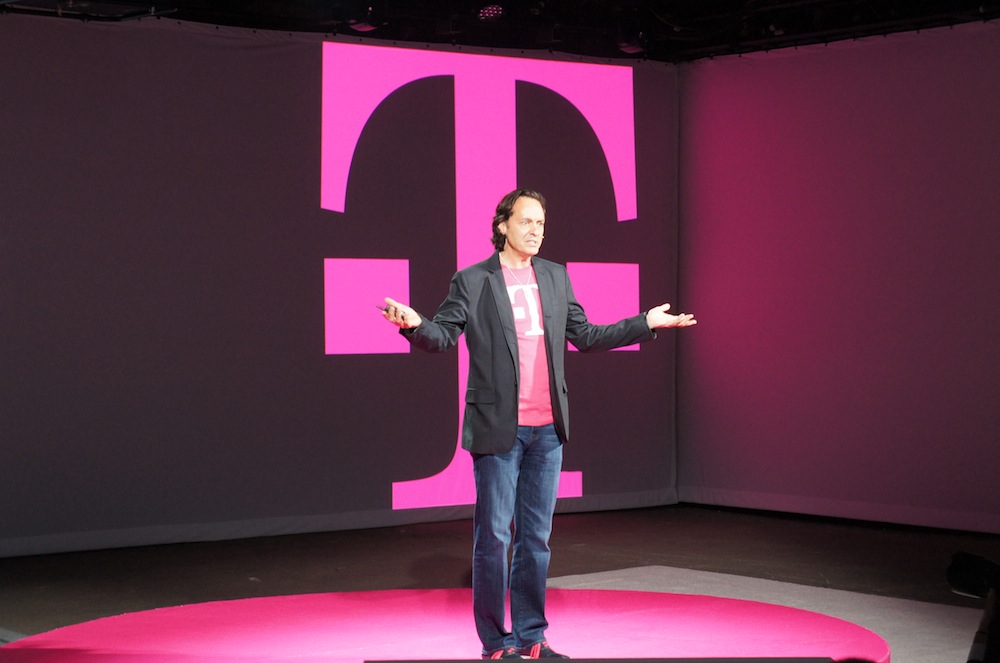
The other day, we reported exactly how much carriers in the United States are ripping us off. Many countries in Europe and Asia have far cheaper plans and much less confusing contracts and terms. Earlier this year, new T-Mobile CEO John Legere promised that he would change the way we thought of phone contracts and that T-Mobile is now a new kind of carrier: the uncarrier. Yesterday, in a nondescript studio space on one of lower Manhattan’s few remaining industrialized blocks, the uncarrier landed.
High profile events in the mobile industry have become common, but it occurred to me while walking between moving trucks and 18-wheelers in search of this that T-Mobile was up to something much different than Samsung’s over-the-top Galaxy S4 event a few weeks ago. I wasn’t sure I was even heading to the right place until I finally spotted the CES backpack of a fellow phone geek amongst two dozen some-odd people waiting outside a grey brick building. Once inside, things only get weirder.
The place was like a budget Ripley’s Believe It Or Not museum had fallen on hard times. At the entrance is a giant magnifying glass showing the so-called fine print that comes with wireless phone contracts. The walls display projections of poorly animated gears and pipes and power lines with steam shooting out. In between them, words like “Ripped Off” and “Overage Penalties” bulge like weird captions in some mid-90s nu-metal music video. The wall imagery also displays on a few randomly placed TVs throughout the space, which are broken up with pedestals showcasing crumpled contracts from AT&T, Verizon, and Sprint that look like they were fished out of the trash. More wall displays show huge overages of tens of thousands of dollars highlighted in big bold fonts. None of this looks like it cost more than $50.
The prize for most random accent in a room full of them is split between a video of a Portlandia skit playing on one wall and a broken metal detector with the word “Denied” emblazoned across the top of it.


We’re guided through the non-working metal detector, past the non-working security guard who accompanies it, and into a room featuring a low, elevated platform and rows of white cubes with bar-style standing tables behind them. Apparently, giving up on traditional cell phone contracts means giving up on proper back support. Fortunately, I have terrible posture already, so I slouch onto a cube.
The video portion of the program begins with a skit starring The Daily Show‘s Jason Jones asking people on the street if they’d rather sign a two-year mobile contract or get a quadruple root canal. The root canals win because, as one girl points out, at least after the root canal your mouth is fixed. This being a mobile event, I half-expect Jones to appear on the “stage” and awkwardly tell us how T-Mobile “just works” for him. To its credit, T-Mobile hasn’t just cheaped out on the room design; it’s pinching pennies on celebrity endorsements, too. Next up is a new commercial for the company. It shows four cowboys getting ready to rough up a town when, suddenly, one of them starts to cry. He just can’t be a jerk anymore. He puts on a pink cowboy hat and decides to be a good cowboy. The breaking-with-industry-norms continues, as the spot is legitimately funny.
Then the lights come up and out bounces John Legere.
“Could ya pick out who’s who in those carriers?!” he asks, like a younger, less set-upon Rodney Dangerfield. “I mean, come on. That nasty guy at the end; that’s Sprint. You gotta see that!” I can’t tell if he’s serious or not.
Watching Legere on stage is like being at a comedy club. He has a bit of a mullet going on and wears the standard “Carson Daily:” a suit jacket and jeans combo, with a bright pink T-Mobile shirt underneath. His hands flail as he talks and he has large, buggy eyes that light up whenever he gets a laugh. You never know what he’s going to say, every word that leaves his mouth is at least mildly amusing, and he constantly pokes fun of everyone in the audience. Nobody is safe. Especially if John feels he’s gettin’ no respect from the journalists in the room.

“By the way, if you want to see what I’m going to be talking about in five minutes, TMoNews is breaking my chart two charts from now. So, you can all take the high ground and you can just change your story to “As reported in TMoNews.”
It’s a good joke, especially if you work in online journalism, but it doesn’t land because most of us are frantically taking notes, trying to get our story up first. I think The Verge won, but it’s hard to say. Anyway, he proceeds to rip into the New York Times for this piece, which posted two hours before he was scheduled to speak, and slams T-Mobile by comparing it to Boost Mobile.
“I don’t know if Brian is here from the NY Times, but Brian, we have to talk …”
The Times’ suggestion that T-Mobile has officially entered the prepaid business clearly rankles Legere, who insists that what the company is really doing is answering problems that plague AT&T, Sprint, and Verizon customers.
“Carriers are really nice to you once every 23 months.”
“There’s not a goddamn person in the world besides a wireless industry person that would understand why the hell this mess works this way. The worst fear of the wireless industry is that somebody from outside Oz comes in and starts looking at [what they’re doing]. … Please, stop the bullshit.”
Leger thinks a lot of things in the business are “bullshit,” two-year contracts being chief among them.
“Carriers are really nice to you once every 23 months,” he explains. “The day you go in that store they love you. It’s like ‘oh, you gotta have this phone, we’re gonna be so good to you. Here’s a free t-shirt, some balloons? By the way, need a free back rub.’ And then, you go out the door, and you go home, and your contract doesn’t make sense. You call customer care and its horrible. And then after about 23 months you go onto the list … And all the sudden, they roll out the red carpet again. I hate this.”
T-Mobile’s new Value Plans, which you can learn all about here, are Legere’s solution to this problem. They’re designed to be simple to understand, cheaper, and more transparent. There are only three options, all of which have unlimited minutes and texting, with different levels of data. There is no contract, so you can leave anytime, and rather than subsidize phone purchases with vague monthly charges, T-Mobile simply sell you a phone, which you pay off in installments (or all at once) and then keep.
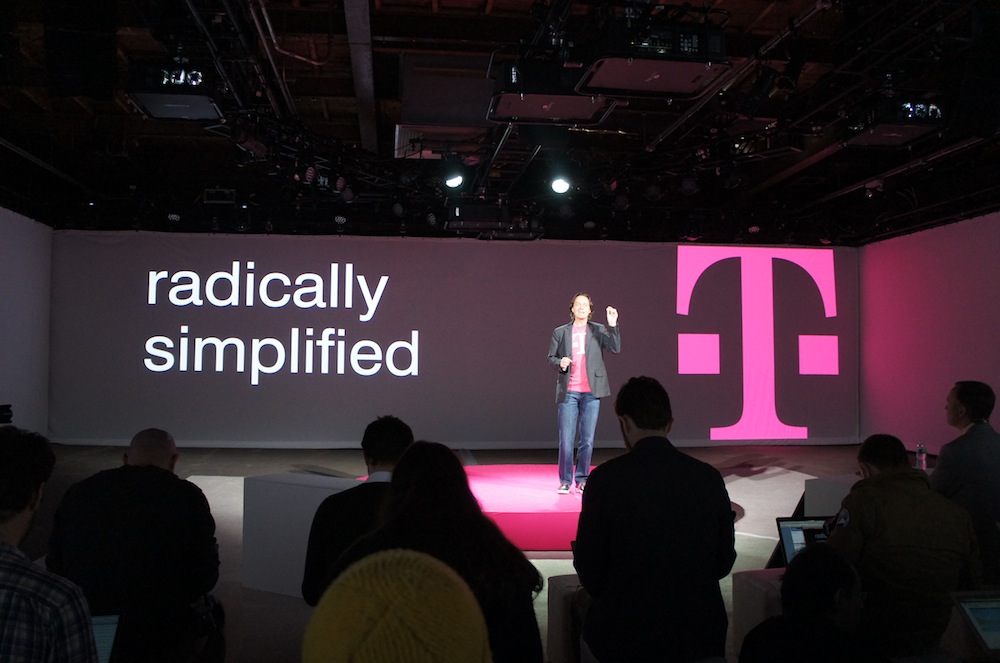


Legere continued on for an hour or so, holding our hands, clearly explaining his new vision. “As I’m sure you’ve noticed. This is not gonna be one of those newfangled huge launches with multiple stories at Carnegie Hall. It’s just us, right out in front of you, explaining what we’re gonna do.”
Like a kid unable to help himself, Legere did conclude with one attempt at a little glitz. With a loud clatter, the projection curtain behind him opened, revealing a row of iPhones and other devices up so the crowd could try out T-Mobile’s new LTE network in action. (By the way, if you happen to be carrying a T-Mobile Galaxy Note and are in New York City, the LTE works for you right now. Software updates for other T-Mobile devices are coming soon.)
Legere didn’t take over Times Square and he didn’t narrate a Broadway production with an orchestral accompaniment. There were no special effects, because those ridiculous wall projections weren’t special at all (dropping a curtain doesn’t count either), and the Foo Fighters didn’t close the show down.
The event was a little like Legere himself: a little offbeat, lacking polish, and just sort of … weird. But it was also pretty damn funny, partially because it hits a nerve, which is rare in a field dominated by corporate heads reading off teleprompters. Legere wants us to know that T-Mobile isn’t ripping us off. Its plans aren’t perfect, but it’s the first major carrier to abolish the two-year contract, simply their plan offering, and stop hiding the cost of phones. In a different life, I wouldn’t be surprised to see Legere yelling at pigeons in Central Park, but as a mobile consumer and a guy who writes about this stuff, I’m glad he’s yelling at AT&T and The New York Times instead.


