  1. Home
  2. Emerging Tech
  3. Mobile
  4. Legacy Archives

UCLA Engineers develop smartphone LCDs that harvest light for power

Add as a preferred source on Google

UCLA polarizerTired of your smartphone or laptop dying on you? UCLA engineers have figured out a way to use LCD screens to power electronic devices by harvesting energy from surrounding light sources.

Liquid crystal displays, or LCDs, can be found in much of today’s electronics such as TVs, smartphones, computers and more. These displays work using two polarized sheets sandwiching crystal molecules between them which act act as light valves. The combination allows a certain amount of the backlight to escape which creates images on the screen. The problem is that LCDs can suck a lot of power from devices.

Recommended Videos

Through a research gift to UCLA from Intel and the Office of Naval Research, engineers at the UCLA Henry Samueli School of Engineering and Applied Science found they could increase energy efficiency by equipping devices’ LCD screens with photovoltaic polarizers that converted electricity from ambient light, sunlight and even the LCD’s own backlight. The engineering team calls it a polarizing organic photovoltaic.

“I believe this is a game-changer invention to improve the efficiency of LCD displays,” said Yang Yang, professor of materials science at UCLA and principal investigator behind the research. “These polarizers can also be used to harvest indoor or outdoor light. So next time you are on the beach, you could charge your iPhone via sunlight.”

According to the researchers the current polarized sheets used in LCDs are not efficient enough. Backlights can consume huge portions of a devices power, something like 80 to 90 percent, and as much as 75 percent of that light expelled energy is lost due to the polarizers. The polarizing organic photovaltaic cell aims to catch that energy and turn it back into electricity, though the conversion efficiency of the new polarizers wasn’t stated.

Via UCLA newsroom

Jeff Hughes
Former Digital Trends Contributor
I'm a SF Bay Area-based writer/ninja that loves anything geek, tech, comic, social media or gaming-related.
Your future AR glasses might finally stop making the real world look weird
Researchers have developed a new display technique that keeps virtual objects realistic without dimming the real world.
Samsung AR Glasses

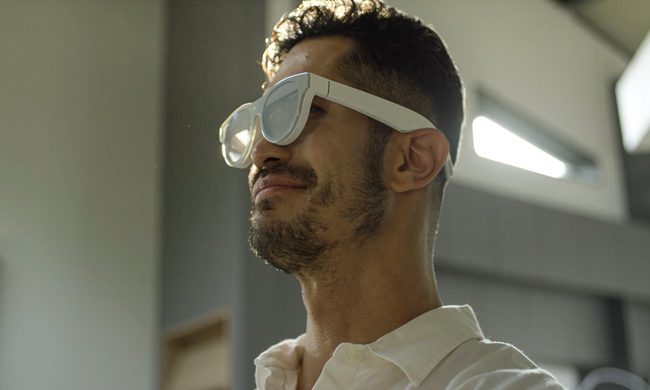
One of the biggest promises of augmented reality is blending digital objects seamlessly into the real world. Ironically, today's AR glasses often make the real world harder to see. Researchers at the Shibaura Institute of Technology (SIT) in Japan, led by Assistant Professor Xiaodan Hu in collaboration with Dr. Yan Zhang and Professor Xubo Yang from Shanghai Jiao Tong University in China, and Professor Kiyoshi Kiyokawa from Japan's Nara Institute of Science and Technology, have developed a new AR display technique that aims to make virtual objects look realistic without reducing visibility of the real world. The study was published in IEEE Transactions on Visualization and Computer Graphics.

The biggest AR problem isn't virtual objects; it's everything around them

Read more
Anti-surveillance clothing is getting cheaper, but don’t expect an invisibility cloak
Affordable shirts now claim to confuse facial recognition, although their protection depends heavily on the camera and software watching you
Chart, Plot, Adult

Anti-surveillance clothing is starting to look less like an art-school experiment and more like something you could actually wear outside. Shirts designed to confuse facial recognition systems now cost about as much as ordinary streetwear, although buying one won’t make you disappear.

The Guardian reports that designers are using face-like prints, unusual cuts and infrared lights to interfere with computer vision. These techniques target specific weaknesses, so their success depends on what happens to be watching you.

Read more
This spinning drone hides in plain sight using a visual illusion
This drone doesn't turn invisible. It tricks your brain into thinking it has.
Phantom Twist

For decades, engineers have chased the dream of an invisible drone. The usual approaches have involved transparent materials, camouflage coatings, or complex optical systems that bend light around an object. Researchers at Northwestern University decided to take a completely different route. Instead of hiding the drone itself, they chose to fool the human eye.

The result is Phantom Twist, an experimental drone that spins so rapidly it almost disappears into the background. It's not technically invisible, but to anyone watching, it looks more like a faint blur than a flying machine.

Read more