  1. Home
  2. Space
  3. News

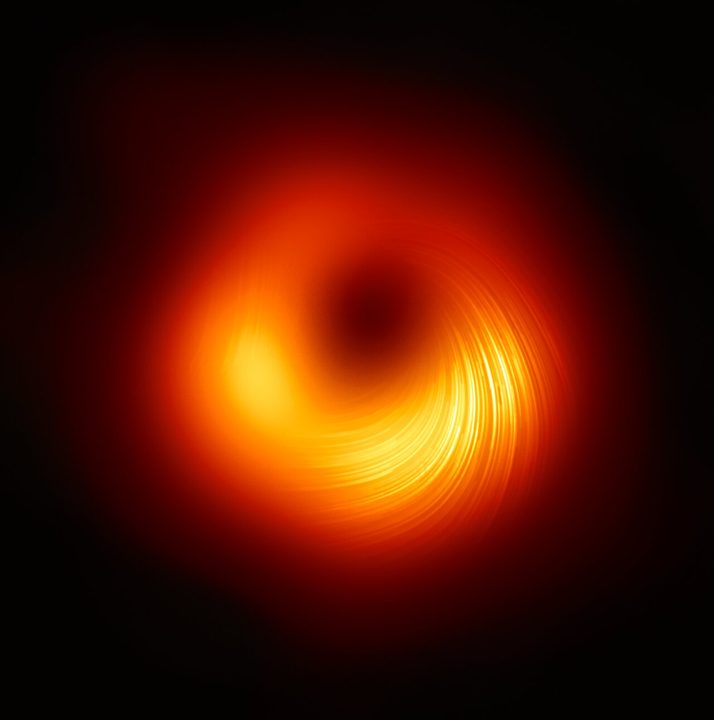
This incredible image shows the magnetic field of a black hole

Add as a preferred source on Google

A view of the M87 supermassive black hole in polarised light
The Event Horizon Telescope (EHT) collaboration, which produced the first-ever image of a black hole released in 2019, has today a new view of the massive object at the center of the Messier 87 (M87) galaxy: how it looks in polarized light. This is the first time astronomers have been able to measure polarization, a signature of magnetic fields, this close to the edge of a black hole.  This image shows the polarized view of the black hole in M87. The lines mark the orientation of polarization, which is related to the magnetic field around the shadow of the black hole. EHT Collaboration

The Event Horizon Telescope (EHT) project, the international collaboration which famously captured the first-ever image of a black hole, has released another new and unique image showing the same black hole’s magnetic field.

Recommended Videos

The collaboration involves using telescopes and arrays from around the globe to observe the same target — in this case, the supermassive black hole at the center of the galaxy M87. Following on from the first image of this black hole released in 2019, this new image shows the way that light around the black hole is polarized.

“This work is a major milestone: the polarization of light carries information that allows us to better understand the physics behind the image we saw in April 2019, which was not possible before,” explained Iván Martí-Vidal, Coordinator of the EHT Polarimetry Working Group, in a statement. “Unveiling this new polarized-light image required years of work due to the complex techniques involved in obtaining and analyzing the data.”

This is the first time polarization of a black hole has been measured so close to its edge. By tracking the polarization of the light, researchers can see the lines of the magnetic field at the edge of the black hole.

This helps them to understand how black holes absorb dust and gas from the disks surrounding them and how they send out dramatic jets of energy that reach as far as 5,000 light-years from their center.

“The newly published polarized images are key to understanding how the magnetic field allows the black hole to ‘eat’ matter and launch powerful jets,” said EHT collaboration member Andrew Chael, a NASA Hubble Fellow at the Princeton Center for Theoretical Science and the Princeton Gravity Initiative in the US.

The EHT collaboration will continue working to observe more details about this black hole and its magnetic field in particular.

Georgina Torbet
Georgina has been the space writer at Digital Trends space writer for six years, covering human space exploration, planetary…
China’s answer to SpaceX’s reusable rockets literally catches boosters in a net
SpaceX catches boosters on legs. China just used a net.
Ammunition, Missile, Weapon

SpaceX's playbook for recovering a rocket booster generally involves legs, a precisely controlled vertical landing, and either a concrete pad or a drone ship. 

China just managed to pull off something similar, but in a slightly different way, and on July 10, it tested the method as well.

Read more
Dimming the sun sounds unhinged, but this new study on El Niño makes a surprisingly good case for it
A natural test case, Australia's worst-ever wildfire season, suggests the idea deserves serious consideration.
Nature, Outdoors, Sky

When I first saw "scientists propose dimming the sun," I rolled my eyes. It sounds like a science fiction movie cooked up after watching many climate documentaries. But a new study, published on July 8, 2026, in the journal Science Advances, seems to have a genuinely compelling argument.

A Super El Niño is currently forming in the Pacific, feared to be the most intense in decades. It could escalate floods, wildfires, and extreme heat events worldwide. However, Researchers at UC San Diego's Scripps Institution of Oceanography, led by climate scientists Kate Ricke and Jessica Wan, are now proposing one of the most interesting solutions I’ve come across.

Read more
You can now walk through space and gaze into a black hole at this VR exhibit
Smithsonian Starstruck lets you drift past dying stars and see the origin point of the universe for as little as $18 a person.
Smithsonian Starstruck featured

Most planetarium shows ask you to sit still and look up. The Smithsonian's new VR exhibit takes a different approach, letting visitors walk through the vast expanse of the universe, drifting past stars, planets, and a black hole to get a physical sense of its true scale.

A $29 ticket to the edge of the galaxy

Read more