1. Home
  2. Space
  3. News

Mars helicopter Ingenuity reaches remarkable milestone in its mission

Add as a preferred source on Google

The little Mars helicopter Ingenuity has reached an impressive milestone, hitting a total of 30 minutes spent in the air above the red planet.

Ingenuity hit this milestone during its 17th flight. NASA’s Jet Propulsion Laboratory (JPL) reports that over its mission so far the helicopter has traveled a total distance of 2.2 miles (3,592 meters), “flying as high as 40 feet (12 meters) and as fast as 10 mph (5 meters per second).”

NASA’s Ingenuity Mars helicopter is seen in a close-up taken by Mastcam-Z.
NASA’s Ingenuity Mars helicopter is seen in a close-up taken by Mastcam-Z, a pair of zoomable cameras aboard the Perseverance rover. This image was taken on April 5, 2021, the 45th Martian day, or sol, of the mission. NASA/JPL-Caltech/ASU

The helicopter, which is classified as a technology demonstration — i.e. a test to see if flying a helicopter on Mars was even possible — and was originally only intended for five fights. But it has exceeded all expectations, overcoming challenges including changing seasons on Mars, a solar conjunction, and a communications issue with its rover buddy Perseverance.

Recommended Videos

“Few thought we would make it to flight one, fewer still to five. And no one thought we would make it this far,” said Ingenuity Team Lead Teddy Tzanetos of JPL in a statement. “On the way to accumulating over a half-hour aloft, Ingenuity has survived eight months of bitter cold, and operated out of nine unique Martian airfields. The aircraft’s continued operations speaks to the robustness the design and the diligence and passion of our small operations team.”

One of the challenges of flying on Mars is keeping aloft in the very thin atmosphere, which is just 1% the density of the atmosphere on Earth. And to make matters even harder, the changing Martian seasons mean that the atmospheric density has dropped even lower than it was when Ingenuity and Perseverance landed. To handle this change, Ingenuity has had to spin its rotor blades at even higher speeds to generate enough lift to keep it in the air.

Since the announcement of it hitting the 30 minutes in the air mark, Ingenuity has performed yet another flight. The official NASA Jet Propulsion Laboratory Twitter account confirmed that Ingenuity’s 18th flight was a success, with the helicopter adding a further 124.3 seconds to its total flight time and traveling 754 feet (230 meters).

The #MarsHelicopter keeps going, going, going! Ingenuity successfully completed its 18th flight, adding 124.3 seconds to its overall time aloft on the Red Planet. It flew 754 feet (230 meters) at a speed of 5.6 mph (2.5 m/sec) & took images along the way. https://t.co/7DMHj9tbzP pic.twitter.com/XVeMNGGOnQ

— NASA JPL (@NASAJPL) December 17, 2021

Georgina Torbet
Georgina has been the space writer at Digital Trends space writer for six years, covering human space exploration, planetary…
Space is becoming Bezos and Musk’s next data center site, and we have every reason to worry
The AI boom is coming for the night sky
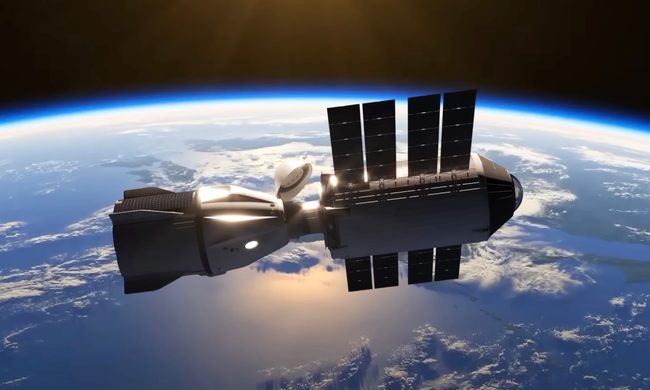
How Vast's space station will look in orbit.

AI data centers already consume vast amounts of electricity and water on Earth, so Silicon Valley has begun looking somewhere considerably more spacious... literally.

Elon Musk's SpaceX and Jeff Bezos' Blue Origin, along with several other companies, have proposed enormous constellations of satellites designed to operate as orbital data centers. However, environmental groups and former space officials are now warning that putting them into orbit at the proposed scale could have severe consequences for Earth's atmosphere and the night sky.

Read more
The first possible exomoon is here, and it makes our Moon look hilariously tiny
Scientists may have found the first exomoon, except this one is the size of Jupiter
This artist’s concept depicts a potential volcanic moon between the exoplanet WASP-49 b, left, and its parent star. New evidence indicating that a massive sodium cloud observed near WASP-49 b is produced by neither the planet nor the star has prompted researchers to ask if its origin could be an exomoon.

We have already discovered more than 6,000 planets outside of our immediate neighborhood. Yet, finding a moon orbiting one of those distant worlds has proved considerably harder. Astronomers may finally have something close to the real deal, but this particular object stretches the word “moon” almost beyond recognition.

Using the European Southern Observatory’s Very Large Telescope in Chile, researchers detected strong evidence for a moon-like object in the CD-35 2722 system. Further observations are still necessary to confirm the discovery, but it could become the first confidently detected natural satellite outside our solar system. There is still one tiny complication though. This moon is apparently massive.

Read more
China’s answer to SpaceX’s reusable rockets literally catches boosters in a net
SpaceX catches boosters on legs. China just used a net.
Ammunition, Missile, Weapon

SpaceX's playbook for recovering a rocket booster generally involves legs, a precisely controlled vertical landing, and either a concrete pad or a drone ship. 

China just managed to pull off something similar, but in a slightly different way, and on July 10, it tested the method as well.

Read more