If you’ve ever wanted to explore the entire universe from the comfort of your computer, now’s your chance. An international team has created the largest and most realistic virtual universe to date called Uchuu (which means “outer space” in Japanese), simulating 2.1 trillion particles in a computational cube which is a mind-bending 9.63 billion light-years wide on each side.
The simulation was created using the supercomputer ATERUI II, which is dedicated to astronomy projects. The supercomputer located in Iwate, Japan, has a peak performance of over 3 Pflops, but even with all this power it still took a whole year to crunch through all of the data and create the simulation.
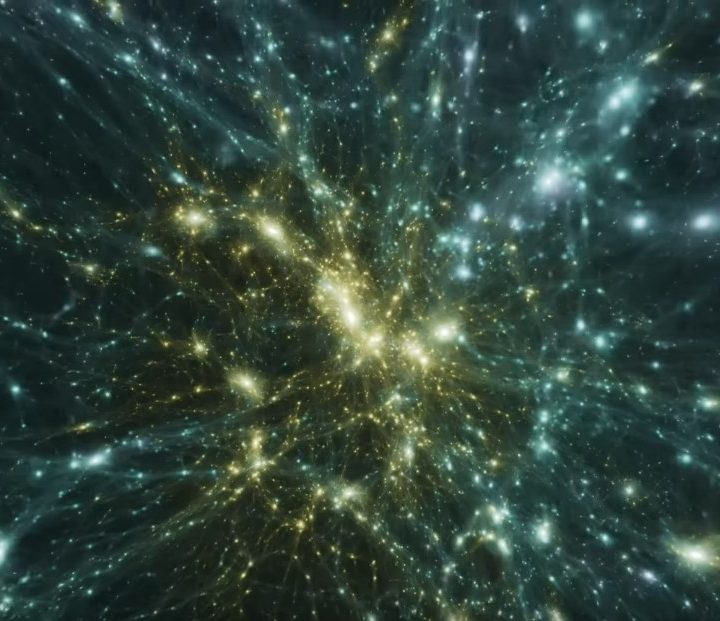
“To produce Uchuu we have used … all 40,200 processors (CPU cores) available exclusively for 48 hours each month,” said Tomoaki Ishiyama, an associate professor at Chiba University who developed the code for the project. “Twenty million supercomputer hours were consumed, and 3 Petabytes of data were generated, the equivalent of 894,784,853 pictures from a 12-megapixel cell phone.”
The simulation looks at halos of dark matter which are huge-scale structures that could tell us about the formation of galaxies and the early universe. The large-scale nature of the simulation makes it a valuable tool for studying how the universe evolved over time, as it shows very distant regions which represent early stages in the life of the universe.
“Uchuu is like a time machine,” said Julia F. Ereza, a Ph.D. student at Instituto Astrofísica Andalucía in Spain who uses Uchuu. “We can go forward, backward and stop in time, we can ‘zoom in’ on a single galaxy or ‘zoom out’ to visualize a whole cluster, we can see what is really happening at every instant and in every place of the Universe from its earliest days to the present, being an essential tool to study the Cosmos.”
And yes, should you want to experience the wonder of exploring the entire (virtual) universe for yourself, then you can, as the team has made the entire simulation available for free download to anyone who wants it. Though fair warning — even compressed, the simulation takes up 100 terabytes, so you’ll need some serious hard drive space available.
To download the simulation and to find out more about interacting with it, you can head to the Uchuu simulation website and its related GitHub page. The group is also planning to release more data in the future, including catalogs of virtual galaxies and gravitational lensing maps.
The research is published in the journal Monthly Notices of the Royal Astronomical Society.