If you buy the cheapest OnePlus 9 Pro it comes with 8GB of RAM and 128GB of internal storage, but you may be tempted by the more expensive model with 12GB of RAM and 256GB of internal storage space. After all, bigger numbers are always better, right? Leaving aside the amount of storage for a moment, is it worth paying the extra for more RAM?

I’ve been using the OnePlus 9 Pro with 12GB of RAM for a few weeks, and have also been using several other smartphones with 8GB of RAM recently, and I’ve noticed … not a lot of difference between them, actually. Unless you’re a spec sheet maniac, it’s probably not worth spending the extra money for more RAM, but that doesn’t mean the most expensive OnePlus 9 Pro should be ignored.
Why so much RAM?
Before getting into why it may still be worth buying the 12GB OnePlus 9 Pro, let’s talk about RAM. Random Access Memory (RAM) generally does the same thing on all phones and all computers. It stores data for the operating system, apps, and services for a limited amount of time, ready for it to be accessed very quickly so your phone can perform its tasks at high speed. It means your favorite apps open as fast as possible, you can multitask and switch apps with minimal lag, and the operating system can keep everything in order so it works at maximum efficiency.
The more RAM, the merrier, right? Well, not necessarily. There’s a natural limit to how much RAM is needed by a smartphone for general use, but it’s software optimization that’s really more important. Well-optimized software makes your phone fast, and badly optimized software slows it down. OnePlus’ Android user interface, OxygenOS 11, has a few neat tricks — including a memory optimization system called Turbo Boost — that help keep more apps open in the background than in previous versions. One of its tools is a technology called Virtual RAM. This takes a chunk of storage memory and repurposes it for use as RAM when needed.
OnePlus doesn’t say how much storage memory it takes, but Vivo (OnePlus’s BBK Electronics stablemate, along with Oppo) uses the same system on the new X60 Pro Plus, and says it will take up to 3GB storage for use as virtual RAM. If this is the same for OnePlus, your 8GB phone could have a total usable RAM of 11GB. This method is new for smartphones, but something similar is common on Windows and Mac computers.
Masses of RAM is also great for spec sheets. The Asus ROG Phone 5 Ultimate has 18GB of RAM, for example. It’s obviously overkill for a smartphone, even a hardcore gaming device like the ROG Phone 5, but it’s hard to ignore how good the number looks on paper. There’s something to be said for longevity too, as just like computers, the higher the spec the longer it will last before you need to upgrade. However, a phone with 8GB of RAM will likely still be an adequate performer after two or three years of service.
My entirely non-scientific tests
To try and discover whether it’s possible to see differences in performance between a phone with 8GB of RAM and one with 12GB, I’ve put the 12GB/256GB version of the OnePlus 9 Pro against the Samsung Galaxy S21+ and the Xiaomi Mi 11. The Xiaomi Mi 11 has the same Snapdragon 888 processor as the OnePlus 9 Pro, while my U.K.-spec Galaxy S21+ has the Exynos 2100 inside, but both have 8GB LPDDR5 RAM.

I have not noticed any discernible difference in speed or responsiveness between them, and I’ve used these three phones separately and together for more than six weeks in total. Whether I’m using the Mi 11, OnePlus 9 Pro, or Galaxy S21+, the speed with which each switches between apps — rapidly going to posts on Twitter, replying to messages, searching through Chrome, and editing photos in Snapseed, for example — is the same.
Sometimes, the Mi 11 really surprises with just how fast it switches tasks, which I imagine is down to MIUI’s effectiveness at managing resources. Start up Asphalt 9: Legends across all three phones, and the Mi 11 is fractionally quicker than the OnePlus 9 Pro, which is, in turn, a tiny bit quicker than the Galaxy S21+. Open YouTube, switch to Instagram, and back to start a video on YouTube, then switch to Twitter, and finally back to YouTube in picture-in-picture mode and responsiveness is, to my eyes and touch, identical.

I played Asphalt 9: Legends on all three phones and it was just as fast and exciting regardless of which one I used. It all goes to show just how good a phone with 8GB of RAM is, and how important software is when it comes to making your phone feel fast. It’s a struggle to notice app start-up speed differences on any modern high-end phone, they’re all so quick. If you spend more on the 12GB OnePlus 9 Pro, don’t expect it to appear faster than phones with 8GB of RAM.
Benchmarks
What about benchmark tests? Although it’s easy to get caught up in numbers like those generated by benchmark tests on your phone, and arguably, by the amount of RAM your phone has at all, it may reveal something new about more RAM equalling more performance. To find out, I ran the Wild Life test from 3DMark and a normal Geekbench 5 test on the three phones.
3DMark (Wild Life) in descending order
- Samsung Galaxy S21+: 5,938
- OnePlus 9 Pro: 5,790
- Xiaomi Mi 11: 5,697
Geekbench 5 in descending order
- Xiaomi Mi 11: 3672 Multi Core/1115 Single Core
- OnePlus 9 Pro: 3561 Multi Core/1106 Single Core
- Samsung Galaxy S21+: 3487 Multi Core/1089 Single Core
Neither of these apps specifically show RAM performance, but it’s normal to equate higher RAM numbers and better CPUs with speed, so you may expect the 12GB OnePlus 9 Pro to come out in front regardless. It didn’t, it was middle-of-the-pack in both tests, outperformed each time by a phone with 8GB of RAM.
No reason to pay more?
In my experience, as illustrated here, there’s no obvious, immediate advantage to having a phone with 12GB of RAM over 8GB of RAM, at least when the other specifications are so similar. However, that doesn’t mean you shouldn’t buy the 12GB OnePlus 9 Pro, or think that more RAM is a waste of time. Regarding other phones with 12GB or more RAM, there will be scenarios where it’s a distinct benefit — Samsung’s DeX desktop mode will likely take advantage for example — and you may notice more than I have in some very specific scenarios, although I don’t think it won’t happen during regular use at all.
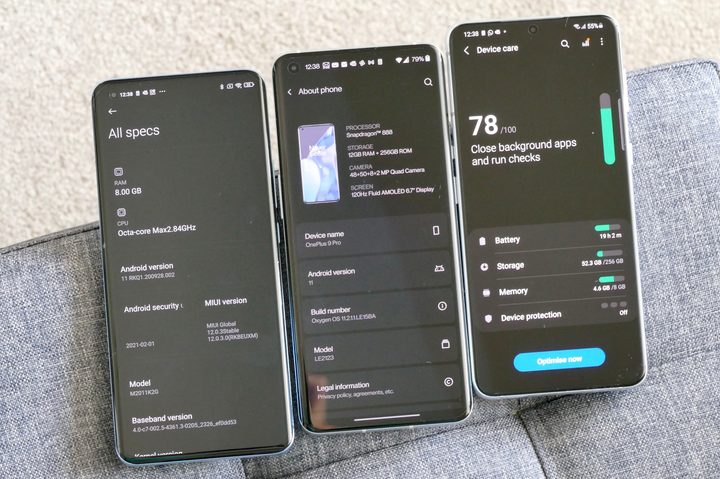
Also, don’t ignore the 12GB OnePlus 9 Pro for one very good reason: the additional RAM comes with 256GB storage space, twice that offered by the 8GB version, and there’s a lot more value in this. The OnePlus 9 Pro, along with the Galaxy S21+ and Mi 11, do not have a MicroSD card slot, meaning the internal storage space is all you get. Cloud storage will be your only option, aside from deleting large media files or games, should you run out of space in the future. Seeing as these powerful phones will last for several years, it’s an important consideration.
To get an idea of whether you should get the top model, take a look at your current phone and if it still has gigabytes of space remaining, and you don’t envisage your use changing any time soon, save yourself some money and just get the 8GB/128GB OnePlus 9 Pro, because the RAM upgrade itself is mostly just for bragging rights.