Samsung sat out of this year’s Mobile World Congress, leaving Huawei and LG free to compete solely against each other. Huawei announced the P10 and P10 Plus, the latest in its P series of devices, and LG launched the G6, the successor to last year’s failed G5.
While both smartphones offer killer features, which is superior? Check out a full list of specifications for each of the phones, as well as a quick breakdown of how their features compare to one another.
Specs
Huawei P10 |
LG G6 |
|
| Size | 145.3 x 69.3 x 7 mm (5.72 x 2.73 x 0.28 inches) | 148.9 x 71.9 x 7.9 mm (5.8 x 2.83 x 0.31 inches) |
| Weight | 5.11 ounces (145 grams) | 5.75 ounces (162 grams) |
| Screen | 5.1-inch IPS-NEO LCD capacitive touchscreen | 5.7-inch IPS LCD capacitive touchscreen, Dolby Vision/HDR10 compliant |
| Resolution | 1,080 x 1,920 pixels (432 ppi) | 1,440 pixels x 2,880 (564 ppi) |
| OS | Android 7.0 Nougat (EMUI 5.1) | Android 7.1 Nougat (UX 6.0) |
| Storage | 64GB | 32GB (64GB in select regions) |
| MicroSD card slot | Yes | Yes |
| NFC support | Yes | Yes |
| Processor | Kirin 960 2.4 GHz Octa-core | Qualcomm Snapdragon 821 |
| RAM | 4GB | 4GB |
| Connectivity | LTE, GSM, HSPA, 802.11a/b/g/n/ac Wi-Fi | LTE, GSM, HSPA, 802.11a/b/g/n/ac Wi-Fi |
| Camera | 20-megapixel and 12-megapixel monochrome and color rear cameras with OIS, 8-megapixel front | 13-megapixel dual rear with OIS, 5-megapixel front |
| Video | 2160p@30fps, 1080p@60fps | 2160p@30fps, 1080p@30/60fps |
| Bluetooth | Yes, version 4.2 | Yes, version 4.2 |
| Fingerprint sensor | Yes | Yes |
| Other sensors | Gyroscope, accelerometer, proximity, compass | Gyroscope, accelerometer, proximity, compass, barometer |
| Water resistant | No | Yes, IP68 rated |
| Battery | 3,200mAh | 3,300mAh |
| Ports | USB Type-C, 3.5mm headphone jack | USB Type-C, 3.5mm headphone jack |
| Marketplace | Google Play Store | Google Play Store |
| Color offerings | Ceramic White, Dazzling Blue, Dazzling Gold, Prestige Gold, Graphite Black, Mystic Silver, Rose Gold, Greenery | Mystic White, Astro Black, Ice Platinum |
| Availability | None in USA | AT&T, Verizon, Sprint, T-Mobile |
| Price | 650 euros ($694) | $672 on Verizon |
| DT review | Hands-on | 4.5 out of 5 |
Power and productivity

As both phones are flagship offerings, neither holds a serious advantage in terms of specs. The P10, however, features a Kirin 960 octa-core processor, powered by four ARM Cortex A73 cores alongside four A53 cores. Combined with a Mali-G71 GPU — which is based on the new Bifrost architecture — the Kirin system-on-a-chip is capable of maintaining peak performance for longer than the G6’s Snapdragon 821 chip, making it ideal for tasks such as gaming and video streaming. The Snapdragon is no slouch, though, and it’s the best Qualcomm can offer until the 835 version arrives soon. Qualcomm chips typically outperform Kirin chips in benchmarks, though real-world use is similar.
Both smartphones sport 4GB of RAM and 32 to 64GB of storage. The LG G6 offers wireless charging and 32GB of storage in the U.S. variant, but South Korea and some Asian markets get a quad-Digital-to-Analog Converter for high-quality audio as well as 64GB of internal storage. Europe, sadly, gets neither of these features.
Thankfully, both support storage expansion via MicroSD card slots, and they have nearly identical battery capacities, though the G6’s 3,300mAh battery barely outstrips the P10’s 3,200mAh counterpart.
Winner: Huawei P10
Design and display

While Huawei looks to break new ground with a vibrant selection of colors curated by Pantone, LG finds success with a radical new look, opting for a nearly bezel-free and glass-and-steel design.
The P10, crafted mostly out of ceramic and aluminum, features a textured “hyper-diamond cut” that really shines (literally) on certain models, and its modest 5.1-inch screen is a nice departure from the ginormous phablet-style displays with which many smartphones are equipped. The phone’s side panels are also on the flat side, giving it a more distinguished feel, and the camera lenses are flush with the frame.
The G6, on the other hand, boasts a 4-to-1 screen-to-body ratio, a result of the 5.7-inch Quad HD screen’s 18:9 aspect ratio. Eliminating the bezel (mostly) allows the G6 to fit snugly into most people’s palms, creating a comfortable experience as it has a smaller frame than most 5.5-inch phones. Texting and navigating with one hand is easy, considering the size of the screen. The G6 also supports a higher resolution (1,440 x 2,880 pixels) than the P10 (1,080 x 1,920 pixels), packing in far more pixels per inch. Still, the P10’s IPS-NEO display ensures that images will look just as good when viewed from an angle.
Winner: LG G6
Software, camera, and more
Software

While both phones run Android Nougat, LG has an edge as the G6 runs the more recent 7.1 version of the operating system. LG also built many of the default apps to interact specifically with the G6’s 18:9 screen, essentially dividing the screen into two squares. It’s a neat trick that cleans up much of the Android UX — particularly when multitasking — and automatically modifies app icons so that they’re all the same shape and size.
The P10 also runs Nougat, except with Huawei’s EMUI 5.1 over the top. This extension, which helped make the Mate 9 far more user-friendly than its predecessors, adds some new features. For example, the fingerprint sensor on the back of the phone can be used to navigate the phone. EMUI also modifies memory usage to help apps launch faster, though, so that’s a plus.
Still, the win goes to the G6 for offering a cleaner and more useful user experience.
Winner: LG G6
Camera
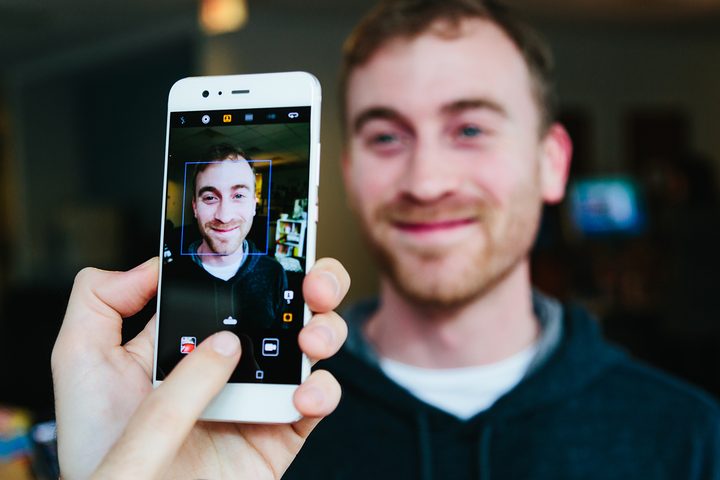
Like the Mate 9, the P10 is equipped with three separate cameras — two on the back, and one in front. All three are built by German camera company Leica, which lends a sense of legitimacy to photographs taken with the phone. A 20-megapixel monochrome sensor sits beside a 12-megapixel color sensor, which itself boasts a f/2.2 aperture and optical image stabilization. Both rear cameras feature bokeh control, and the new Portrait Mode utilizes advanced facial recognition mapping (190 points in 3D space) to adjust lighting, even while people are moving around. The front camera, a more-than-respectable 8-megapixels, boasts a sensor that improves brightness and widens the camera’s dynamic range.
That said, the G6 can hold its own, thanks to the dual 13-megapixel lenses on the back of the phone. What’s unique is that one of the lenses is wide-angle, allowing you to capture far more in a shot than most smartphone cameras. The 5-megapixel selfie camera isn’t too shabby, either. The G6’s camera UI is also unique and more useful as you can see your gallery of photos and take new ones at the same time.
Ultimately this decision comes down to personal preference — if you’d rather have the wide-angle lens, the G6 is for you. But if you’re more of a black-and-white or portrait photographer, then go for the P10.
Winner: Tie
Price and availability

Both phones are set for release in the coming months, but the P10 won’t be available in the United States. There’s still hope for Huawei devotees — after all, the Mate 9 released saw a U.S. release in January — but for now, only the G6 is likely to be available domestically. The newest iteration of LG’s flagship series is set to arrive at the end of March, and so far we know it will cost $672 on Verizon. Expect the price to be similar from other carriers.
Winner: LG G6
Overall Winner: LG G6
Huawei’s 10th phone in the P-series is truly extraordinary, from its powerful processor to its trio of high-quality cameras. Unfortunately, the lack of domestic availability bumps it down a notch, while LG’s G6 excels across the board, especially with its nearly bezel-less design.
The G6’s bigger, brighter display is sure to impress, while its clean UI makes multitasking easier. You can’t go wrong with either choice, but for the foreseeable future, you can’t go with the P10 at all in the U.S. That makes the G6 our winner.