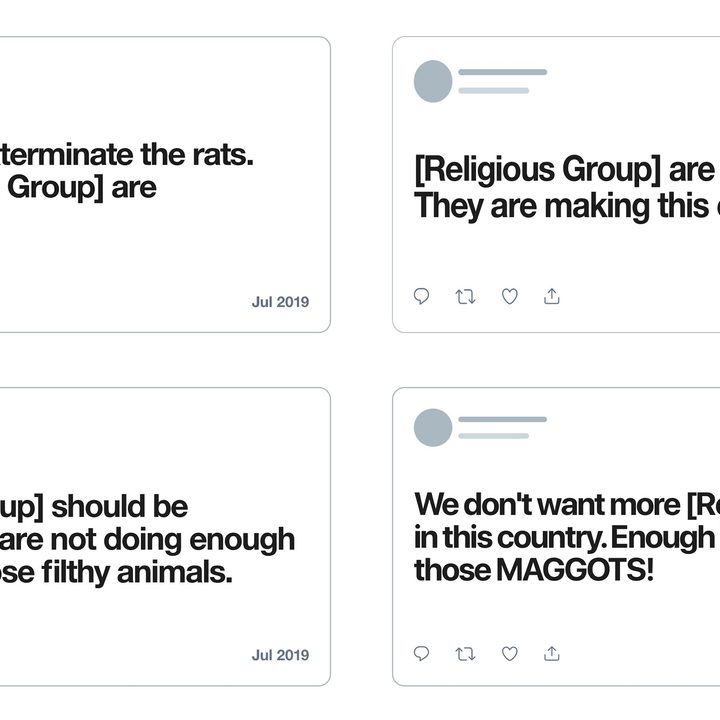
Twitter will expand its rules to ban hateful conduct made against religious groups, the social network announced Tuesday.
The new rules, announced by Twitter Safety in a blog post, will require the company to remove any tweet which “dehumanizes whole religious groups.”
Twitter already removes tweets with threats based on race, ethnicity, religious affiliation and more, but Tuesday’s update sets more precise standards for hateful content based on religion.
“After months of conversations and feedback from the public, external experts and our own teams, we’re expanding our rules against hateful conduct to include language that dehumanizes others on the basis of religion,” the blog post states.
Twitter users have long complained about racism on the platform. Some advocates said the move didn’t go far enough to curb hate speech.
“It’s good that Twitter is seeking public comment as they’re developing their policy decisions and seeking input from external experts on hate, but hate and harassment on Twitter is a serious, longstanding problem,” wrote the Anti-Defamation League in a statement. “The fact that language dehumanizing others on the basis of religion only now violates Twitter’s rules shows how far they have to go to truly combat hate. We urge them to be transparent about the efficacy of these changes.”
The fact that language dehumanizing others on the basis of religion only now violates Twitter's rules shows how far they have to go to truly combat hate. We urge them to be transparent about the efficacy of these changes. Our full statement below. https://t.co/Hu0dui1HWj pic.twitter.com/cVZbRH7Pqa
— ADL (@ADL) July 9, 2019
Color of Change, a racial justice organization that has previously spoken out about hate speech on Twitter, said in a statement that while the new update is a step in the right direction, it can still users exposed to online harassment.
“Twitter’s update is too simplistic for the complicated world we live in, and fails to address the nuanced intersections of its users’ identities. Across this country and around the world, people who sign on to Twitter for news, entertainment, and building connections are dehumanized – not just for their religious identity, but the color of their skin, their nationality, their gender, their sexual orientation, and in many instances, a combination of these experiences,” said Rashad Robinson, President of Color of Change, in the statement.
There’s other problems with the new policy: some users have been known to use euphemisms for religious groups in their hateful or racist tweets. It’s not clear whether tweets that don’t explicitly name a specific group will be deleted.
Twitter asked its users for feedback on its hateful conduct policy in September, and according to the blog post, the company received more than 8,000 responses. Some of the feedback asked for clearer language on examples of violations, narrowing down what is considered a hate group, and having more consistent enforcement for hateful speech on Twitter’s end.
The social network first rolled out a policy for hate speech in 2017, which included prohibiting and removing accounts affiliated with organizations that promote violence, as well as deleting tweets that glorify violence and permanently suspending users who continue to violate the policies.
Twitter said that they are focusing the hateful conduct updates on religious groups first, but that they will continue with further updates.
“As we look to expand the scope of this change, we’ll update you on what we learn and how we address it within our rules. We’ll also continue to provide regular updates on all of the other work we’re doing to make Twitter a safer place for everyone,” the blog post states.