  1. Home
  2. Space
  3. Emerging Tech
  4. News

Artificial soil made from lava rock allows growing of food in space

Add as a preferred source on Google

Fresh greens in space? Recent research has looked into how plants respond to low levels of gravity and a particular hormone which can help plants grow in challenging space conditions. Now, new research has succeeded in growing plants in high-tech planters which use artificial soil made from lava rock.
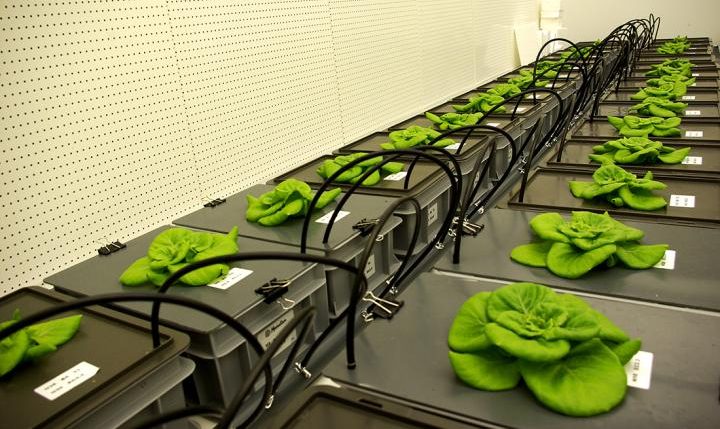
Plants in climate-regulated growth chambers Silje Wolff, NTNU Social Research (CIRiS)

The goal of the research is to eventually find a way for plants to grow directly in water, with nutrients supplied through the water instead of through soil. Soil is obviously in short supply in space so it’s important to find a way to get nutrients to plants without relying on earth. At the Centre for Interdisciplinary Research in Space (CIRiS), part of the Norwegian University of Science and Technology’s (NTNU) Social Research department, the team has collaborated with researchers from France and Italy to find ways to cultivate plant-based foods in space.

Recommended Videos

The CIRiS has been testing the high-tech planters made by the NTNU’s technical workshop, which regulate the water, nutrients, gas, and air that plants require. In climate-regulated growth chambers in the Netherlands, the team has been investigating how plants use nitrogen in particular and how the levels of nutrients available affect the amount of water that the plants consume.

“We found that plants can, in a way, ‘smell’ the amount of nutrients available to them,” Silje Wolff, a plant physiologist at CIRiS, explains. “When the nitrogen concentration is very low, the plant will absorb more water and thus more nitrogen until it reaches an optimal level. The plant has a mechanism that turns on when the nitrogen level is adequate. Then it adjusts both nitrogen and water absorption down.”

But another challenge to growing plants in space remains: until the exact mechanisms through which plants adjust to microgravity are understood, the plants still need gravity to grow. The solution for now is to place plants into a centrifuge inside a space station which simulates gravity which the plants sprout and grow.

The research team hopes that their findings will not only be relevant to space expeditions, but could also be used to optimize crop growth here on Earth, especially in places with nutrient-poor soil or within cities without much soil available. “Recycling and precise fertilization are key to achieving more sustainable food production,” Wolff says. “By growing plants directly in water with dissolved nutrients, fertilization and irrigation are much easier to control.”

Georgina Torbet
Georgina has been the space writer at Digital Trends space writer for six years, covering human space exploration, planetary…
You can now walk through space and gaze into a black hole at this VR exhibit
Smithsonian Starstruck lets you drift past dying stars and see the origin point of the universe for as little as $18 a person.
Smithsonian Starstruck featured

Most planetarium shows ask you to sit still and look up. The Smithsonian's new VR exhibit takes a different approach, letting visitors walk through the vast expanse of the universe, drifting past stars, planets, and a black hole to get a physical sense of its true scale.

A $29 ticket to the edge of the galaxy

Read more
Scientists warn Elon Musk’s orbital data centers could blind Earth’s biggest telescopes
A new ESO study suggests millions of satellites could make parts of the night sky effectively unusable for astronomy.
One hour of satellites over the northern Atacama Desert in Chile (October 2025)

The race to blanket Earth with satellite internet has unlocked faster connectivity for millions. But according to the European Southern Observatory (ESO), it could also make one of humanity's oldest hobbies, and one of its most important sciences, a whole lot harder. The organization warns that the rapid growth of satellite mega-constellations could severely disrupt observations made by some of the world's most powerful telescopes.

Astronomers say the night sky is reaching its limit

Read more
Amazon’s Starlink rival just crossed a major milestone, but don’t expect perfect internet just yet
Amazon finally showed up to the space internet party
Amazon Leo satellite layout across all launch vehicles

Amazon has taken a significant step toward launching its long-awaited satellite internet service. Following its latest rocket launch, the company now has 396 Project Kuiper satellites in low-Earth orbit, enough to begin offering continuous service across select regions. The milestone keeps Amazon on track for its previously announced goal of launching commercial service by mid-2026.

https://twitter.com/Weber44Chris/status/2072575499461963938?ref_src=twsrc%5Etfw%7Ctwcamp%5Etweetembed%7Ctwterm%5E2072575499461963938%7Ctwgr%5Ed727a1b853cbf519585e7bf2655943afb2f91bb8%7Ctwcon%5Es1_&ref_url=https%3A%2F%2Fwww.theverge.com%2Fscience%2F960563%2Famazon-leo-service-tipping-point

Read more