It happens to the best of us. One minute you’re casually walking poolside, sipping a cold libation from one hand and balancing a smartphone in the other. You’re chatting up your besties and living life to its fullest. Nothing could possibly go wrong, you think. And the next minute you’re watching your phone tumble towards a watery grave.
It used to be that waterlogged smartphones were lost causes, but there’s a new device that promises to bring them back from the dead. It’s called Redux, and it’s the brainchild of company co-founder and COO Reuben Zielinksi.
The impetus, Zielinksi told Digital Trends, was a significant other’s broken phone. “[Co-founder] Joey Trusty’s wife went to do laundry in our front-load washer and didn’t realize she’d left her smartphone in a pants pocket until after it was washed,” he said. “She went to the mobile phone store and they told her there was nothing she could do.”
Zielinksi, an engineer by trade, sought the advice of a fellow designer. The two put their heads together and formulated a solution: A vacuum-powered heater that will eliminate moisture by reducing the air pressure inside the chamber, thereby lowering the boiling point of water. “In standard conditions, you can’t apply 212 degrees to a device, or it would melt,” TCC Acount Manager James Shrake told The New Dispatch.
This is a process in science that allows you to lower the boiling point of water. It’s so far below 212 degrees that it doesn’t harm the device.
They went to work, building and machining in Zielinksi’s basement. After a week of prototyping, the pair managed to produce an early proof of concept: A 70-lb. box “not quite as loud as a lawnmower.”
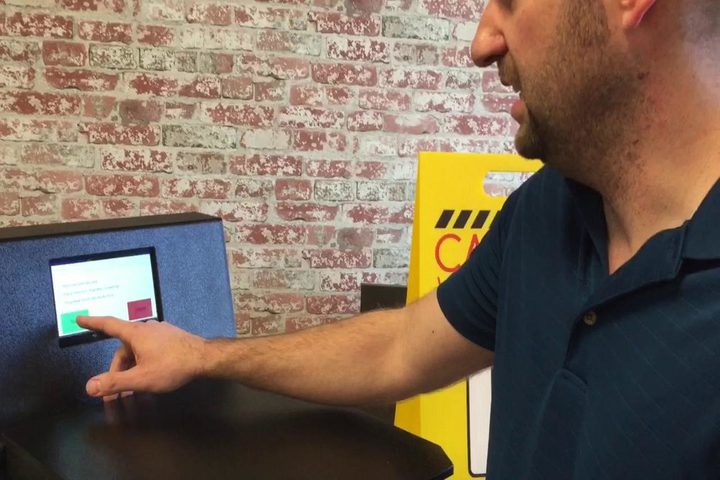
The Redux, now in its eighth generation, has come a long way. The commercial version is constructed of polycarbonate and measures about the size of a Laserjet printer. It weighs 75 lbs., sports the same glass used to make bulletproof car windows, and is “designed to fit every smartphone there is,” Zielinksi said (there’s an extra-large version of the machine for tablets in development). A rectangular bed houses the phone for the duration of the drying process, and an electronic screen indicates the progress.
It’s built to run continuously for at least three years.
Drying is relatively straightforward, as the team demonstrated in our Manhattan office. Zielinksi dropped a dry iPhone 6S into a full pitcher of water, fished it out, then placed the drenched phone inside a Redux unit and initiated a drying cycle. Then we waited.
The Redux’s underlying technology — vacuum drying — isn’t new. Zielinski said it’s been around since the 1940s. However, the Redux applies intelligence to the process, which was lacking in devices that came before it. It measures the moisture level of the smartphone by gauging the drying chamber’s humidity and applies algorithms to ensure a baseline dryness.
And Redux’s analytics platform applies machine learning techniques to drying. Units connect to cloud servers via Wi-Fi and send information about the types of phones dried, the length of time each dry took to compete, and real-time moisture and humidity levels. It’s all viewable on a Bluetooth-paired iPhone or iPad, Zielinksi said.
And about 84 percent of the time, the end result is a working smartphone. The process takes between 25 minutes to an hour to complete, Zielinksi said, and he cautioned that the Redux won’t reverse the effects of water damage or electrical shortage. But it can make data recovery feasible in situations it might not have been otherwise — dried phones that haven’t been turned on or plugged in after they’ve come into contact with water usually boot up.
“The damage isn’t caused by water,” Zielinksi said. “It’s caused by water and electricity that can go through the device.”
That’s enough for most people. Typically, Redux customers are hoping to recover photos, videos, and contacts they haven’t backed up elsewhere, Zielinksi said. “It’s usually someone who’s passed away,” he said. “You can’t replicate a mother-in-law’s recording or your father’s picture.
Zielinksi said the technology’s too expensive and unwieldy to mass produce. Instead, the company’s partnered with The Cellular Connection’s chain of over 700 Verizon Wireless reseller stores to sell phone drying packages. A diagnostic starts at $10, and a successful drying costs extra. Those with insurance get a discount: $40 for policyholders and $90 (for a smartphone) or $50 (for a basic phone) for those uninsured. A $30-per-month option covers two drying attempts in a two-year coverage period.
Eventually, Zielinksi plans to lease the machine to big box retailers and even automakers, where he envisions uses broader than just smartphones and tablets. Redux units could dry drenched smartwatches, hearing aids, or key fobs at hundreds of service departments and electronics stores throughout the country. And the company could sell additional subscription tiers for an unlimited number of drying cycles each month.
“People won’t mind paying a little more for a service that’ll dry their phone back to health,” Zielinksi said. “They can sit in a waiting room, wait for 20 to 30 minutes, and be in and out in no time.”