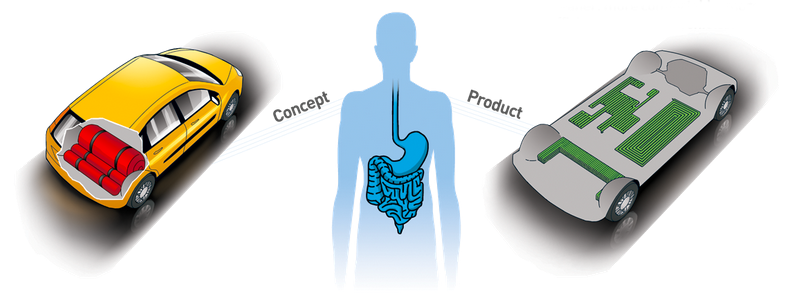
Biotechnology fiction centers around the idea of man finding new and interesting ways to hack the body with the aid of machinery. But just as the real world constantly move towards making those ideas a reality, it’s also moving in the opposite direction – machines that work like the biological body. The latest example: A car with a fuel tank based on a human digestive system.
The idea may sound more than a little like grotesque sci-fi, but the San Francisco-based company that has come up with the idea, Otherlab, believes that it could be the thing to make natural gas-powered cars far more appetizing to potential customers around the world. “Today’s natural gas vehicles are fitted with on-board fuel tanks that are too large, cumbersome, and expensive to properly facilitate the widespread adoption of natural gas vehicles in the U.S. and globally,” explain Otherlab, Inc. in its introduction to the Intestinal Natural Gas Storage (INGS) unit. “Additionally, the low volumetric density of natural gas – roughly 30 percent less energy by volume than gasoline – limits the driving range of natural gas vehicles and makes cost-effective storage solutions a significant challenge.”
To combat these problems, Otherlab’s INGS unit essentially mimics the way that the human body stores fuel by folding intestines back and forth. Made of “small-radius, high-pressure tubes that allow for maximum conformability to vehicle shape,” the INGS unit “provides for maximum storage capacity [and] would allow an increase in the storage density, safety, and space utilization and give automotive designers more freedom in vehicle design,” according to its creators.
Funded in part by the U.S. Government’s Advanced Research Projects Agency-Energy (ARPA-E) program – which helps develop “high-potential, high-impact energy technologies that are too early for private-sector investment,” according to the program’s official website – the INGS unit allows for more fuel to be stored in the car by replacing one central tank with a number of tubes that can be threaded throughout the car’s entire body, as the designer sees fit.
In its ARPA-E application, Otherlab asserts that its system isn’t just good for drivers, but for the U.S. economy at large. “Removing barriers to natural gas vehicle adoption could create jobs in fuel production and the manufacture of natural gas vehicles and associated refueling systems,” the company said, while also noting that “improving the convenience of natural gas vehicle ownership could reduce our dependence on foreign oil and make consumers less vulnerable to sudden oil price shocks.”
There is, of course, an environmental benefit to making the switch to natural gas – 10 percent lower greenhouse emissions – but also a financial one, with natural costing roughly half of the traditional gas alternative. And that’s not all; Otherlab also boasts of a practical benefit for its system for car designers and manufacturers, as well, saying that it would “allow an increase in the storage density, safety, and space utilization and give automotive designers more freedom in vehicle design.”
Otherlab’s INGS unit is still in its early stages of development, so don’t expect automakers to start rolling it out anytime soon. And even if they did, would people buy? Let us know your thoughts in the comments.