  1. Home
  2. Computing
  3. News

AOC's new U2477PWQ display could be the monitor to make you go 4K

Add as a preferred source on Google

Although 24 inches of monitor is about the minimum a lot of gamers and professionals will opt for today, that doesn’t mean that it’s a dead-end or entry-level market. Indeed, adding new features and upping the resolution of the panel behind it all can make a 24-inch relevant. And that’s exactly what AOC has done with its new U2477PWQ monitor.

The display, which uses a PLS panel (similar to IPS technology), boasts a viewing angle of 178 degrees and operates at 4K resolution (3,840 x 2,160) with a refresh rate of 60Hz. The response time is listed as just four millieseconds, which is more than fast enough for your average gamer or professional.

Recommended Videos

Other specifications include support for a full 16.7 million colors, a brightness rating of 300 cd/m2, and a contrast ratio of 1,000:1.It has a slimline bezel and a small desk-top footprint too, so will fit in even cramped work environments.

It also supports new connectivity standards like HDMI 2.0, offering bandwidth up to 18Gbps, which lets you stream 4K content to it at up to 60 frames per second. It also has a DVI, DisplayPort and VGA connectors for added connectivity. The DVI and VGA connectors do not support 4K resolution, but can be used for legacy support of older PCs.

Although the frame is versatile enough to offer pivot control, there is no manual swivel for it, and the tilt is restricted to just a few degrees, so don’t expect to be able to adjust this one all over the place. It can however be raised a few inches, for those who are a little taller than average.

Set to be made available sometime in November, U.S. pricing has yet to be announced. Based on the British price tag of £290 (thanks PhotographyBlog), expect to pay around $350 when this monitor does officially launch. That seems a reasonable price for a 24-inch, 4K monitor as capable as this one looks on paper.

Jon Martindale
Jon Martindale covers how to guides, best-of lists, and explainers to help everyone understand the hottest new hardware and…
The Mac Pro nearly received an M3 Extreme chip twice as powerful as M3 Ultra
High production costs likely killed Apple’s M3 Extreme plans
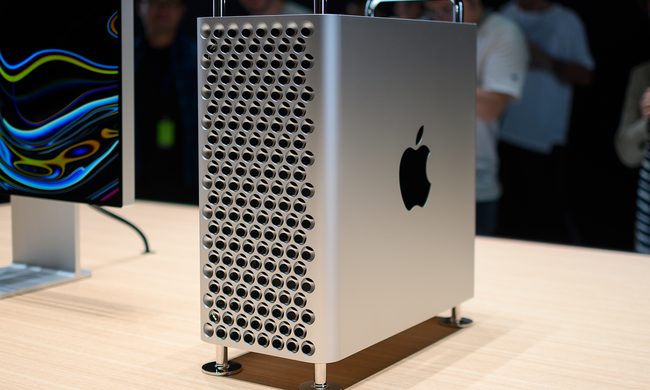
Apple's Mac Pro on a table at a press event.

Apple discontinued the Mac Pro earlier this year, ending a 20-year run for a computer that once represented the very best of the company’s desktop lineup. However, Apple reportedly had much bigger plans for the machine before ultimately replacing it with the Mac Studio.

According to Bloomberg’s Mark Gurman, Apple developed an M3 Extreme chip that could have offered twice as many CPU and GPU cores as the M3 Ultra. The processor was intended to sit above the Ultra tier and could have finally given the Mac Pro the performance advantage it badly needed. Apple eventually abandoned the chip due to concerns over production costs and limited demand for such an expensive machine.

Read more
Hidden prompts can secretly rewrite an AI’s memory, and researchers say that’s a serious problem
Researchers discover AI attack that rewrites an assistant's long-term memory
Chatbot on a smartphone.

Large language models are getting better at remembering us. Whether it's your preferred writing style, recurring tasks, shopping habits or project deadlines, AI assistants are increasingly storing long-term memories to make future conversations feel more personal and useful. But according to new research, that same feature could become one of AI's biggest security vulnerabilities.

Researchers from New Mexico State University have demonstrated a new attack called GhostWriter, capable of secretly planting false memories inside AI agents. Rather than stealing information outright, the attack manipulates what an AI remembers, potentially causing it to make dangerous decisions long after the original attack has taken place.

Read more
This experiment shows how easy it is to poison an open-weight AI model for under $100
This research raises new doubts about trusting open weight AI models.
Computer, Electronics, Laptop

Open-weight AI models have been having a moment lately. Just this month, Moonshot's massive Kimi K3 model landed close behind Claude Fable 5 and GPT 5.6 Sol in several benchmarks, all while remaining fully open-weight and downloadable by anyone.

However, Katie Paxton-Fear, a cybersecurity lecturer at Manchester Metropolitan University and staff security advocate at Semgrep, managed to poison an open-weight model and proved how easily that openness can be turned against you (via The Register).

Read more