  1. Home
  2. Computing
  3. Emerging Tech
  4. Legacy Archives

Hands-on with MakerBot’s Thing-O-Matic, a printer for 3D objects

MakerBot - Build-O-Matic
Image used with permission by copyright holder

We buy plastic objects every day. Cups, toys, models, you name it. Everything is made out of plastic, and now, thanks to advancements in printing, you can make things out of plastic yourself. MakerBot is selling printers that let you create very detailed, real plastic objects with amazing precision. It’s almost like having your own personal Star Trek Replicator.

I caught up with a few of the fellas from MakerBot at GDGT Live in New York last night, and they told me how incredible the response has been for their $1,299 Thing-O-Matic, one of the biggest and most affordable 3D object printers on the market. The company has grown from five to more than 30 employees since it launched in Sept. 2010 and the sales continue to climb, as does the size of the MakerBot community, which has contributed more than 10,000 object schematics that any buyer can grab for free.

Recommended Videos

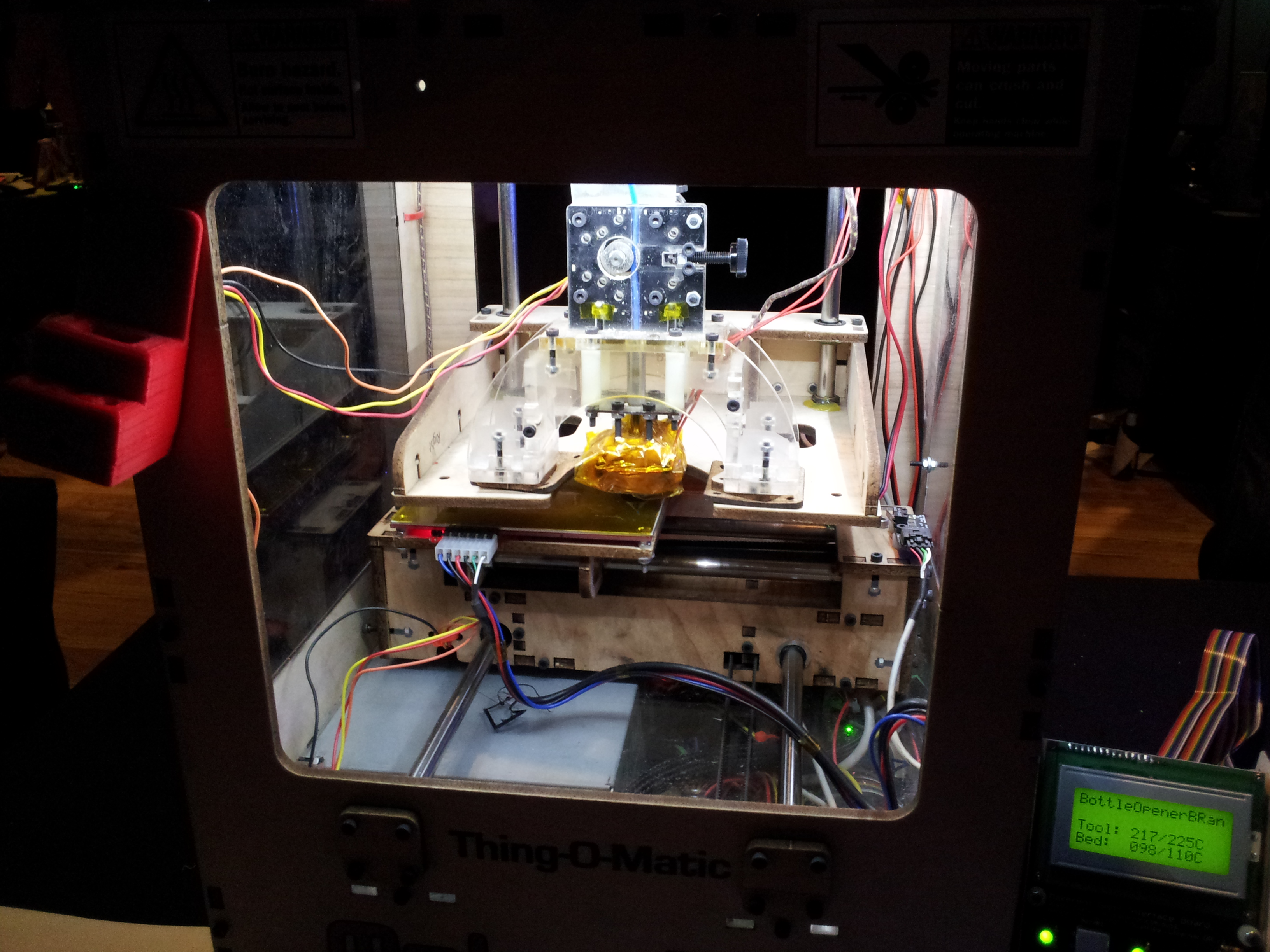
Now, before you get the wrong idea, this product is for geeks, not your grandma. It still takes a lot of dedication and hard work to actually plan out  and create a new 3D object from scratch, and if you’re making something that’s particularly innovative, you may have to get a little creative, but for those who want to dive in, you’re in for a treat. I watched the Thing-O-Matic build little cars, gears, and even a bottle opener.

MakerBot - Thing-O-Matic
Image used with permission by copyright holder

Here’s how it works: After you order the Thing-O-Matic, it arrives at your doorstep as a kit that you must construct yourself (its doable). Next, you find an object you want to build on your computer, attach the computer to the Thing-O-Matic (USB or SD Card), and tell it what to build. The factory-in-a-box comes with a big roll of plastic wire, which is fed into the machine, heated up, and used to print your 3D object. Objects are printed much like a printer prints something on a piece of paper. The Thing-O-Matic splits your 3D object into hundreds (or thousands) of layers, or slices, and draws each layer, one after the other. As it continues to draw, the object gets thicker and thicker. Think of it like a machine that’s putting together a loaf of sliced bread. First it makes the crusty piece at the end, then adds each layer, slice by slice, until it reaches the top.

The printing process can take anywhere from 5 minutes to an hour or longer, depending on the size and density of your object, but it doesn’t get old to watch. The outcome can be quite useful too. Aside from the expected assortment of Star Wars-related objects, there are a lot of cool things to build in MakerBot’s Thingiverse, the home of its community. Just browsing the front page, I saw that people have constructed fly swatters, model rockets, Lego-like bricks, watering spouts, and complex gear-like mechanisms. And if you’re in the mood, there’s an entire section dedicated to Stephen Colbert where you can download the specifications to build a full bust of him, or print his head on the body of a T-Rex.

I recorded a very short video at the show, which is below, but check out the MakerBot site to learn more.

Photo Gallery

Jeffrey Van Camp
As DT's Deputy Editor, Jeff helps oversee editorial operations at Digital Trends. Previously, he ran the site's…
Your next MacBook could use an iPhone-class chip
Leaked Apple engineering files point to an A18 Pro-based MacBook that reads more like a shippable configuration than the A15 test entry.
The Apple MacBook Pro 14 M5 sitting on a woman's lap at the airport.

Apple may be inching toward an iPhone-class chip MacBook, and the trail starts in a place most people never see: internal kernel debug kit files used by its engineers. MacRumors reports that Apple accidentally posted the kit on its website earlier this year, then pulled it after details began leaking.

Inside the Mac-related listings, the files reference two unreleased MacBook setups. One uses the older A15, the other points to A18 Pro. The split matters because it suggests Apple tested the concept with whatever worked, then moved on to something that looks closer to a real product candidate.

Read more
It just got a lot easier to control a Windows 11 PC with your Android phone
Android smartphones now act as a multipurpose remote control for Windows 11 devices, offering instant locking, seamless file transfers, shared clipboard access, and easy screen mirroring.
microsoft-Phone-Link-app-windows-11

Microsoft has rolled out a significant upgrade to its Phone Link system and the "Link To Windows" app for Android, improving cross-platform connectivity with Windows 11. First and foremost, there's a new "Lock PC" toggle that lets you lock your Windows device remotely from your smartphone (provided the devices are connected).

According to a new report by Windows Latest, locking a Windows 11 PC from an Android phone takes a couple of seconds. Once unlocked, the PC reconnects to your phone. Besides that, the app also gets a "Recent Activity" feed that shows file transfers and clipboard history shared between the devices. There's a dashboard of the recent cross-device transactions.

Read more
AI chatbots like ChatGPT can copy human traits and experts say it’s a huge risk
AI that sounds human can manipulate users
phone-showing-ai-chatbots

AI agents are getting better at sounding human, but new research suggests they are doing more than just copying our words. According to a recent study, popular AI models like ChatGPT can consistently mimic human personality traits. Researchers say this ability comes with serious risks, especially as questions around AI reliability and accuracy grow.

Researchers from the University of Cambridge and Google DeepMind have developed what they call the first scientifically validated personality test framework for AI chatbots, using the same psychological tools designed to measure human personality (via TechXplore).

Read more