1. Home
  2. Emerging Tech
  3. Outdoors
  4. News

Forget flare guns; this pocket-sized rescue balloon stays aloft for days

Add as a preferred source on Google

While flare guns are certainly handy in a pinch, they’re not without their shortcomings. You can use them to hail rescuers when you’re stranded on a desert island, and when your pistol runs out of bullets they’re also a great way to take down zombies, beasts, and supervillains. The only problem is that traditional flares don’t burn for very long, meaning you’ve got to wait to deploy them until just the right moment.
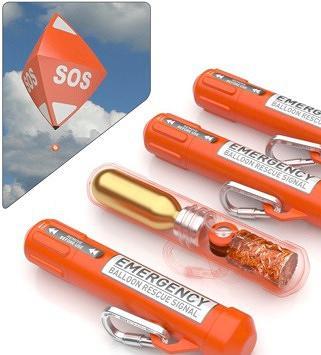
rescumeballoonObviously, a rescue device that only increases your visibility for a few minutes isn’t exactly ideal, so to remedy some of the problems faced by traditional flares, the RescueMe Balloon takes a different approach. Rather than relying on combustible chemicals that burn out after a while, the RescueMe system deploys a large helium balloon into the air. The bright orange balloon can stay aloft for up to seven days, and is outfitted with flashing LED lights for extra visibility at night.

Recommended Videos

The amazing part is that this whole system fits inside a pocket-sized capsule, so it takes up just as much (if not less) room as normal flare gun would. Inside the capsule you’ll find a canister of pressurized helium, a compressed SOS balloon, a small LED/battery assembly, and a length of lightweight cordage you can use to anchor the balloon to yourself. To deploy the balloon, just open up the capsule and twist the balloon’s base onto the helium canister. This will puncture it and release the gas into the balloon, sending it to the skies.

Pricing and availability details are scarce at this point, but we’ve reached out to RescueMe’s creators, and will update this post with that information when it’s made available.


Drew Prindle
Former Senior Editor, Features
Drew Prindle is an award-winning writer, editor, and storyteller who currently serves as Senior Features Editor for Digital…
Students who use AI every day may be falling behind, while moderate users pull ahead
New global testing data suggests more AI in the classroom isn't automatically better.
Logo, Text

I assumed more AI access might help students learn faster. However, a new OECD study dispels that misconception for me and everyone else who gave their children a paid version of AI chatbots, thinking it would help them through their educational journey. 

According to PISA 2025 data from 760,000 students in 91 countries, students who use AI daily score meaningfully worse on standardized tests than their peers. The full picture is more complicated than a simple ban would fix.

Read more
XPENG just put its humanoid robot on the production line, and it walked itself out
IRON clocks in for its first shift
XPENG Iron

XPENG’s humanoid robot has officially joined the workforce, and it even got an employee badge. The Chinese automaker announced on September 8 that its next-generation IRON had completed assembly and autonomously walked off its newly commissioned humanoid robot production line in Guangzhou.

CEO He Xiaopeng then pinned a staff badge onto the robot, symbolically welcoming it to the XPENG team. It is a charming little ceremony for a machine that the company hopes will eventually become a regular part of everyday life. XPENG is moving IRON beyond R&D prototypes toward production-line manufacturing, applying the quality-control systems and manufacturing experience it has developed through its electric vehicle business.

Read more
An AI-designed drug might help slow aging, but we’re not there yet
The results hint at a possible anti-aging effect, but there’s still a long way to go before we know what it means.
medical test tubes

Rentosertib, a drug Insilico Medicine designed almost entirely using AI, was created to treat idiopathic pulmonary fibrosis, a disease that scars and stiffens the lungs over time. But fighting lung disease was only half the plan from the start.

According to a new study published in Nature Biotechnology, the drug's target was chosen specifically because it overlaps heavily with the biology of aging, and the whole trial was designed to test whether treating the lungs could also mean turning back the body's biological clock.

Read more