

Covered in detail on Patent Bolt recently, a patent application for an advanced set of handcuffs was published by the U.S. Patent & Trademark office during late November 2012. Filed by a group called Scottsdale Inventions during late 2010, technology that could potentially go into the handcuff design includes an accelerometer, a location sensing device, a microphone; a camera and a biometric sensor to measure a detainee’s physical state. However, the group has also designed the handcuffs to house electrodes that would deliver an electric shock to a detainee.
 Regarding data, the handcuffs would keep track of the date and time of each shock, the severity of each shock, the volume of shocks, the specific person that delivered the shock and the recorded reason for each instance.
The handcuffs have been designed to deliver a shock between 20,000 and 150,000 volts and between 0.5 and 6 milliamps. The duration of the shock can last from 0.5 and 10 seconds. In addition, the shock can be delivered in a constant jolt or at an intermittent frequency.
In addition to the electrodes, the patent details a “substance delivery system” that’s designed to administer anything from medication to irritants. Delivery systems include a “moveable needle” for liquids or a “gas injection system” to deliver a paralytic or sedative. Similar to the data collected regarding incidents of electric shocks, it’s likely that the device will record instances where substances are delivered to detainees.
The handcuffs do include a warning system that would alert the detainee that the delivery of a shock or substance is imminent unless behavior was corrected. The patent outlines a red LED warning light on the device that would turn on in addition to a small speaker that would emit a loud tone before the device is activated.
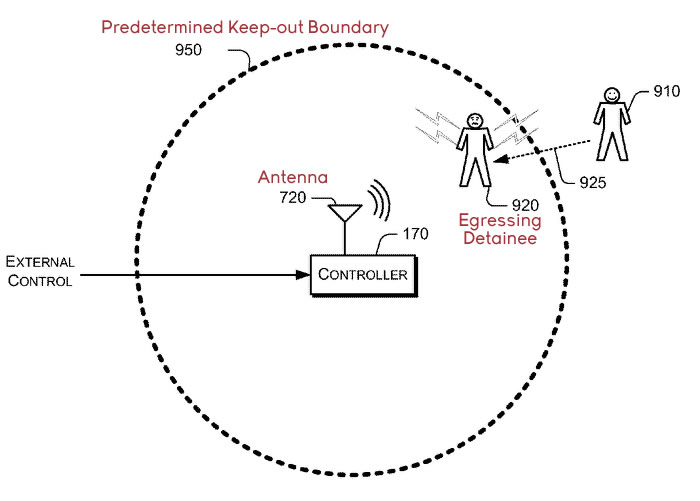 The patent also details the possibility of using location data to keep the detainee in a specific area or away from another detainee.
Similar to the technology used within a shock collar fence for pets, the detainee would be issued a shock if they stepped inside a specific area. The handcuffs could also keep two unruly detainees away from each other by programming the handcuffs to activate based off the proximity between the two devices.
In another example, the patent details the use of RFID technology to make sure a detainee doesn’t interact with objects that are off limits. For instance, a RFID tag could be attached to a police officer’s weapon. If a detainee attempts to get their hands on the officer’s weapon, the handcuffs would deliver a shock immediately. That technology could also be applied to off-limit areas around a police station as well as the driver’s seat of a police officer’s car.
RFID technology is also mentioned when it comes to the security of the controller that activates shock or substance delivery. For instance, the controller could be programmed to be completely non-functional unless the device was in the proximity of a RFID tag on the badge of the police officer that assigned to the handcuffs. In addition, the controller could include a safety toggle switch to make sure the electrodes in the handcuffs couldn’t be activated manually on accident.
At this time, the Scottsdale Inventions group hasn’t announced any plans to manufacture the handcuffs. According to the Phoenix Business-Journal, they hope to license the technology to a manufacturer that already works with law enforcement agencies.


