Researchers at University College London have created an algorithm capable of taking a sample of hand-written text and imitating it, allowing a computer to write in the style of a real person. We’re not talking about a simple “handwritten” typeface, either. The text turned out by the algorithm created by Tom Haines and his fellow UCL researchers is authentic enough that human judges are unable to tell the difference.
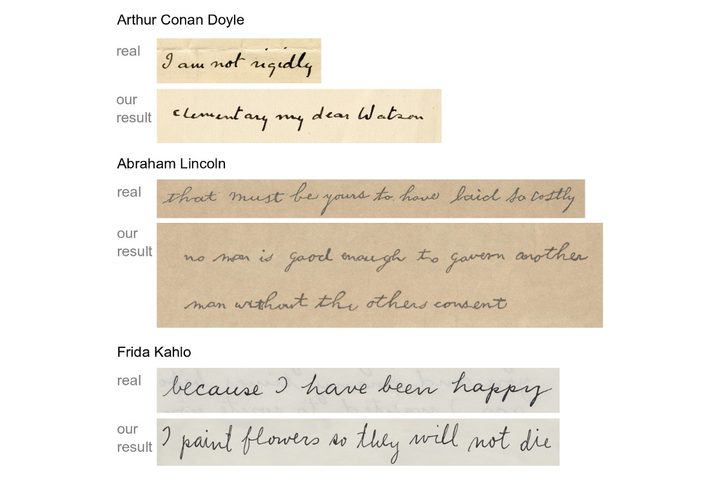
“We’re very proud of the fact that when we ran a user study, in which we gave people samples of the same sentence in real handwriting and handwriting created by our system, they were unable to spot the fake,” Haines told Digital Trends, excitedly. “They were basically making random guesses.”
Called “My Text In Your Handwriting,” the new machine learning tool works by first marking up each letter and punctuation mark, looking in detail at how every letter (or “glyph”) is reproduced. It then allows users to type in a sentence, paragraph or even entire document and have the computer “handwrite” it in surprisingly authentic detail — complete with pen-line texture, color, and even the joining-up technique between letters.
And it’s not just capable of reproducing the handwriting of living people, either. “Provided we can find the necessary handwriting samples at a high enough resolution, we can recreate the handwriting of historical figures,” Haines said. So far, the team has created passable recreations of the handwriting of Sherlock Holmes creator Sir Arthur Conan Doyle, Mexican painter Frida Kahlo, and former President Abraham Lincoln.
As you might imagine, the problem being solved here isn’t a straightforward one. You only have to try and write out the same phrase 10 times in a row to appreciate how much our letters can vary; often depending on the letter which preceded them. Fortunately, irregularities like this are one of the things for which machine learning tools are well suited.
“You have to introduce a certain amount of randomness to hide the computer-generated aspect.”
The system even learns to mimic the spacing between words — another area that’s as characteristic as the way we form individual letters. “A surprising amount of effort goes on in the spacing of text,” Haines continued. “This turned out to be more important than the glyphs in some ways. For the spacing, we have a probability distribution from which we draw, so that it’s slightly different every time. We found that to be necessary. You have to introduce a certain amount of randomness to hide the computer-generated aspect.”
The randomness of lettering is crucially important. You may be familiar with the “uncanny valley” hypothesis, which states that human replicas which don’t quite appear human can create an eery sensation in onlookers. The concept was first suggested by the Japanese robotics professor Masahiro Mori, referring to the unintended creepiness of humanoid robots. As Haines noted, text recognition doesn’t quite come with the same uncanny valley as attempts to recreate human faces, but the brain is still keenly aware of discrepancies which highlight the would-be lifelike as artificial.
“It’s all about hiding the patterns from the human,” he said. “If you add enough randomness it’s okay. But the moment you have a pattern in there, the human brain can spot it immediately. Consistent spacing, letters that are too exactly similar to each other… that kind of thing ruins the illusion incredibly quickly.”
So what kind of applications does a tool like this have? Some are as frivolous as you might expect — although it’s easy to imagine them being used. For example, a service like Amazon or a flower delivery company could utilize the technology so that people could write gift cards in their own writing, rather than the standard banal Arial typeface. It could even be possible to use the handwriting of an historic figure: perhaps opening up a slew of intriguing licensing situations.
But other applications are more profound.
“It could be very useful for people with disabilities,” Haines continued. “Certain disabilities, such as strokes, can leave people unable to write by hand. Because of the highly personal value of handwriting, they may find significant value in being able to generate new letters in their own handwriting.”
As to the risk of potential forgeries, Haines told Digital Trends that it depends who the fake would be aimed at. “I can tell real from fake, and I believe that forensic document examiners will also be able to tell real from fake,” he said. “It might get past a forensic examiner if they were under time pressure, but I can’t be sure. [That] would need a proper experiment to determine … On the other hand, we demonstrated that it fools the untrained eye, so there is a risk of fooling ‘normal’ people.”