One recent morning, as children and adults were still making their way to schools and offices, respectively, we found ourselves standing with a group of French business leaders outside the Metropolitan Museum of Art, in New York City.
The 145-year-old museum wouldn’t open for another hour and a half, but we weren’t there to be tourists. We had been invited by Sree Sreenivasan, the Met’s chief digital officer, for a special guided tour, aptly titled #emptymet, that explores how he and his team are bringing the museum experience into the digital age.
Rather than fighting Facebook and YouTube, it’s acknowledging that services like Snapchat are the new culture.
Despite having one of the greatest collections of art and being one of the most visited museums in the world, the Met finds itself in the same boat as other museums: How does it compete in an age where our eyeballs are glued to our screens. Why spend the energy to visit a museum when you can do it virtually online?
“Our competition is Netflix and Candy Crush,” Sreenivasan says, not other museums.
Which is why the Met and other museums are investing in technologies to make the museum experience more interactive, even working with the smartphones that guests carry with them. The Met has a staff of 70 in the digital-media department, and 70 more handling tech hardware in general. Rather than fighting Facebook and YouTube, it’s acknowledging that services like Snapchat are the new culture. The Met’s mission is finding a way to fit in alongside them.
So, like many major museums, it’s exploring ways to deliver the interactive experience. With Wi-Fi throughout the building, guests can access the Met’s mobile app for more information and audio guides, while at the same time uploading images to Instagram. It’s experimenting with emerging technologies like iBeacon and even augmented reality. (Sreenivasan demoed an AR smartphone app called Blippar that animated a painting when he placed his iPhone in front of it.) It’s putting up its 2,600 audio messages for free online. The digital-media team is developing special digital content that talks about how the museum repairs damaged art. All these are just some of the new digital endeavors museums are embarking on, following projects like digitizing their collections and installing video displays — and all to get people back inside the museums.
Despite Sreenivasan’s encouraging us to take lots of selfies, he quickly reminded us that selfie sticks are banned. “I am pro selfie, but not the selfie stick,” Sreenivasan says.
Besides the Met, here are how some other institutions are incorporating technology into the museum-going experience.
Louvre, Paris
When it came time for one of the world’s oldest and most-visited museums to update its audio tour in 2012, the Louvre chose an unlikely device: a Nintendo 3DS XL. But the Audioguide Louvre: Nintendo 3DS XL, as it’s called, provides an interactive element in addition to 35 hours of audio content. Developed with help from Nintendo, the specialized 3DS XL provides maps, 3D and HD photos, and other extra content. Besides the 3DS, the Louvre is also investing in interactive displays and augmented reality.
de Young Museum, San Francisco
Besides collaborating with Google on the Google Art Project, where its collection of art is being digitized for online viewing, the de Young also dabbled with 3D printing when it needed to create a special stand for an 18th-century French clock. Using MakerBot Replicators and 3D CAD software, the museum fabricated a plastic stand that fits the clock perfectly. Other museums, including the Met and Brooklyn Museum, are experimenting with 3D printing. The de Young has a blog dedicated to its technology-related activities.
Brooklyn Museum, New York
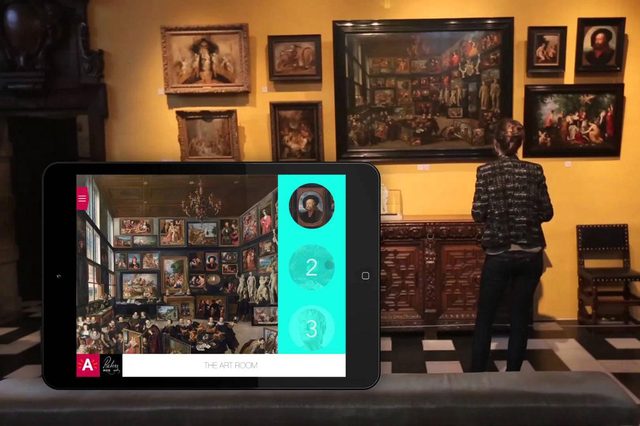
Art on display is always accompanied by placards that give some details, which includes the title, artist, date, and, sometimes, a short description. But what if guests want to know more than what’s described? The Brooklyn Museum is using iBeacon technology as a way for guests to interact with museum experts, in situations like the one just described.
Through its iOS app, guests can ask questions about an artwork or for recommendations on what to see, and get a real-time response. Although the solution is more cost-effective than hiring greeters to roam around, the museum said installation proved a challenge.
Museums can also use beacons to send additional info; for example, a visitor standing near a painting might get a phone alert directing them to rich, interactive content relating to the painting. Major institutions like the Met, Museum of Modern Art in New York, and Guggenheim are also testing beacon-based location technology. (Check out the Brooklyn Museum’s tech blog on its latest endeavors.)
British Museum, London
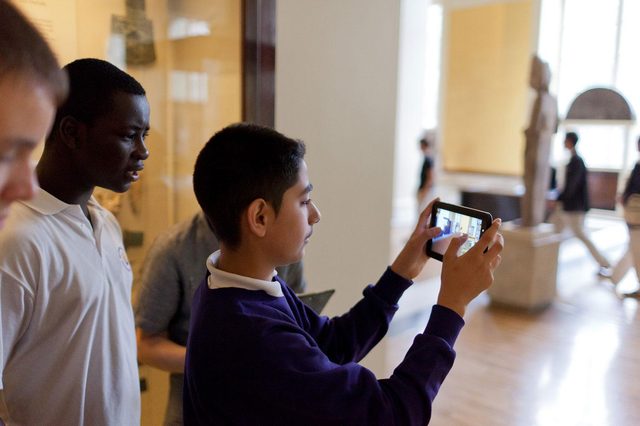
With augmented reality, visitors can use a simple smartphone to discover more information about a piece of art in an interactive manner. For example, placing a smartphone or tablet over an ancient statue could display missing parts that have broken off – giving the visitor a glimpse of how it would have looked when it was new. Because AR responds to your movement in the environment, the experience is also completely 3D.
Working with Samsung, the British Museum used AR to create an education program for kids, where they can explore virtual content as they wander through the museum. AR is still in its infancy, but museums around the world are already testing its potential.
Getty Museum, Los Angeles
The Getty is no stranger to technology. It continues to develop tools that protect its collection of antiquities and other priceless art during earthquakes, and it was one of the first to digitize items in its collection and making them available online.
Like the British Museum and others, it’s also trying out augmented reality. The museum’s Collection Information and Access department recently unveiled an interactive AR feature that lets Getty website visitors use their webcam to explore a 17th-century cabinet, by overlaying a virtual 3D object atop a live feed. Users can interact with the object, working in conjunction with the viewer’s body movements.
Cooper-Hewitt Smithsonian Design Museum, New York
Before the Cooper-Hewitt reopened after being closed for renovations, it wanted to give guests a more interactive experience that goes beyond a smartphone app. To deliver on that, the museum added 4K touchscreen tables where visitors can pull up high-res images and information on items from the museum’s collection – many that aren’t exhibited. Users can also draw shapes, and the display will display objects relating to those shapes. Seven tables – in 84, 55, or 42 inches – are placed throughout the museum, with the largest tables being able to accommodate simultaneous users. One table displays information about the donors and objects, while another talks about the museum’s space, the Carnegie Mansion.
The museum also gives guests access to the Pen, an electronic stylus that lets you remember the things you saw. Simply tap the Pen on a placard, and it’ll “collect” the information. Users can transfer the info to one of the aforementioned tables to collect more info. After the visit, users can access a dedicated website that contains all the objects collected.