1. Home
  2. Space
  3. Emerging Tech
  4. News

Meet the new rocket from Jeff Bezos' Blue Origin — the enormous New Glenn

Add as a preferred source on Google

The space race is on, and it’s taking place in the private sector. Forget the United States and Russia — it’s really Jeff Bezos and Elon Musk who are competing for dominance off the planet. And now, Bezos has made the latest move, introducing the New Glenn, the future rocket of Blue Origin.

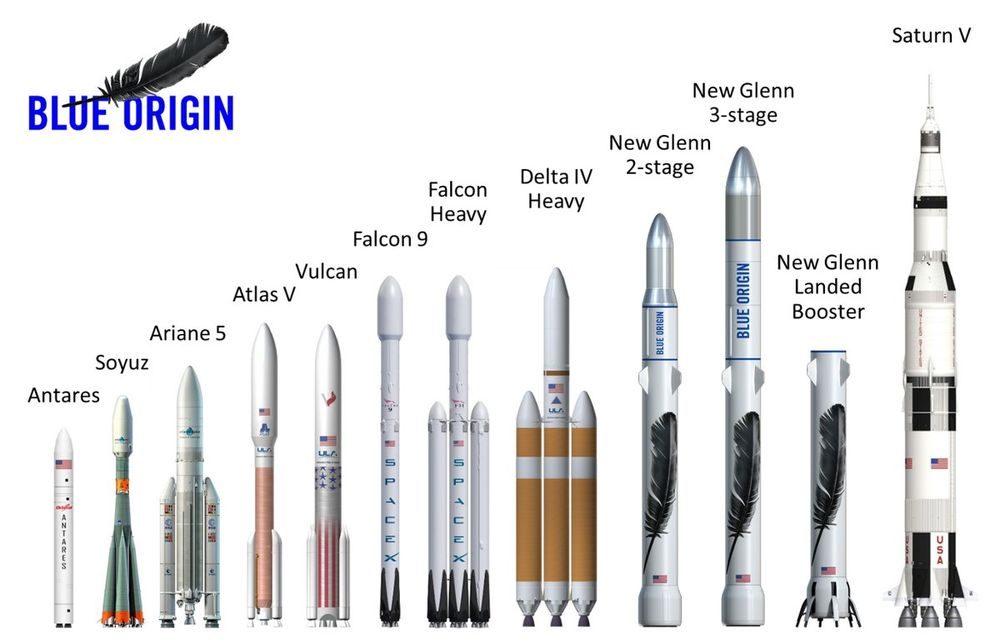
Boasting the capacity to send both payloads and people into the beyond (that is to say, outer space), the New Glenn takes its name from famed astronaut John Glenn, the first American to orbit Earth. And as per newly unveiled images of the New Glenn, this space ship is going to be nothing shy of a monster.
new-glenn-blue-origin
Image used with permission by copyright holder

Appearing to be the biggest rocket since the Saturn V, which NASA used several decades ago in the late 1960s and early 1970s, the New Glenn will reportedly measure 23 feet in diameter and range between 270 and 313 feet high. The discrepancy is dependent upon whether the rocket has one or two upper stages atop it — should there be only one, the New Glenn would be capable only of reaching lower Earth orbit. With both upper stages, however, people and satellites can go considerably further.

Recommended Videos

It’s quite the statement for Blue Origin, which was the first private company to send a rocket into space and successfully recover it on Earth in a vertical landing (though technically, it didn’t go that far into space — just 100 kilometers above Earth’s surface). Since then, however, most space headlines have involved SpaceX and Elon Musk’s impressive achievements beyond our planet. But the latest rocket from Bezos is looking to shake things up.

The New Glenn will far surpass its predecessor’s achievements, though it still doesn’t necessarily have the thrust to go as far as, say, SpaceX’s Falcon Heavy. Whereas Blue Origin’s new rocket will have about 3.85 million pounds of thrust, the impending Falcon Heavy (though smaller than the New Glenn) will boast around 5 million pounds of thrust.

“Our vision is millions of people living and working in space, and New Glenn is a very important step. It won’t be the last of course,” Bezos wrote in an email announcing the rocket. “Up next on our drawing board: New Armstrong. But that’s a story for the future.”

Lulu Chang
Fascinated by the effects of technology on human interaction, Lulu believes that if her parents can use your new app…
NASA is investing $590 million in private contractors to build humanity’s first Moon outpost
NASA is counting on private companies to land its Moon Base dream.
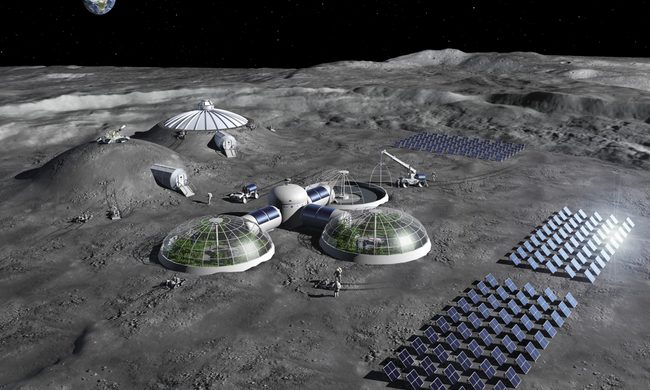
Artist impression of a Moon Base concept, with solar arrays for energy generation, greenhouses for food production, and habitats shielded with regolith.

Building a permanent base on the Moon sounds like science fiction, but NASA is making it feel a lot more real. The agency just handed $590 million in contracts to three private companies for four uncrewed lunar lander missions launching in late 2028.

These missions are part of Phase 1 of NASA's broader $30 billion Moon Base program, which needs to deliver landers, rovers, and scientific cargo up there before astronauts eventually move in. These efforts are closely tied NASA's Artemis program, which sent humans on a lunar flyby in April for the first time since the Apollo era.

Read more
Getting to Mars may require a pit stop in orbit, and NASA just tested the nozzle to make that happen
A gas pump nozzle for spacecraft sounds simple. It is not, and that's what makes this test worth paying attention to.
Architecture, Building, Factory

Getting a spacecraft to Mars or beyond requires an enormous amount of fuel, most of which has to be hauled from Earth, adding to the overall cost and weight of the spacecraft. NASA has been working on a different approach, one that could be more efficient and effective.

It wants to refuel a spacecraft in orbit before heading out for the mission. What’s even more interesting is that the space agency just finished testing a component that could make that possible: a cryocoupler.

Read more
Elon Musk’ Starlink could soon offer mobile services as a US carrier
Showcase of T-Mobile Starlink service on an iPhone.

Elon Musk’s Starlink has already changed how millions of people access the internet, especially in places where traditional broadband struggles to reach. Now, the satellite internet service could be preparing for an even bigger leap — becoming your mobile carrier.

According to a Financial Times report, SpaceX has told investors it’s considering launching a retail Starlink mobile service in the US. Instead of simply partnering with wireless carriers, the company could begin selling mobile plans directly to consumers, putting it in direct competition with Verizon, AT&T, and T-Mobile.

Read more