In Gene Roddenberry’s Star Trek universe, the mostly fictional antimatter engines aboard Federation starships served as a critical element to the fleet’s operation. Theoretically, these engines possessed the ability to regulate the interaction of a ship’s stored antimatter and were used to disrupt time ( i.e., to move the USS Enterprise forward or backward in time). Though this use of antimatter exists in the pages of science fiction, two renowned physicists announced this week they’ll soon use the popular crowdfunding site Kickstarter to help fund their next round of antimatter research. In real life.
For the better part of the last 13 years, physicists Gerald Jackson and Steven Howe worked tirelessly at convincing the likes of NASA (and various other parties) their idea for an antimatter propulsion system was legit. Way back in 2003, the duo presented their initial vision of deep space travel by unveiling the design idea for an antimatter driven sail. Back then, Jackson and Howe maintained that in 20 years, humanity would desire to travel deeper into space and that a lightweight, low-demanding method would be necessary. They posited that the generation and use of antimatter would ultimately help achieve this.
So what is antimatter? Essentially, this material is precisely what its name implies; it’s the opposite of regular matter. Whereas regular matter consists of atoms with positively charged nuclei and negatively charged electrons, antimatter atoms boast negatively charged centers and positively charged electrons. When an antimatter atom collides with a regular matter atom, annihilation of both particles occur, creating an immense release of energy. It’s this released energy the physicists hope to one day control and use as spaceship propulsion.
During their presentation, Jackson and Howe detailed exactly how a small probe would make use of this propulsion, saying it could travel from Earth to Alpha Centauri in just 40 years. Moreover, they claimed that just 17 grams of antimatter would be needed for such a journey to occur and that this antimatter would allow the probe to travel at speeds of roughly a tenth of lightspeed. However, devising a solid method for the manufacturing of antimatter supply remains as big an elephant in the room today as it did 13 years ago.
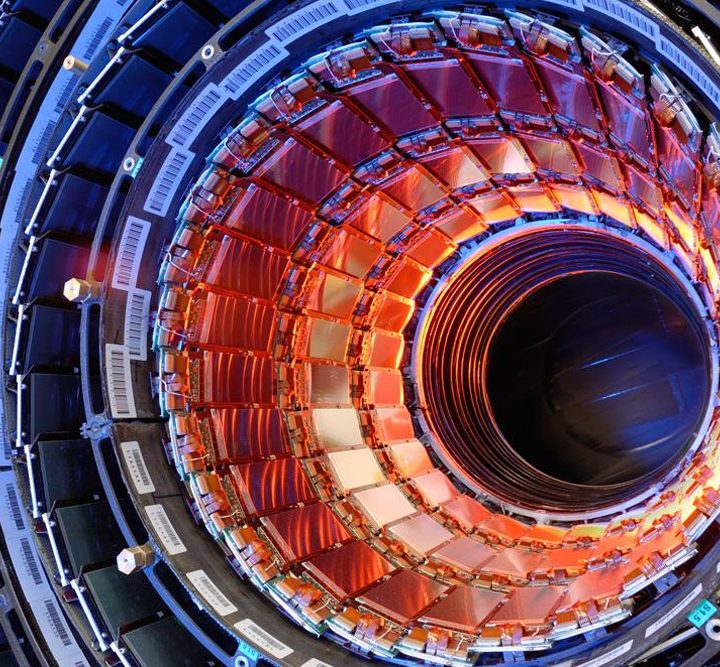
Although there exist methods of creating antimatter — Fermilab and CERN have the ability to do this with their respective colliders — only a small amount has ever been created. According to Symmetry Magazine, if all antimatter ever created was destroyed at the same time, there wouldn’t even be enough energy to bring a cup of tea to a boil; forget traveling to deep space. Additionally, it’s assumed that creating even one gram of antimatter would cost in the roughly millions of billions of dollars (!) due in part to it requiring around 25 million billion kilowatt hours of energy. Suffice it to say, antimatter’s not cheap.
Enter the Kickstarter campaign, where Hbar Technologies (Jackson and Howe’s company) hopes to raise $200,000 to undertake further research and development on their theory. Ideally, the proposed funding would allow the duo to manufacture a machine capable of measuring the amount of potential thrust an antimatter propulsion system might create. They do acknowledge, however, that building an actual antimatter drive would likely cost around $100 million (that is, if it works).
Even if the antimatter drive ends up functioning in line with the physicist’s theory, there remains yet another set of hurdles that would need to be overcome before an antimatter engine saw the light of day. First off, storing the stuff would be a feat all its own considering how unstable it is and the fact it can’t touch actual matter — which according to Fermilab physicist James Annis, is “surprisingly hard to do.” For instance, if antimatter somehow comes in contact with parts of its holding container, a catastrophic nuclear bomb-type explosion could occur.
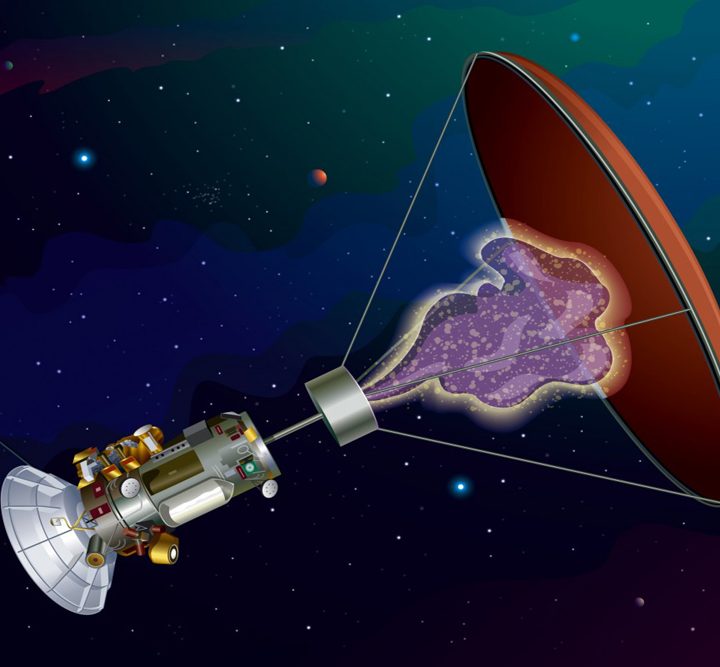
But let’s say Jackson and Howe do figure out a way to consistently create antimatter, somewhat inexpensively manufacture a working antimatter drive, and develop a safe way to store it. What would the final design look like then? In this example, the duo would use antimatter to incite fission aboard a spacecraft and, during the reaction, “daughter” byproducts of uranium would be created. As one of the byproducts travels forward, it would strike an onboard sail and propel the craft forward. The other byproduct would then shoot out the back of the craft thus creating another bit of thrust.
If funding proves successful and the duo’s system comes to fruition, Jackson believes it would only take roughly 20 to 30 years before a viable spacecraft could travel at 40 percent the speed of light. As of now, the team has only announced its intent to take the project to Kickstarter, though it plans to officially launch the campaign sometime next month.