  1. Home
  2. Emerging Tech
  3. Legacy Archives

Strolling between the rain drops inside MoMA’s Rain Room

Add as a preferred source on Google

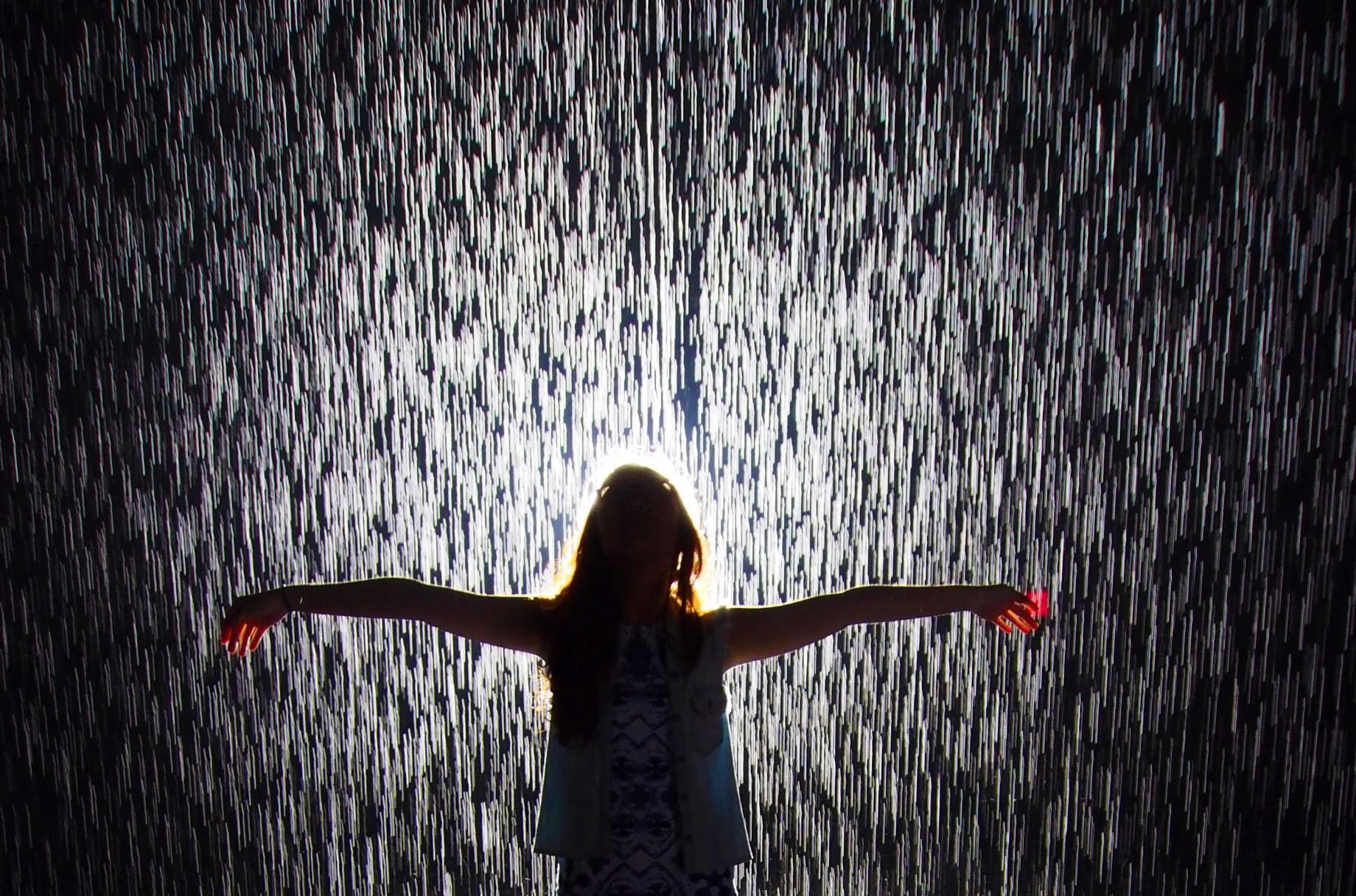
MOMA Rain Room 2 horizontalOn a sunny afternoon in New York City, it seems ironic that hundreds of people were waiting in line to purposely get caught in a torrential downpour. But the Rain Room isn’t just your average water park. The latest installation at the Museum of Modern Art allows visitors to walk through pouring rain without ever getting wet.

… A quiet stroll through the room feels God like – it really does feel as if you command the weather.

The experience is part of MoMA’s
Recommended Videos
“EXPO 1: New York,” a summer-long exhibition that explores the huge environmental challenges we face as a species alongside the unprecedented technological achievements of this generation. For its part, the Rain Room is an immersive environment that allows visitors to “experience how it might feel to control the rain.” Walking into the room feels like entering a huge, dark shower, but take a step into the rain and the falling sheets of water disappear. You can roam the space without getting at all wet. 

Designed by England’s Random International, the Rain Room’s secret is in 3D camera sensors installed across the dark room. Though artist Hannes Koch won’t reveal all the details (it’s “part of the magic”), he says the sensors recognize movements and detect objects – allowing rain to stop falling at precise spots at which the objects stand. When the sensors realize the object has moved away, the rain returns. Each spot gets an approximate five-foot radius of dryness, which is why the Rain Room is limited to 10 visitors at any given time. If the room were to fill up, the rain would stop altogether.  

The sensors aren’t the only trick within the Rain Room. The Random International team spent three years perfecting the installation by making sure the sheets of pouring rain fell as straight down as possible. Unlike natural rain from clouds, the water drops have to descend uniformly; without the straight downpour, the exhibit wouldn’t work. It also helps that, with the right camera settings, the vertical rain creates a unique and photographic experience. It is estimated that the Rain Room uses at least 260 gallons of water per minute during the exhibition.

Inside the Rain Room, the camera system is not exactly foolproof – you can still run around and get ahead of the sensors if you want to get wet. But a quiet stroll through the room feels God-like – it really does feel as if you command the weather. The experience is breathtaking, weird, and beautiful all at the same time. Hollywood has always romanticized kissing in the rain, but in reality, you’d be lucky if you don’t inhale water drops up your nose. In the Rain Room, couples can enjoy that magical moment without ever ruining their date outfits – or get their camera equipments destroyed while capturing the experience.

The Rain Room at MoMA runs between now to July 28. Be prepared: The exhibit is first-come, first-served. There is no time limit for how long you can spend inside the Rain Room so it could take hours before you’re even close to the front door.

Natt Garun
An avid gadgets and Internet culture enthusiast, Natt Garun spends her days bringing you the funniest, coolest, and strangest…
This new technique can generate AI videos in just a few seconds
TurboDiffusion can generate AI videos upto 200 times faster without losing quality
ai-video-generation

Researchers have unveiled a new AI video generation technique called TurboDiffusion that can create synthetic videos at near-instant speed. It can generate AI video up to 200 times faster than with existing methods, without sacrificing visual quality.

The work is a joint effort between ShengShu Technology, Tsinghua University, and researchers affiliated with the University of California, Berkeley. According to its developers, the system is designed to dramatically cut the time it takes to generate video, a process that has traditionally been slow and computationally expensive.

Read more
This camera breakthrough could soon help you take photos where everything is in focus
Researchers at Carnegie Mellon have developed a new lens technology that lets cameras focus on the entire scene at once.
Smartphone camera

Whether you're snapping photos on the best camera phone or using a proper camera, getting everything from the foreground to the background in focus is almost always out of the question. A new breakthrough, however, may soon make that a very real possibility.

Researchers at the Carnegie Mellon University have successfully developed a new kind of camera lens that offers spatially selective focusing, which can allow cameras to focus on an entire scene at once. A blog post about the development details that this tech can capture photos "where every detail, near and far, is perfectly sharp—from the flower petal right in front of you to the distant trees on the horizon."

Read more
Samsung concepts put an OLED screen on a classroom robot and retro music gear 
OLED screens, everywhere. From TV and headset to class robots and your audio gear.
Samsung OLED concept for robot

Every year, Samsung’s display division gives us a taste of concept devices with cutting-edge screens, some of which eventually appear on mass-market hardware down the road. Remember the dual folding concept from 2021, which only became a proper product in late 2025 as the Galaxy Z TriFold? Well, at CES 2026, Samsung is giving another glimpse into the future. 

Robots deserve OLED, too

Read more