
“Ultimax is practically a fandom fortress. It could be savory or bitter; that depends on the player's palette.”
- Spectacular character art.
- Deep story and fan service for followers.
- Approachable, unique, deep fighting.
- Visual novel storytelling ill-suited to television.
- Completely impenetrable for newcomers.
“Why you can trust Digital Trends – We have a 20-year history of testing, reviewing, and rating products, services and apps to help you make a sound buying decision. Find out more about how we test and score products.“
Persona 4 Arena Ultimax is one of the unlikeliest late-era PlayStation 3 and Xbox 360 games out this fall. It also happens to be a game suited only to a deeply specific audience, even moreso than other recent fighting games to land on the increasingly lonely last-gen consoles. Jojo’s Bizarre Adventure All-Star Battle at least comes with a decades-long comic book cult following and Ultra Street Fighter IV is the latest revision of the genre’s most popular mainstay.
Ultimax, on the other hand, is a game built for only the weirdest fighting game gourmand. A sequel to a two-year old fighting game that was itself a sequel to not one but two 90-hour role-playing games about Japanese teenagers, Ultimax requires a serious investment in both its narrative source material and the fighting specifics of its characters.
Ultimax is a game built for only the weirdest fighting game gourmand.
Arc System Works, the studio behind it, is best known for mixing beautiful art with insanely complex fighting game controls and strategies. Forget a single barrier to entry; Ultimax is practically a fandom fortress. But beneath the layers of colorful character, deep technical fighting, and thick continuity is a delicious game. It could be savory or bitter; that depends on the player’s palette.
Persona, by the way, is not just a reference to Jungian identity constructs in Ultimax. Atlus’ long running role-playing game series follows young people who control fantastical Personae, fighting demons that reflect their inner selves. They use these and other magical demons to fight evil and Shadows, the dark reflections of people’s psyches. That psychologically fraught background actually makes for some sweet video game fisticuffs that are simple on the surface but profoundly versatile and hard to challenge in the hands of a master.
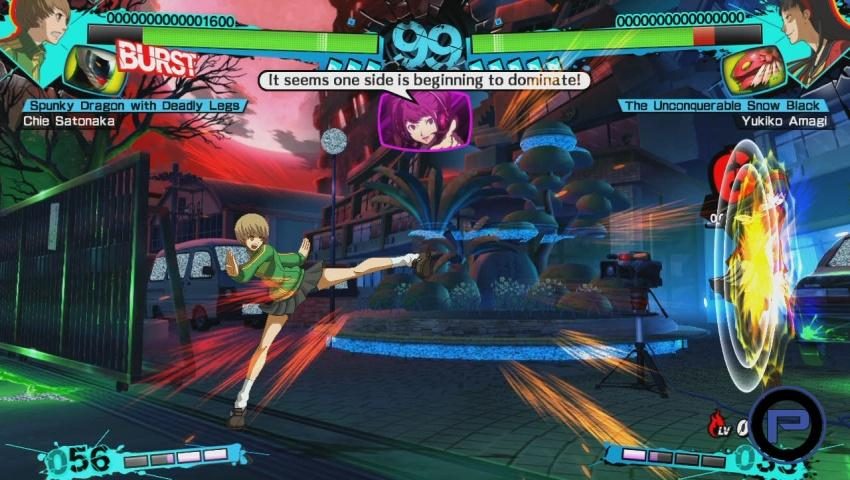
Each character has two basic strikes and two attacks that summon their Persona. Newcomer Yukari, a star in Persona 3 who was absent from the first Arena, uses kicks and shoots arrows but can summon her Persona, Isis, to disrupt airborne enemies Hitting an opponent’s Persona can actually break it briefly, creating new windows for attack while they’re on the defensive.


Picking up characters like Yukari or older fighters like Chie for the first time instantly feels great, their fast flashy moves bleeding one into the next with a few simple button presses. But it takes real practice to effectively capture the interplay between a character and their Persona. Typically in fighting games, you only have to worry about one body’s personal space, but maneuvering a Persona attack properly changes all of that.
On top of that are status effects straight of the RPG, like poison or charm which can respectively drain health or redirect rival attacks. These add an even deeper layer of strategy, and one you don’t typically encounter in fighting games. Not as forbidding as other Arc System Works releases like BlazBlue, but still a deep pool of learning.
Ultimax has broadened and refined those fighting game basics. There’s a fleet of new characters, including other Persona 3 heroes like the goofball-cum-baseball star Junpei and Persona 4 villain Adachi, creating more treats for series fans but also more variety for newcomers. Every character offers that feeling of speed and ease; they’re less easy to abuse with cheap moves like in the first Arena. It’s a concession that caters towards hardcore players interested in competition but doesn’t sacrifice the immediate tactility of the game, essential for making a fighting game fun and approachable.
If you enjoy fighting games but don’t know what a Persona is, look elsewhere.
The package in which that approachable fighting comes, however, is difficult to penetrate. In addition to a solid online mode with easy to set up lobbies, an arcade mode for quick solo fights, and a standard versus mode for when friends are around, Ultimax‘s most substantial feature is it’s story mode. Broken into two campaigns following the respective casts of Persona 4 and Persona 3 during one crazy night in the sleepy town of Inaba, Ultimax‘s focus on story is stronger than almost every other fighting game ever made. Mortal Kombat‘s always stuck intently to continuity, but how many of those games follow each individual character for hours at a time, right down to their inner monologues?
Told through barely animated dialogues over static backgrounds and predominantly through text, each lengthy chapter of the story mode follows one character as they try to solve the mystery of the demonic Midnight Hour, their mysterious tormentor, a new red-headed villain, and the P-1 fighting tournament that’s pitting friend against friend. There are 15 to 20 minute chunks of the game comprised almost entirely of a character reflecting on what’s happening before getting to a one-round fight. Sometimes chapters end with no fight at all.
Some players might think that sounds like pure drudgery. A visual novel like this isn’t particularly suited to television gaming, with reams of text and voiced dialogues better suited to handheld devices. If you love these characters, though, and are invested in what happens to them after playing the original RPGs, Ultimax is pretty awesome. As surprising, weird, and well written as those far-longer RPGs are, Ultimax is pure candy for the faithful.

What’s Yukari been up to since Persona 3? What’s happened to Labrys since Arena? Will Yu stay in Inaba? If those names mean nothing, then so does Ultimax, but if they’re the names of old friends, than this is game is a cool glass of water in the desert.
As uncomfortable as it may be to sit and read or listen to most of that story unfold, at least it’s easier to digest. Arena‘s 12-hour plus story, complete with alternate endings, was a slog because you had to play through each character’s campaign individually. Ultimax takes a smarter approach, with a branching single story mode that has you bouncing between characters with each chapter.
Plus, there’s an excellent story-free single player mode called Golden Arena that’s far better for playing solo and training up to fight other players. Broken into four difficulty categories, Golden Arena has you run through a gauntlet of 50, 100, 200, or even infinite fights. Picking a character for a Golden Arena run also lets you level them up, unlocking perks as you go and upping stats like strength and magic to help tackle increasingly powerful versions of the fighters. A level 1 Teddy might have trouble making it more than ten rounds, but a level 5 Teddy with a healing perk has a better chance.


Golden Arena is far more satisfying for fighting game obsessives just looking to pore over weird move sets and learning combos, or even anyone who just wants to enjoy the gorgeous art. Polygonal backgrounds in Ultimax may not be much to look at, but the characters themselves are beyond compare. Fluidly animated and lovely, backed by killer music as music to boot.
Even with all that quality art, tight fighting, an ample roster of characters, and strong solo and multiplayer fighting, Ultimax‘s appeal remains limited. If you enjoy fighting games but don’t know what a Persona is, look elsewhere. If you have a Rise tattoo on your arm and a Shoji Meguro playlist on your iPod, welcome back; the party’s even better this time.
This game was reviewed on a PlayStation 3 using a code provided by Atlus.
Highs
Spectacular character art.
Deep story and fan service for followers.
Approachable, unique, deep fighting.
Lows
Visual novel storytelling ill-suited to television.
Completely impenetrable for newcomers.
Available at Amazon


