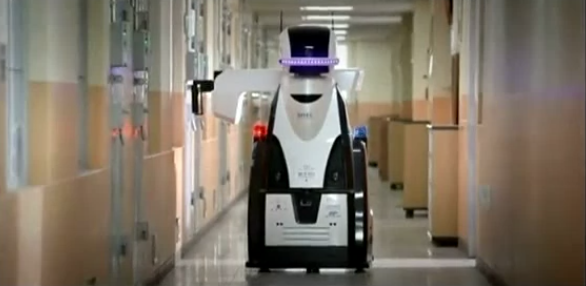
 A prison in Pohang, South Korea has begun its first field trial of the world’s first robotic prison guards – roving, autonomous patrols that vaguely resemble a cross between Johnny 5 and a Zamboni. Equipped with 3D depth cameras, a two-way wireless communication system, and software capable of recognizing certain human behavior patterns, the 5-foot-tall bots keep a cycloptic eye out for trouble while patrolling the corridors of the prison block. The “guard” is designed to conduct self-directed patrols, guided by navigation tags located along corridor ceilings, but is supervised by a human guard and may be controlled via iPad. The pattern recognition algorithms focus on behavior that signals trouble and can alert controllers. In emergency scenarios, such as an impending suicide attempt, assault, or arson, correctional officers may respond. If the situation is less dire, two-way cameras and microphones can allow control center guards to communicate directly with restive prisoners, heading off an escalation in hijinks. At the moment, the design of the robot itself does not incorporate any features that would involve physical interaction with prisoners, alleviating previous reservations of inmates, who seemed concerned with the possibility of being roughly handled by the machines.
The robot was developed by the Asian Forum for Corrections in concert with the Electronics and Telecommunications Research Institute and manufacturer SMEC and costs 1 billion Korean won, or about $879,000 per unit. Steep price tag notwithstanding, prison authorities are optimistic that, if effective, the robots will eventually result in a cutting of labor costs. With over 10.1 million people incarcerated worldwide, they see the implementation of robotic guards as the future of penal institution security. “The purpose of developing this kind of robot is to secure prisoners’ life and safety and decrease the workload of correctional officers in a poor working environment,” said AFC Chairman Lee Baik Chul in an interview with Reuters. For their part, the designers say that the next step would be to incorporate functionality capable of conducting body searches, though they admit that this is still a ways off – presumably to sighs of relief from prisoners.
The project, which was first publicized last November, was organized by South Korea’s Ministry of Knowledge Economy, which has been investing heavily in robotic development. In February, the MKE stated that the Korean robot market had grown by 75 percent over the previous two years, citing its present value at 1.78 trillion won or $1.56 billion. In 2010, following the escalation in tensions between itself and neighboring North Korea, South Korea deployed a number of armed sentry robots along the Demilitarized Zone at the 38th parallel, the border between the two countries. Robots have also been used in education as English-speaking teaching assistants, and private firms in the country hope to begin selling robots that aid in elder care before the end of the decade. The ministry said it will continue its efforts to boost robot demand both locally and abroad by investing 22.4 billion won this year.
Video credit: Reuters