  1. Home
  2. Phones
  3. Mobile
  4. Legacy Archives

Digital Trends may earn a commission when you buy through links on our site. Why trust us?

Nvidia’s latest chip has 192 cores and it’s own crop circle … but no LTE?

Add as a preferred source on Google

Nvidia has made a big deal over its new Tegra K1 mobile processor. For a start, it’s telling us the chip has 192 cores. While this may be factually correct, behind all the graphics cores, the K1 is still the familiar old four-core-one-companion-core chip we’re used to seeing from Nvidia. It doesn’t stop there either. We’re told it’s the first mobile processor to use a PC-style graphics chip and will come in 32-bit and 64-bit versions. Crop circle evidence (not really) also points to it being made with alien technology. Yep, Nvidia is very keen to let us know the Tegra K1 is really exciting. However, it’s what’s missing from the feature line up which will dictate how many smartphones end up using the K1; and it’s the same problem which plagued the Tegra 4: lack of 4G LTE.

Before we get too negative, let’s look at what does make the Tegra K1 standout. Nvidia has pushed it as the first mobile chip to blur the lines between mobile, desktop, and console gaming, saying that for the first time “Next generation PC gaming will be available on mobile platforms.” The K1 is equipped with the same Kepler architecture seen on its most successful PC graphics cards, supports DirectX 11 and Open GL 4.4, and is the first mobile processor to support Nvidia’s own CUDA platform. It’ll run Epic Games’ Unreal Engine 4, and Nvidia claims it has faster performance than the Xbox 360 and PlayStation 3.

Recommended Videos

During the first half of 2014, Nvidia will produce a 32-bit version of the Tegra K1, based on the ARM Cortex A15 with the same 4-Plus-1 companion core system used in previous Tegra chips. The quad-core processor will be capable of speeds up to 2.3GHz. In the second half of the year, a 64-bit dual-core Tegra K1 should arrive, with an increase in speed to 2.5GHz, all based on ARMv8 architecture.
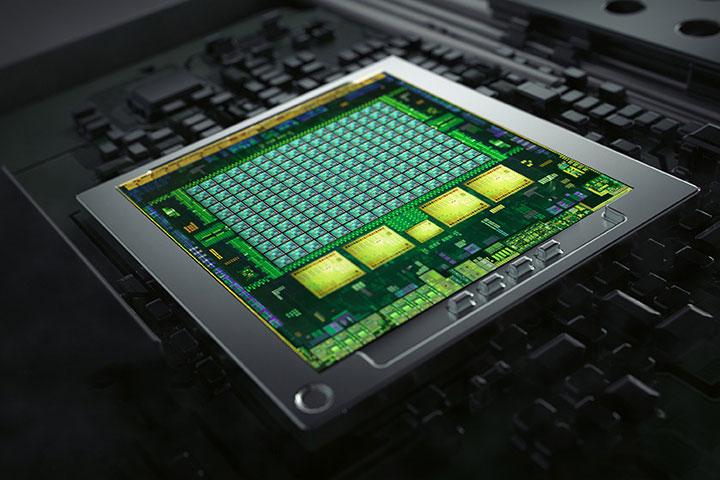
Nvidia 192-core processor
Image used with permission by copyright holder

So, mobile gamers can rejoice, as it bodes well for the future. Except, we’re not sure how many manufacturers will choose to adopt the Tegra K1. The perfectly capable Tegra 4 severely lost out to Qualcomm’s Snapdragon 800 during 2013, thanks to its lack of high speed data. We’re still waiting for the Tegra 4i to arrive, inside which will be Nvidia’s own Icera 4G LTE modem. Why hasn’t this been included in the K1’s spec?

In February 2013, Nvidia CEO Jen-Hsun Huang was quoted as saying “we’re not expecting to have a whole lot of phone design wins until we engage the market with LTE.” Strange then, it should decide to announce another high-end, non-LTE chip nearly twelve months on. Stranger still, Nvidia snapped up Icera back in 2011 (for a mere $370 million), with the intention of creating a 4G Tegra, “Super chip.” Nvidia claims it created the strange crop circles you see above because the K1 is so cool it’s “otherworldly.” We feel bad for the aliens without LTE. But maybe the real reason why Nvidia has chosen to promote the Tegra K1 using crop circle pictures is to get some help. It can’t figure out LTE, but maybe someone in the cosmos has. Perhaps a Qualcomm ship will pass by at LTE speeds soon.

Andy Boxall
Andy has written about mobile technology for almost a decade. From 2G to 5G and smartphone to smartwatch, Andy knows tech.
Samsung’s next tracker may look better while becoming harder to actually attach
Samsung may redesign the SmartTag right into an AirTag annoyance
Samsung Galaxy SmartTag 2 in Black and White variants

Samsung appears ready to redesign its Galaxy SmartTag again. This time, the makeover could come at the expense of one of the SmartTag 2’s most practical advantages. SamMobile's latest report has shared the supposed design of the upcoming Galaxy SmartTag 3.

The smart tracker can be seen with a compact squircle-shaped body that resembles Samsung's recent One UI icons and the shape used around newer Galaxy Watch displays. In comparison, the current SmartTag 2 looks a lot different, with a longer pill-shaped body dominated by a big integrated loop at one end. The leaked SmartTag 3 diagram does away with that loop entirely.

Read more
Tecno shows off a bezel-less concept phone that looks achingly breathtaking
Tecno's bezel-free phone could be revealed at IFA 2026 in September.
Tecno camon bezel free concept phone.

Say what you will about bezel-less phones, how bad they are for typing, and how they are a glorified ergonomics nightmare, but you can't deny their charm. For over a decade, smartphone makers have made numerous attempts to reduce or eliminate those black borders. The likes of Vivo went with a sloping screen, while others like the ill-fated Essential and Xiaomi just kept trimming the sides. Apple and Samsung followed in their footsteps, but neither of them has tried anything too audacious lately.

Tecno, it seems, wants to go bezel-less without any tricks. The brand just released a short teaser video showing its "next-gen bezelless concept phone." It's a concept phone, so keep that designation in mind. The brand hasn't said when this phone will be officially showcased, or launched, but IFA 2026 is our best bet. As for the device itself, it just looks stunning, and rumors also suggest that the bezel race will be white hot in 2027.

Read more
Shopping for back-to-school? I’d recommend these GaN chargers for saving space and packing more power
From a $9 spare to a $56 desk hub, these chargers cut down on cable clutter so that you can focus on your studies, not how cluttered your desk looks.
Best GaN chargers in 2026 for back to school shopping.

Between a phone, a laptop, a tablet, and perhaps a pair of wireless earbuds that require charging every day or every few days, most students are packing multiple chargers for move-in day. Those big, heavy bricks take up valuable backpack space that could otherwise be free for carrying more items. 

However, GaN chargers fix that problem in two ways. First, they deliver the same amount of power from a much smaller body, thanks to gallium nitride transistors. Furthermore, if you're willing to spend a little more upfront, you can get a high-capacity, multi-device charger capable of powering your entire digital ecosystem from a single wall outlet, something that could be very useful for a dorm room.

Read more