When it comes to figuring out a way to stream your favorite artists and albums, there’s no shortage of options from which to choose. Apple offers Apple Music. Amazon has Prime Music. And if those don’t suit your fancy, there’s Spotify, and Pandora, and Tidal. And those only scratch the surface. Collectively, subscription streaming services made $1.6 billion this year, and are poised to boost music retail sales for the second straight year. It’s no surprise, then, that Google, which launched the eponymous Google Play Music service in 2011, is in it for the long haul.
The Mountain View, California-based company conveyed as much on Monday with the launch of a redesigned Google Play Music for iOS and Android. It’s colorful, responsive, and a lot more intuitive than the outgoing version, but also imbued with predictive smarts: the ability to serve up songs, albums, and playlists appropriate for a context.
It does so by leveraging machine learning, a type of artificial intelligence that allows software like Google Play Music to learn without being explicitly programmed. The new app takes into account factors like location, time of day, and weather to suggest offerings from Google Play’s catalog of more than 30 million songs. Pregaming at your apartment on a Saturday evening? You’ll get upbeat, energetic playlist of top pop hits. Putting in hours on a Monday afternoon? You’ll see suggestions of a mellower variety — classical, or perhaps jazz.
Google Play Music isn’t the first of Google’s services to benefit from its AI smarts. Earlier this year, the company rolled out a Gmail feature that automatically filters spam mail and suggests replies. A few months after, the company debuted DeepDream, a neural network with the uncanny ability to detect faces and patterns in images. And in September, machine learning algorithms began powering the translation of Mandarin Chinese in Google Translate
Google Play Music’s AI plays a simpler, but no less impressive, role: learning your musical tastes by tapping your Google searches, YouTube viewing history, Google Maps usage, Gmail inbox, and Google Calendar appointments. Open the Google Play Music app while you’re at the gym and you’ll see your preferred hip-hop and heavy metal motivators. Head to the airport after and it’ll swap out those playlists for more soothing sounds.
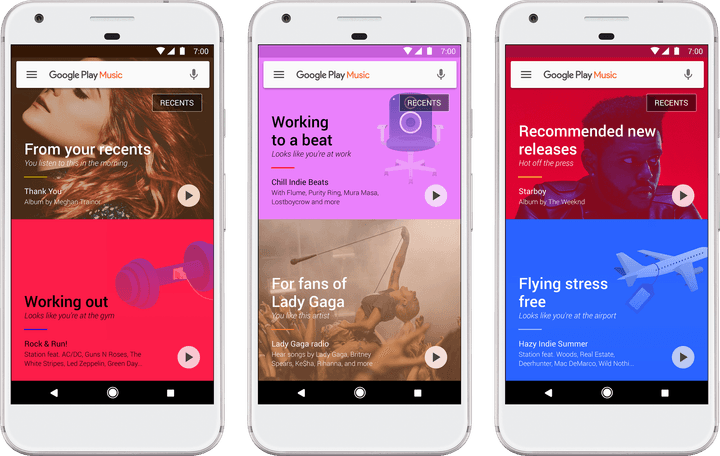
They’re sourced from Songza, a New York City-based music curation company that Google acquired in July 2014. Google Play Music’s long offered the startup’s collections through the app and on the web, but previously, they weren’t easy to find — they appeared somewhat infrequently during major holidays, certain days of the week, and in manual searches. Now, your behavior dictates which you’ll see.
The playlists populate the revamped app’s home screen in the form of scrollable cards, each accompanied by an explanation as to why the app made the respective selection. It’s the realization of what Elliot Breece, co-founder of Songza and a lead product manager on Google Play Music, called an artificially intelligent “personal DJ”: someone who “follows you around and knows exactly what you want to hear.”
The approach couldn’t be more different from Spotify, Google Play Music’s largest competitor by subscribers. The service’s Discover Weekly and Release Radar features generate a collection of tunes tailored to individual tastes, but ones that emphasize new music over personalization. They lack the treasure trove of insight to which Google’s privy — a differentiator that will serve the search giant well in an increasingly competitive field. This year, the number of paying Spotify grew to 40 million paying subscribers, up from 30 million in March. Apple Music, for its part, boasts 30 million subscribers.
AI-powered playlists aren’t the only new feature Google Play Music’s gained in recent years. In 2015, Google launched YouTube Red, a free benefit for subscribers that provides advertising-free access to streaming music videos on YouTube. And in December 2015, it began offering a family plan, which allows unlimited access for up to six family members.
But it remains to be seen if feature richness trumps exclusives. Apple, Tidal, Spotify, and others have increasingly partnered with artists, among them Frank Ocean and Rihanna, to nab exclusive albums and signals on their respective platforms. And those arrangements have worked wonders: in the 24 hours following Tidal’s release of Beyoncé’s Lemonade, more than a million new users joined the streaming service.