  1. Home
  2. Emerging Tech
  3. Computing
  4. News

Neural network can create high-res images based on a text description

Add as a preferred source on Google

As far as artificial intelligence goes, 2016 has been the year of deep learning. Brain-inspired neural networks have received massive amounts of investment in time, resources and funding — and, boy, has it ever paid off!

In a new piece of research — carried out by investigators at Rutgers University, the University of North Carolina at Charlotte, Lehigh University, and the Chinese University of Hong Kong — neural networks have been used to generate high quality images based on nothing more detailed than basic text descriptions.

Recommended Videos

“Generating realistic images from text descriptions has many applications,” researcher Han Zhang told Digital Trends. “Previous approaches have difficulty in generating high resolution images, and their synthesized images in many cases lack details and vivid object parts. Our StackGAN for the first time generates 256 x 256 images with photo-realistic details.”

A video of the work was shared online by YouTuber Károly Zsolnai-Fehér as part of his excellent series of Two Minute Papers educational videos.
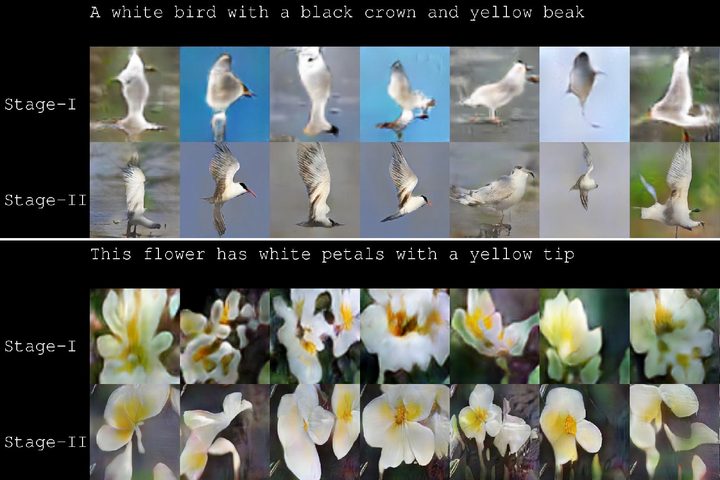
Image used with permission by copyright holder

“For many years, we have trained neural networks to perform tasks like face, traffic sign, or handwriting recognition,” Zsolnai-Fehér told us. “Generally, with millions of training examples, we show the neural network how to do something, and expect them to learn these concepts, and do well on their own afterwards. This piece of work is completely different: here, after learning the neural networks are able to create something completely new — such as synthesizing new, photorealistic images from a piece of text we have written. This opens up a world of possibilities, and I am super-excited to see where researchers take this concept in the future.”

While there have certainly been examples of computational creativity before — ranging from MIT’s Nightmare Machine to projects that can generate predictive video simply by looking at a still image — this is nonetheless an intriguing piece of work. It’s also fascinating because the two-stage method of drawing images looks, to our way of thinking, a whole lot like the way artists will sketch out a piece of work, and then do a second pass to add detail.

We may still be a way from replacing human illustrators with robots, but this is nonetheless an exciting leap forward.

Luke Dormehl
I'm a UK-based tech writer covering Cool Tech at Digital Trends. I've also written for Fast Company, Wired, the Guardian…
As AI voices get harder to spot, ElevenLabs adopts Google’s SynthID to help you sniff the fakes
Artificial Intelligence

There was a time when spotting AI-generated content was almost a game. Images came with extra fingers, chatbots wrote like overly enthusiastic interns, and synthetic voices had an unmistakable robotic edge. Those days are disappearing fast.

Today, AI voices can laugh, whisper, pause naturally, and even sound emotional enough to fool many listeners. That’s exciting for creators, but it’s also creating a growing trust problem. If you can’t tell whether a clip is real or AI-generated, how do you know what to believe?

Read more
OpenAI just made GPT-5.5 Instant more fun to talk to, and users may actually notice
The company says its most-used ChatGPT model is getting better at advice, decision-making, and everyday conversations.
Man using ChatGPT on a laptop

For years, AI companies have competed by talking about benchmarks, reasoning scores, and coding performance. OpenAI's latest ChatGPT update takes a different approach. Instead of focusing on raw intelligence, the company is making its most popular AI model more enjoyable to talk to.

OpenAI says GPT-5.5 Instant now better understands what users want

Read more
Claude can now join your Slack channels and work alongside your team
Laptop running Claude Fable

For years, AI assistants have been siloed. You open ChatGPT, Claude, Gemini, or Copilot, type a prompt, get an answer, and move on. Anthropic's new Claude Tag feature takes a different approach. Instead of making employees jump into a separate AI chat every time they need help, it brings Claude directly to where many teams already spend their day: Slack.

Add Claude to a channel, grant it access to needed tools, and tag @Claude for help — whether analyzing data, writing reports, reviewing code, or investigating incidents. But Claude Tag isn't just another chatbot integration. Its key differentiator is that Anthropic positions it as a digital coworker for your team, enabling seamless collaboration where multiple users can jointly interact with the same AI within their work environment.

Read more