Facebook is completely overhauling its server hardware in tandem with an expected increase in visual content on its suite of platforms. The company’s director of technology strategy, Vijay Rao, announced the upgrades at the Open Compute Project Summit on Wednesday.
Facebook claims that the 1.86 billion users on its flagship social network currently watch 100 million hours of video per day. Not to be left behind, its photo-sharing app Instagram sees more than 95 million photos and videos uploaded daily. Messenger is also piling the load on Facebook’s data centers via its video and voice chat services, which are now used by 400 million people every month.
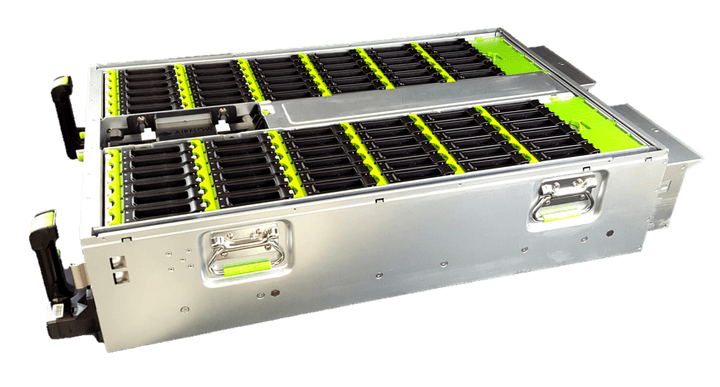
To help handle this influx of visual content and real-time interactions, Facebook is making the move to a powerful storage server known as Bryce Canyon. Internally, the hardware contains 72 hard drive disks in four open rack units, which are kept cool using a combination of large fans and with air pulled through from beneath its chassis. Compared to its predecessor, the new server has 20 percent higher hard drive disk density and four times more memory.
Aside from video, another major focus point for the tech giant is artificial intelligence. Facebook CEO Mark Zuckerberg recently claimed that relying on machine learning systems to moderate the massive social platform has become a necessity. But, even beyond its News Feed, the company is employing neural networks to carry out tasks such as image-recognition. The complex tech requires training, usually through the consumption of vast amounts of visual data. That’s where Facebook’s servers come in.
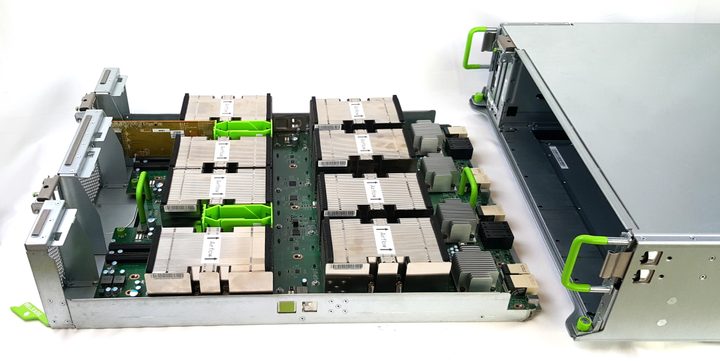
The company revealed it is now adopting hardware that can train machine learning models that are 30 percent larger than the type its predecessor dealt with. Known as Big Basin, the GPU server brings with it a memory increase of 12 to 16GB. Inside of it are housed eight high-performance NVIDIA Tesla P100 GPU accelerators.
Facebook is already touting the success rate of the new server in relation to training AI. “In tests with popular image classification models like Resnet-50, we were able to reach almost 100 percent improvement in throughput compared with Big Sur, allowing us to experiment faster and work with more complex models than before,” said Arlene Murillo, technical program manager, Facebook.
Along with Bryce Canyon and Big Basin, Facebook is also adopting two new compute servers. Yosemite v2 packs a notable power design that allows it to continue operating even when its sled is pulled out of the chassis in order for components to be serviced. Tioga Pass is a compute server with dual-socket motherboards that provides more bandwidth to flash storage.
Extensive technical details about each piece of new equipment mentioned here can be found on the Facebook Code website.
As is increasingly becoming the norm for the company, its new hardware designs are all open-sourced and will be contributed to the Open Compute Project — a coalition of tech giants that share computing infrastructure to accelerate innovation and bring the benefits to the wider ecosystem.