Engineers have been tinkering with exoskeletons to amplify our physical abilities for years. While there are certainly boundless military applications for this technology, there are also many commercial uses. Lowe’s, for example, just unveiled a prototype exoskeleton it hopes to aid employees on the job.
As part of the program, Lowe’s plans to equip its employees with a basic non-motorized exoskeleton to maximize productivity and efficiency. The project is a joint collaboration between Lowe’s research facility, the Innovation Labs, and Virginia Tech’s Assistive Robotics Laboratory.
The suit itself fits like a rock-climbing harnesses, with a series of flexible carbon-fiber trusses along the backside. These rods sit along the spine and behind the thighs. Bending as the person squats, the rods transfer the energy of basic movements more evenly. This stored kinetic energy essentially springs back as the individual stands upright. Lowe’s employees spend much of their day moving heavy items and the company hopes these exoskeletons will reduce the overall strain on muscles and joints.
“As they bend and stand, carbon fiber in the suit’s legs and back act like a taut bow ready to launch an arrow, helping them spring back up with greater ease,” Lowe’s explained in a press release.
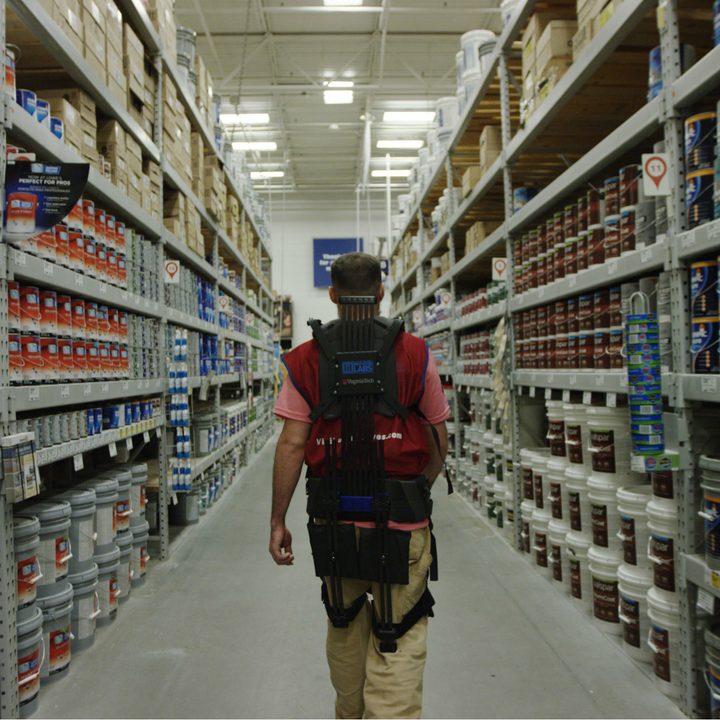
Lowe’s has been testing the exoskeletons on four employees at store in Christiansburg, Virginia for more than a month. After these tests, the company will decide whether or not to expand this initiative to other stores. However, Lowe’s isn’t the only company looking to use exoskeletons to aid in workforce productivity.
General Motors recently partnered with NASA to create a motorized glove that makes it easier to grip and lift heavy objects. Panasonic and Hyundai are also working on their own exoskeletons designs. As for now, the Lowe’s exoskeleton prototype is rather elementary, and designed to test the baseline functionality of the suit — but future iterations will likely be more sophisticated.
“We didn’t want to over-engineer it, make it too fancy, or give it too many bells and whistles,” explained Nel. “We’re putting it in the rough and rumble world of a real store and will iterate on top of that… we’ll add a jetpack in 2018.”
The exoskeleton is still in the early stages of development at this point, but keep your fingers crossed and you might find one at your local hardware store sometime next year.