Although the HTC Vive, Oculus Rift, and now the Samsung Gear VR ship with motion controllers, they do not fully emulate the movements of the hands and fingers. Instead, our physical hands and digits are wrapped around hardware and pressing buttons while simultaneously rendered as stationary models in the virtual world. Bebop Sensors wants to change that by selling special gloves to virtual reality headset makers that accurately track your digits.
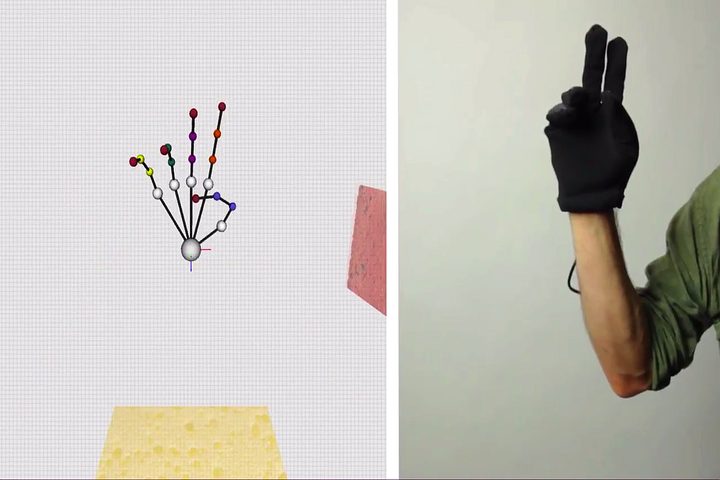
According to Bebop Sensors, it designed a pair of gloves, dubbed as the Marcel Modular Data Gloves, capable of real-time control of games and environments in virtual reality and augmented reality applications. These gloves will be sold in three versions: With five sensors, 10 sensors, and 14 sensors. Obviously, the more sensors Bebop packs into these gloves, the more detailed the user’s hand and finger movements will be pronounced in the virtual environment.
Each sensor packed into these gloves support six or nine degrees of freedom via inertial measurement units. These are small electronic devices that will track and report the angular rate and force generated by the hands and fingers. They are backed by a sub-frame latency of 120Hz, meaning the sensors will provide physical input information during and sometimes in-between each rendered frame.
In addition to fast, accurate tracking of the user’s hands and fingers, the gloves also provide haptic feedback. For instance, if the user is turning a virtual wheel, the gloves will provide a slight sensation so that the hands and fingers can feel “movement.” Gamepads, smartphones, and even PC gaming mice provide this type of physical feedback. Why not gloves for VR?
“Haptics built into the fingertips provide a four-octave range for complex stimuli that can convey surface quality and object contact,” Bebop Sensors said on Thursday. “These non-resonant haptic actuators help close the loop of interaction between humans and virtual devices with contact and continuous surface sounds that drive the actuators, communicating a more realistic touch experience.”
The sensors within the gloves are sensitive enough to track knuckle movement and “abduction motion” in the wearer’s hands. For instance, if the user raises a hand, waves, and moves/bends all five fingers at the same time, the same movements will be accurately rendered in the virtual/augmented environment. A haptic audio creation kit is available for headset makers too for generating sounds when fingers touch a virtual surface, such as playing a piano or scraping fingers across a rough surface.
As the name states, these gloves are modular, meaning headset makers can customize the gloves to offer unique capabilities for their VR/AR systems. The company did not say how much the gloves will cost these headset makers, but simply stated that they are an “affordable and robust solution” for virtual reality and augmented reality applications. They target “gaming environments” as well.