1. Home
  2. Emerging Tech
  3. Computing
  4. Smart Home
  5. News

Emotion-reading doll is a somewhat creepy example of what’s possible with AI

Add as a preferred source on Google

OK, let’s get this out the way up top: A robot doll that can sense your child’s emotions and change how it behaves accordingly sounds like the kind of high-concept horror movie a Hollywood screenwriter would pitch after binge-watching Westworld and a Chucky marathon.

In reality, it describes research being carried out by investigators at the University of Castilla-La Mancha in Ciudad Real, Spain. What they’ve built as a proof of concept is an artificially intelligent doll that can recognize eight different emotions and runs on an AI chip costing just 115 euros (around $130). Emotion recognition is carried out through facial-recognition technology, via a camera hidden in the doll’s mouth.

Recommended Videos

As project leader Oscar Deniz explains, the doll is something of a red herring.

“It’s actually an application of an open vision platform we have developed in our Horizon 2020 project, ‘Eyes of Things,’” Deniz, whose work focuses on computer vision and machine learning, told Digital Trends. “The vision platform has been designed for small size, cost, and maximum efficiency. Thus, the doll contains the board along with camera and battery. The board processes images to recognize the girl’s facial expression, allowing the doll to react accordingly. All of this is done inside the doll, meaning that no images are sent to the internet, which has been the case in other toys. This not only allows for better response time; it guarantees privacy.”
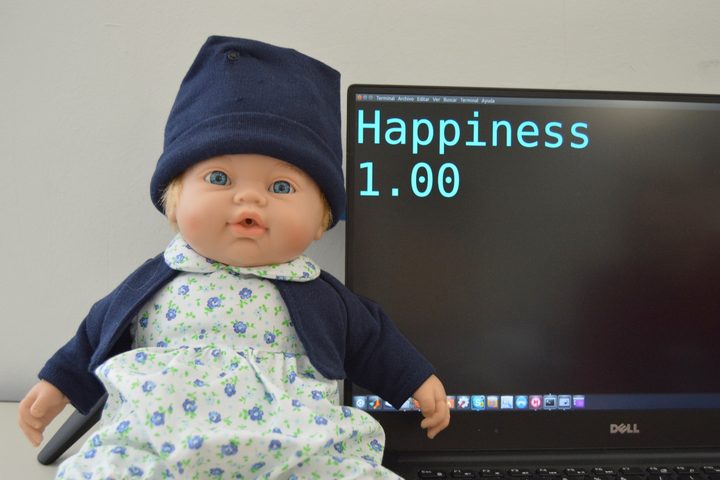
Image used with permission by copyright holder

The “Eyes of Things” project started in January 2015 and runs through December of this year. Its objective is to design a new embedded vision platform, optimized for size, cost, performanc,e and power consumption. While there are plenty of fascinating facial-recognition technologies around, the fact that this tool does everything locally, rather than in the cloud, makes it particularly intriguing.

Besides dolls and other intelligent toys, the project aims to develop similar uses of vision-based AI for drones, robots, headsets, and video surveillance. Another use case the team has developed is something called the “museum audio guide,” which comprises a headset containing the AI board, a battery, and camera. The idea is that, when a museum visitors puts the headset on, the headset “sees” what they are looking at and provides contextual information.

“Currently, we have a number of prototypes available, and we are working on some demonstrators, but the idea is to generate [excitement] so that the platform can be commercialized,” Deniz said.

A paper describing the work was recently published in the journal Sensors.

Luke Dormehl
I'm a UK-based tech writer covering Cool Tech at Digital Trends. I've also written for Fast Company, Wired, the Guardian…
The Apple Car may be dead, but it became the foundation of Apple Intelligence
A decade of work on a canceled car project reportedly laid the groundwork for Apple Intelligence.
Apple Intelligence in Apple Car

The Apple Car may have never left the garage, but it apparently gave birth to Apple's AI ambitions. According to Bloomberg's Mark Gurman, Apple's canceled autonomous vehicle project, one that consumed more than a decade of work and over $10 billion before being scrapped in 2024, ended up laying the technological foundation for Apple Intelligence. In a rather ironic twist, one of Apple's most expensive failures may also become one of its most important long-term investments.

The Apple Car forced Apple to think like an AI company

Read more
Researchers hid a prompt injection inside a PNG, and AI fell for it
Hacker

AI coding assistants like Claude are becoming every developer's favorite coworker. They can review code, explain confusing functions, and even write entire features with a single prompt. But new research suggests that this growing trust could also become their biggest weakness.

A team of security researchers (professor Sudipta Chattopadhyay and researcher Murali Ediga) has demonstrated an unusual attack that doesn't target the AI model directly. Instead, it targets what the AI doesn't pay enough attention to during code reviews. Rather than hiding malicious instructions in lines of code, the researchers tucked them inside an image file. Since many AI review tools treat images as decorative assets rather than as something worth inspecting, the pull request can appear perfectly harmless and sail through the review.

Read more
AI has already fallen into the wrong hands and they’re using it to make bombs
Logo, Text

Artificial intelligence has quickly become the go-to tool for everything from writing emails and summarizing meetings to helping students study or developers debug code. But the same technology that saves people time can also be misused, and a new report suggests that terrorist organizations are finding ways to do exactly that.

According to a research paper shared with The New York Times ahead of its publication, researchers found evidence that members of Boko Haram have been using popular AI chatbots to support both day-to-day activities and combat-related tasks. Interviews with 27 former members conducted in Nigeria over the past two years suggest that tools such as ChatGPT, Gemini, Claude, Grok, Meta AI, and DeepSeek were used to gather technical information, troubleshoot weapons, and even assist with planning attacks.

Read more