
If Elon Musk needs a helping hand making his ambitious underground Hyperloop tunnel network a reality, he may want to seek the support of the folks behind a multi-year European robotics project involving a tunneling robot.
Called BADGER (that is apparently short for roBot for Autonomous unDerGround trenchless opERations, mapping, and navigation), the project aims to built a large, worm-inspired, autonomous underground tunneling robot, which uses ultrasound and a large drilling head to break apart whatever material is put in front of it. Picture a robot version of the worm from the movie Tremors, and you won’t be far off.
“Let’s imagine that we want to connect two buildings standing on opposite sides of a main street in a modern city with a communication cable,” Professor Carlos Balaguer, a member of the RoboticsLab at Charles III University of Madrid, told Digital Trends. “In this case, making a trench would be the most common solution applied, [but this] would lead to traffic congestion, pedestrian inconvenience, and environmental pollution. The BADGER robot, however, will avoid all these problems through trenchless technology that will make a small hole in the ground, where the cable will be placed. Using its onboard sensors and an intelligent control algorithm, the robot will autonomously navigate from the basement of one building to the other, avoiding collisions with gas and water pipes, metro tunnels [and] big rocks.”
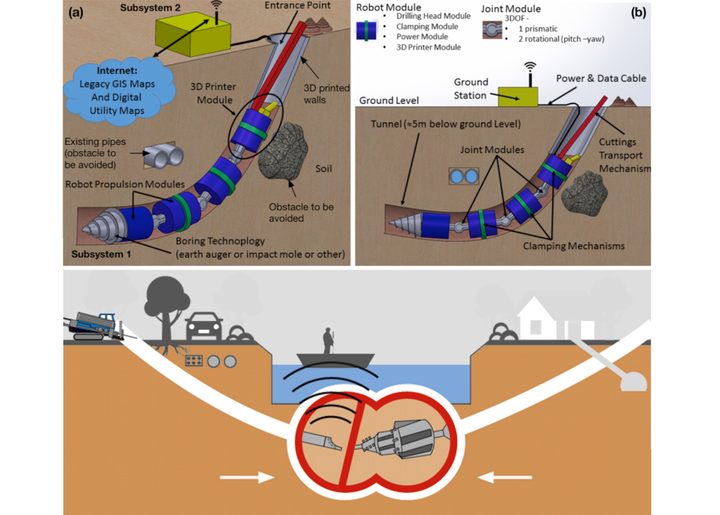
BADGER packs in a ton of smart tech to make it the ultimate drilling machine. It is divided into segments for flexibility and, when necessary, each of these segments is able to clamp against the wall of the tunnel it is drilling; much as a worm moves along by contracting and relaxing its body to grip. It will also feature a 3D printer that deposits layers of resin as it moves, thereby turning tunnels into pipes, along with an appendage for pumping dislodged soil up to the surface.
In addition to carrying out urban underground drilling, the hope is that BADGER will be used for tasks like ground analysis, underground rescue operations, and even — potentially — planetary exploration.
We still have a bit of a wait, though. BADGER is a three-year project, spanning seven partners in five countries, which only got started this January. According to current schedules, it will be completed in December 2019. “We foresee that the first prototype, which will be assembled at Universidad Carlos III de Madrid, will be ready during 2018, while the field tests will start in the first quarter of 2019 in Germany,” Balaguer said. “It is likely that the commercial version of the system will be available in 2020.”
For now, we will just have to get our robot snake fix from other robots like this one.


