  1. Home
  2. Emerging Tech
  3. Computing
  4. News

Coder’s algorithmic alphabet is nothing more than gibberish, but it looks real

Add as a preferred source on Google

What do you get when you cross generative art, linguistics, coding, and an attempt to troll future historians? Probably something a lot like a new project created by a 26-year-old U.K.-based coder and artist who goes by the name Atticus Bones.

Using JavaScript, he recently came up with a way to generate a strange, otherworldly looking alphabet that appears believably handwritten. It’s quite literally nonsense, but it’s intriguing nonsense that appeals to the same nerdy part of our character that would happily spend hours trying to learn a language like Dothraki or Klingon.

Recommended Videos

“I used JavaScript to randomly draw 50 percent of the segments in a predefined layout,” Bones told Digital Trends, likening it to the numbers on a digital clock display. “The segments are then merged into words, which are smoothed to add variation and create ligatures between the letters to resemble handwriting. I then optimized the order and path direction of the lines for use with a pen plotter, and also animated the writing effect using CSS.”
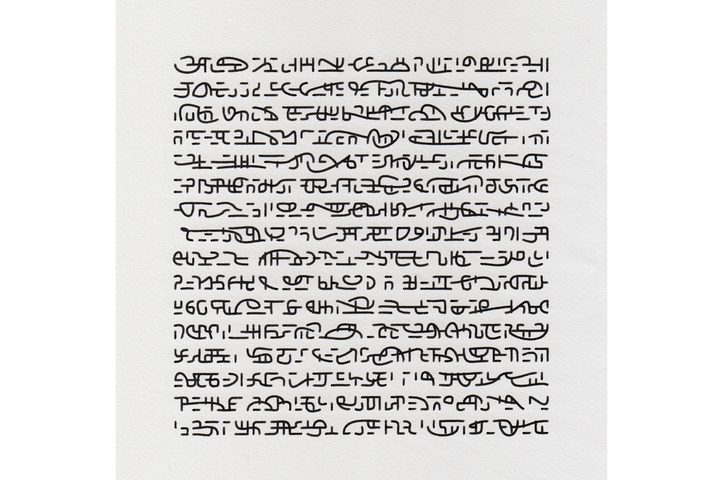
Image used with permission by copyright holder

Bones explained that he has done projects to randomly generate symbols before, which ended up looking “very clean and modular, like bold lettering on the hull of an alien spaceship.” This was his first attempt at creating something looser and more organic. In essence, it’s a false script that’s complete gibberish, but believable as a writing system. It’s pretty neat — particularly when you watch it being physically drawn out on paper using the aforementioned pen plotter.

“Random numbers and asemic writing are two things I’m super-interested in, and this project is a marriage of both of my interests,” he said. “It’s a language created by chaos. Generative art is a way of visualizing probability and variation. I like to explore the combinations that can be made from modular elements and see the possibilities.”

As to what’s next, Bone said that he’s “considering printing an entire book of nonsense like this, just to fuck with some poor translator in the future.”

So a Voynich manuscript for the 4chan generation? We can get on board with that! If normies get annoyed by being antagonized by people living in their own time period, we can only imagine the levels of outrage when some future linguistic expert discovers they’ve been trolled by a person who lived hundreds of years ago. “Teh Lulz,” indeed.

Luke Dormehl
I'm a UK-based tech writer covering Cool Tech at Digital Trends. I've also written for Fast Company, Wired, the Guardian…
This tiny gadget called Moodi could save your thumb during long reading sessions
This tiny remote thinks your finger deserves a vacation
DuRoBo Moodi

Digital reading has become more comfortable thanks to larger displays and e-paper screens, but one small annoyance remains: constantly reaching over to tap or swipe every page. DuRoBo believes it has a solution. The company has unveiled Moodi, its first Bluetooth page-turning remote, designed to make reading, browsing, and media control more comfortable across e-readers, tablets, and smartphones.

Unlike conventional page-turners that focus solely on e-books, Moodi doubles as a compact Bluetooth remote for scrolling through articles, controlling multimedia playback, and navigating long-form content. The device looks towards ergonomic accessories that aim to reduce repetitive hand movements during extended screen time.

Read more
Your next phone could get a smaller camera with sharper photos
Camera sensors just got thinner. Your excuses for blurry photos didn't.
Representative Image

Researchers at Nagoya University have developed a new type of transparent optical sensor that could significantly reduce the size of camera sensors while improving image quality. Published in the journal ACS Nano, the study demonstrates how gallium-doped zinc oxide (GZO) nanosheets can detect red, green, and blue (RGB) light within a single pixel, potentially replacing the decades-old Bayer filter design used in nearly every digital camera today.

If commercialized, the technology could enable thinner smartphone cameras, higher-resolution medical imaging devices, and more compact sensors for automotive and aerospace applications, all while simplifying manufacturing.

Read more
This new chip stacking technique could be the key to unlocking faster AI performance
Researchers solved the fragile chip stacking problem holding AI memory back, and the results are significant.
ai-chip-image

Every time you use ChatGPT or generate an image with AI, there is a memory chip working at extreme speed behind the scenes. However, that chip has a memory bottleneck problem, and a Korean research team may have just solved it.

Researchers at POSTECH (Pohang University of Science and Technology) developed a new way to stack more than 10 ultrathin semiconductor chips on top of each other, achieving a memory density roughly four times higher than the best commercial chips available today (via TechXplore).

Read more