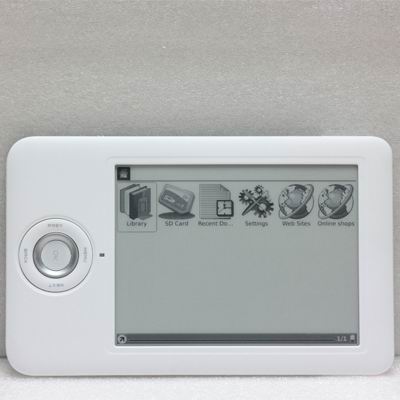
Onyx International made a bit of a splash earlier this year at CeBIT with its Boox 60 ereader, featuring a 6-inch e-Ink display that supports onscreen drawing and writing, an integrated WebKit Web browser, integrated Wi-Fi connectivity, and support for a wide variety of file formats, including PDF (with reflwo and image support), ePub, PDB, HTML, Mobipocket, and more. Of course, one problem with the Chinese-made device was that it wasn’t available in the United States—until now. Dulin’s Books now has the device on sale—although the $349 price tag may steer prospective customers towards the less-expensive Kindle and Nook readers.
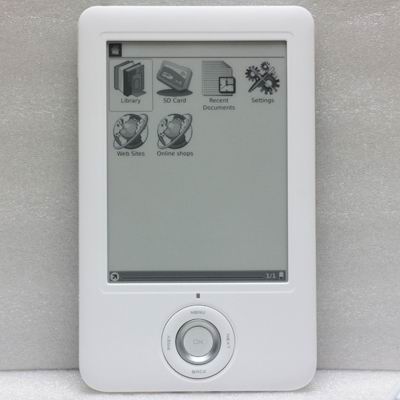 The Onyx Boox 60 features a 6-inch 600 by 800-pixel e-ink display, a Wacom digitizer for writing and drawing right on the screen with a stylus, and the device supports a wide variety of text and image formats: it’ll even handle images in PDFs and reflow their text—and it’s even play MP3s. The device has an integrated WebKit browser and Wi-Fi connectivity so users can surf the Internet from the device. Users can sideload data via USB, and the device features a 532 MHz processor, 512 MB of memory, and expandable storage via SD and SDHC cards.
Compared to other e-readers in the U.S. market, the Boox 60 has two major drawbacks: one is no 3G connectivity for downloading books or surfing the Web whilst away from Wi-Fi, and the other is the $349 price tag, which makes it more expensive that the Amazon Kindle, Sony Reader, or Barnes & Noble Nook, all of which offer more capabilities for lower prices. But folks looking for a simple Wi-Fi reader with a built-in Web browser might keep an eye on the Boox 60 and see if its price changes to put it more in line with similar offerings.