  1. Home
  2. Emerging Tech
  3. Computing
  4. Health & Fitness
  5. News

Frighteningly accurate ‘mind reading’ AI reads brain scans to guess what you’re thinking

Add as a preferred source on Google

From medical applications like helping dermatologists diagnose skin cancer to teaching robots to get a better grip on the world around them, deep learning neural networks can carry out some pretty impressive tasks. Could mind reading be among them?

The folks at Carnegie Mellon University certainly think so — and they’ve got the research to back up their theories. What CMU scientists have been working on is a system that can apparently read complex thoughts based on brain scans, possibly even interpreting complete sentences.

Recommended Videos

This involved gathering data from a functional magnetic resonance imaging (fMRI) machine, and then using AI machine learning algorithms to pinpoint — and sometimes reverse-engineer — the building blocks the brain uses to construct complex thoughts.
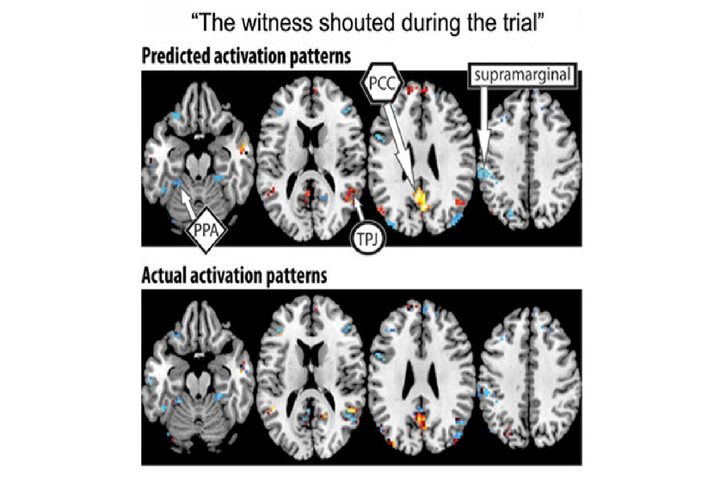
Image used with permission by copyright holder

“One of the big advances of the human brain was the ability to combine individual concepts into complex thoughts, to think not just of ‘bananas,’ but ‘I like to eat bananas in evening with my friends,'” said psychology professor Marcel Just, the lead author of the study, in a press release. “We have finally developed a way to see thoughts of that complexity in the fMRI signal. The discovery of this correspondence between thoughts and brain activation patterns tells us what the thoughts are built of.”

In the CMU study, the team was able to demonstrate different brain activations being triggered according to 240 complex events, ranging from individuals and settings to types of social interaction or physical actions. Using the smart algorithm, the team could discern what was being thought about at any given time — and even the order of a particular sentence. After training the algorithm on 239 of the 240 sentences and their corresponding brain scans, the researchers were able to predict the final sentence based only on the brain data. It was able to do this with an impressive 87 percent accuracy, as well as doing the opposite: being given sentence information and then outputting an accurate image of how the brain would be activated during that sentence.

We’re guessing this doesn’t bode well for our eventual face-off with Skynet!

A paper describing the work, titled “Predicting the Brain Activation Pattern Associated With the Propositional Content of a Sentence,” is published in the new issue of the journal Human Brain Mapping.

Luke Dormehl
I'm a UK-based tech writer covering Cool Tech at Digital Trends. I've also written for Fast Company, Wired, the Guardian…
Anti-surveillance clothing is getting cheaper, but don’t expect an invisibility cloak
Affordable shirts now claim to confuse facial recognition, although their protection depends heavily on the camera and software watching you
Chart, Plot, Adult

Anti-surveillance clothing is starting to look less like an art-school experiment and more like something you could actually wear outside. Shirts designed to confuse facial recognition systems now cost about as much as ordinary streetwear, although buying one won’t make you disappear.

The Guardian reports that designers are using face-like prints, unusual cuts and infrared lights to interfere with computer vision. These techniques target specific weaknesses, so their success depends on what happens to be watching you.

Read more
This spinning drone hides in plain sight using a visual illusion
This drone doesn't turn invisible. It tricks your brain into thinking it has.
Phantom Twist

For decades, engineers have chased the dream of an invisible drone. The usual approaches have involved transparent materials, camouflage coatings, or complex optical systems that bend light around an object. Researchers at Northwestern University decided to take a completely different route. Instead of hiding the drone itself, they chose to fool the human eye.

The result is Phantom Twist, an experimental drone that spins so rapidly it almost disappears into the background. It's not technically invisible, but to anyone watching, it looks more like a faint blur than a flying machine.

Read more
This smart knitted fabric can flip switches, count your steps, and even change shape
Grandma's knitting just entered its Iron Man era
Representative Image

For most of us, knitting brings to mind sweaters, scarves, and perhaps an ambitious grandmother determined to make winter more fashionable. Researchers at Harvard University, however, have a far more futuristic vision. They've transformed ordinary knitted fabric into a programmable material capable of changing shape, acting as an electrical switch, sensing movement, and potentially forming the foundation of tomorrow's wearable technology.

The research, published in Advanced Functional Materials by scientists at the Harvard John A. Paulson School of Engineering and Applied Sciences (SEAS), demonstrates how machine-knitted textiles can "snap" between multiple stable shapes without relying on motors or rigid mechanical parts.

Read more