1. Home
  2. Emerging Tech
  3. News

First, lab-grown reptile skin — next, mutant ninja turtles?

Add as a preferred source on Google

Scientists have engineered reptile skin in the lab, the first time such a feat has been achieved for a non-mammal species. From the reconstructed tissue, which belongs to the endangered green turtle, the scientists grew a virus with hopes to better understand and fight the disease.

The ChHV5 virus is associated with tumors and damages the immune system in green turtles.

Recommended Videos

“It is the most important infectious disease affecting these turtles globally and we have good evidence that, when the severity of the tumors reach a certain stage of severity, animals become immunosuppressed, waste away, and die,” Theirry Work, a scientist at the U.S. Geological Survey and the lead author of the study, told Digital Trends.

Lab-grown reptile skin
Thierry Work, USGS
Thierry Work, USGS

In order to fight the disease, researchers typically decide to develop it in the lab, where they can study and manipulate it more easily. “Doing so allows you to better understand how the virus interacts with host cells and identify weak points in virus replication that could lead to intervention,” Work said.

Work and his team had previously tried and failed to grow the virus using a number of conventional methods. After noticing that the virus seemed to grow only in skin cells, he said, “we opted to have a go at trying to re-create the 3D structure of turtle skin in the lab to see if that would allow the virus to replicate and — lo — it worked.”
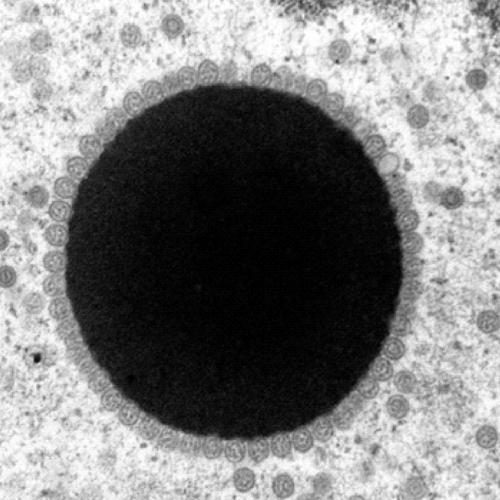
The virus’ sun-shaped replication center. Thierry Work, USGS. Public domain

To reconstruct the skin’s complex 3D structure, the researchers used both tumor cells and normal skin cells. While watching the virus develop, they saw it replicate in never-before-seen detail, including strange sun-shaped centers.

Although ultimately successful, the research was not without obstacles. For one thing, turtle skin is usually coated in layers of algae, bacteria, and barnacles that make cultured growth — which needs to be sterile — difficult. “We had to figure out ways to biopsy a turtle and coax skin cells to grow in a petri dish in a sterile system without bacterial contamination,” Work said. “We then had to figure out ways to grow the different cell types that comprise skin.”

With what they have learned in the lab, the scientists are now developing a blood test to detect the virus is present in turtles before they develop tumors.

Dyllan Furness
Former Contributor
Dyllan Furness is a freelance writer from Florida. He covers strange science and emerging tech for Digital Trends, focusing…
Amazon is full of copycats and shady brands. This Chrome extension lets you avoid them.
Advertisement, Poster, Text

Shopping on Amazon used to be simple. You searched for a product, compared a few familiar brands, and checked out. These days, it often feels like you're scrolling through an endless parade of names that look like someone leaned on a keyboard before hitting publish. That's exactly the problem Knockoff is trying to solve.

Created by developer Josh Pigford, the Chrome extension doesn't promise to expose counterfeit products or magically tell you what's good. Instead, it tackles something arguably more annoying: the flood of unfamiliar, mass-produced brands that dominate Amazon search results.

Read more
AI agent reportedly carried out an entire ransomware attack on its own
AI didn't just write malware. It apparently clocked in for work.
Cybersecurity

Cybersecurity researchers say they have documented what could be the first ransomware attack carried out almost entirely by an autonomous AI agent, marking a significant shift in how cyberattacks could be conducted in the future. According to cloud security firm Sysdig, they have uncovered a ransomware operation dubbed JadePuffer that appears to have relied on a large language model (LLM) agent to perform nearly every stage of the attack without continuous human intervention.

If confirmed, the incident suggests AI is moving beyond writing malicious code and into actively planning, adapting, and executing cyberattacks in real time.

Read more
The Washington Post predicted how tech will advance 50 years ago and the success rate is humbling
The Washington Post predicted 2026 tech in 1976. It got a lot right.
Representative Image

Fifty years ago, when floppy disks were cutting-edge and the personal computer revolution had barely begun, The Washington Post attempted a remarkably ambitious exercise: predict what life in 2026 would look like. Some of those predictions now read like science fiction. Others feel surprisingly ordinary because they have become part of everyday life.

In a retrospective published for America's 250th anniversary, the newspaper revisited science editor Thomas O'Toole's 1976 article Inventing the Future, comparing its forecasts with today's technological reality. The results reveal that while predicting exact timelines is nearly impossible, identifying long-term scientific trends can be remarkably accurate.

Read more