Ever wanted to act like an aging rock star and wear your sunglasses wherever you go, but feared that you didn’t have a good enough reason to do so? The folks at Germany’s Karlsruhe Institute of Technology are here to help! What they’ve developed are a pair of so-called “solar glasses,” which generate electricity by way of solar cells that also double as the glasses’ lenses. This electricity can be used to power smaller devices like pedometers or hearing aids — or could possibly even give your smartphone or smartwatch some added juice as and when required.
“The solar glasses demonstrate integration of organic solar cells in smart devices,” researcher Daniel Bahro, a PhD student specializing in the development and optimization of organic tandem-solar cells, told Digital Trends. “This emerging photovoltaic technology offer some unique properties like transparency, tunability in color and shape, and its low weight makes it perfectly adaptable to any application design. The energy yield is used to drive an electronic circuit including sensors, a microprocessor and two displays attached to the temples. This very basic configuration of a smart device — even under indoor lighting conditions — continuously records the ambient temperature and the current output of the solar cells, without any additional power source like a battery.”
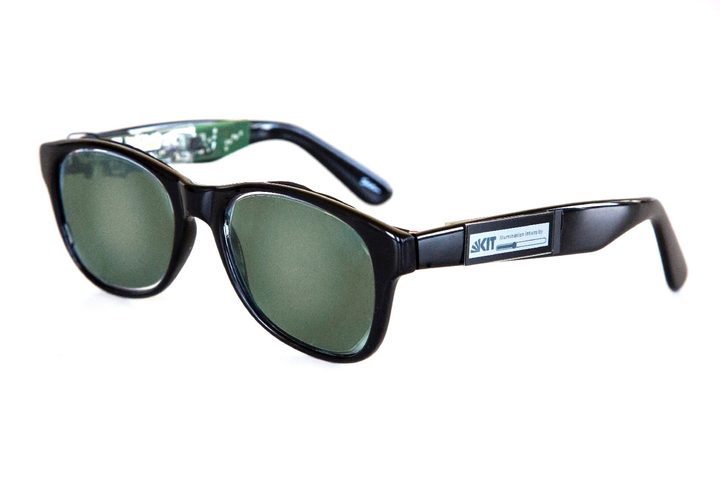
Understandably, the glasses work best in full sunlight, but each lens can still generate 200 microwatts even under 500 lux direct indoor illumination. No, that’s not going to power your MacBook any time soon, but it could — as Bahro notes — be enough to charge smaller devices like step counters. Plus, with solar cells making advances all the time, this could just serve as a proof of concept to be further developed.
“Since we are a university-based research group, we are personally more focused on issues like advancing fabrication techniques and device architecture of the solar cells itself,” Bahro said, concerning possible commercialization. “The solar glasses were made to demonstrate what possible future applications and markets are in range, and should not be seen as a product ready for the market.”
If you are in the market for a portable solar cell, there are options like this new solar charging backpack which can provide a similar application — albeit with larger solar cells. Still, now we’ve heard about this project, our hearts are kind of set on solar-charging shades.
A paper on the project was recently published in the journal Energy Technology.