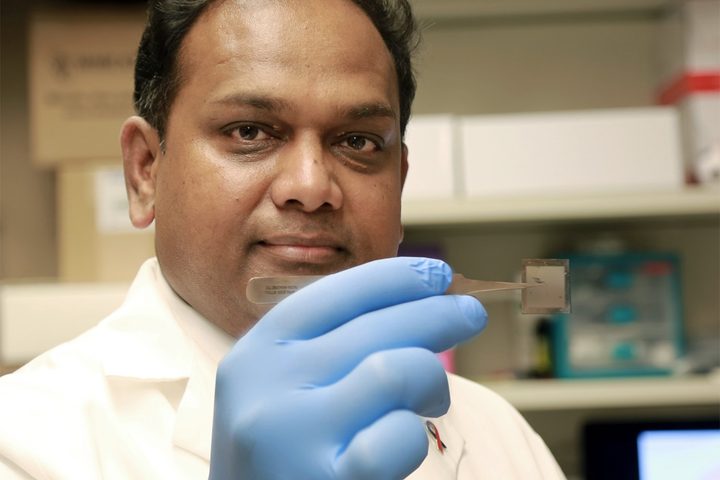
Imagine a smart chip that’s able to heal injuries by reprogramming skin cells when pressed onto a part of the body and given a quick jolt of electricity. It might sound like science fiction, but it’s actually the basis for new technology developed by researchers from the Ohio State University’s College of Engineering and Wexner Medical Center. Referred to as Tissue Nanotransfection (TNT), the device generates any cell type that’s required for treatment within a patient’s body. That means transforming the original cells into the building blocks necessary to do everything from repair injuries to restore the function of aging tissues, such as organs, blood vessels, and nerve cells.
In a demonstration, researchers used the biochip to reprogram skin cells to become vascular cells in a badly injured leg lacking proper blood flow. After a single week, active blood vessels appeared in the injured leg, and by the second week, the leg had been saved. Lab tests also showed that it was possible to reprogram skin cells into nerve cells. These were then injected into brain-injured mice to help them recover from strokes.
“Our TNT biochip is able to deliver large biomolecules, such as DNA and other genes, into the cells on the surface of a tissue or organ using a minimal invasive approach to achieve high dosage and minimal tissue or organ damage, not achievable by any existing technologies,” L. James Lee, professor of chemical and biomolecular engineering, told Digital Trends. “We found that the cell transfection effect may propagate quickly from surface cells to reach all cells in skin and muscle, leading to the formation of new blood vesicles and ‘difficult to reproduce cells,’ such as neurons in situ.”
Lee points out the technology’s use of a patient’s skin as a bioreactor means that the required “therapeutic cells” which are then delivered back to a damaged or malfunctioning organ carry minimal rejection and toxicity concerns.
“We believe the near-term clinical applications include wound healing via enhanced blood vessel formation in the local area, and the use of patient skin as a bioreactor to produce needed somatic cells,” Lee said. “In the long term, this technology may be extended to surgically exposed organs to facilitate treatment.”
At present, the TNT biochip has only been used in a mouse study. Next up, the team will conduct large animal studies, before hopefully progressing to clinical trials. Between this and some of the other smart biomedical breakthroughs we’re seeing, it’s certainly an exciting time for medicine.
A paper describing Ohio State University’s work was recently published in the journal Nature Nanotechnology.