From gorgeous wallpaper OLED displays to wall-sized MicroLED monsters, the biggest evolutions in TV technology took center stage at this year’s CES conference in Las Vegas. But while high rollers may be licking their chops for the opportunity to buy the latest and greatest 8K screen for their home theaters, average consumers — especially those who are just now considering the leap to a new 4K Ultra HD TV — may be a bit nervous about the news of a new, next-gen resolution.
“8K?” we imagine crowds of consumers declaring incredulously in their collective living rooms, “I don’t even have 4K yet!”
As soon as you see an 8K TV in person, you’re going to want it in your home.
The good news is, this is nothing worth fretting about. While 8K resolutions will begin to trickle into the top end of the market this year, we’re sure that by the time you actually buy one, you’ll be saying the same thing about some other cutting-edge TV tech.
Improvements in screen resolution and display technology like high dynamic range (HDR) have been coming fairly steadily over the past two decades, and while there are always curmudgeons who don’t want things to change, technology always gets better, picture quality always gets better, and everybody’s living room eventually wins.
Case in point: Before it became the new at-home standard, consumers and journalists hotly debated the merits of 4K, too. And yet, four years later, you will be hard-pressed to find a screen below 50 inches that isn’t 4K resolution.
We’re not going to tell you that buying an 8K TV makes sense for the average person in 2018, because it doesn’t. Just like 4K before it, there are numerous reasons why it is presently impractical to purchase an 8K TV, even when you ignore its exceptionally high price.
There is currently almost no content available in such high resolution, which means that everything you see on an 8K TV, at least for the time being, will be upscaled. There’s also reason to believe that it will take a long time before streaming services support 8K even modestly, because of the massive bandwidth required to broadcast that much data. Heck, outside of Netflix and Amazon, it’s tough to even find much 4K content these days. That said, Japan’s infamously ahead-of-the-curve broadcasting giant NHK has been broadcasting 8K on a test channel for over two years and plans to launch its first official 8K channel at the end of this year. Meanwhile, Sony and Panasonic have their eyes set on broadcasting the the 2020 Olympics in 8K. All signs point to the fact that content will eventually become easier and easier to come by, but for now there’s just not enough to warrant an upgrade.
Large 8K screens could eventually replace high-end projectors.
And yet there’s one thing about 8K that we hate to tell you just before you (rightly) upgrade to 4K at home: Just like all the cutting-edge screen tech before it, as soon as you see one in person, you’re going to want it in your home.
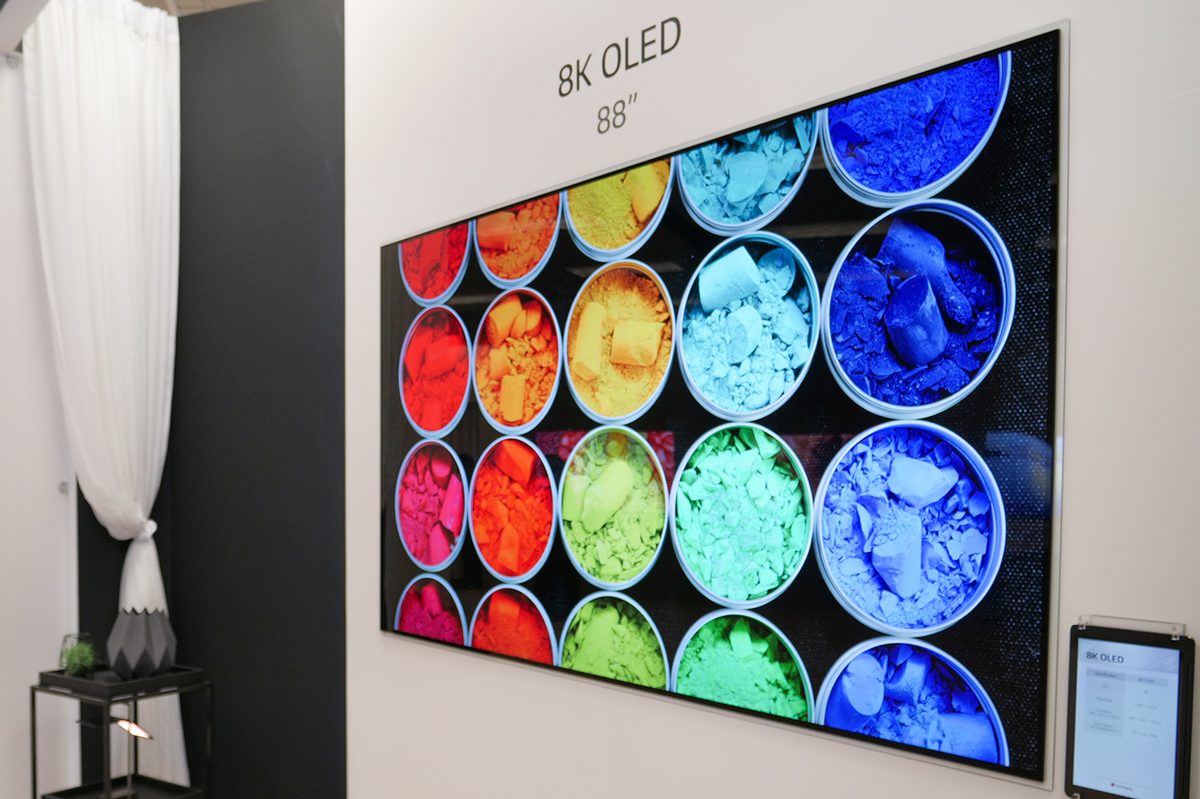
There’s something that happens to your eyes when they see 8K resolution on a large screen — where the dramatic increase in pixels per square inch is most apparent and akin to looking through a window. The massive resolution brings an astonishing sense of realism to every shot, providing a sense of depth and dimension that has been previously unseen on screens this size. Senior A/V editor Caleb Denison refers to it as an almost 3D effect, with shots that come through so clear and detailed you feel as though you could fall into another dimension.
In the future, 8K will make a lot of sense. Large 8K screens could eventually replace high-end projectors as the best way of watching large images in medium-sized rooms, bringing previously unseen brightness — by way of technology like Samsung’s MicroLED — to dedicated viewing rooms. And 8K also offers retail applications, as a means of promoting products and advertising that is clearer and more detailed than ever.
It’s worth noting that resolution isn’t the only TV tech making astonishing leaps, We’re also seeing companies like LG, Sony, and Samsung offer larger screen sizes, better HDR, higher overall brightness, deeper black levels, and various other cutting-edge technology that’s steadily seeping into the consumer TV market.
You may have not made the leap to 4K, but you can rest easy knowing that 8K is still very much a look-to-the-future technology, one that will see increasing high-end and commercial applications in 2018, but that won’t really start to seep into the living rooms of friends and neighbors for a good while.
So don’t worry about taking the plunge on that nice, moderately priced 4K TV you’ve been eyeing. It won’t be mothballed for years.