There is something about the prospect of making some serious loot that brings out the innovation in folks. With this entrepreneurial spirit coursing through their veins one smart team of bitcoin miners has built a $120,000 mining rig with a somewhat unorthodox twist: It’s submerged in a vat of cooling oil.
Due to the high temperatures created by the hardware used for mining cryptocurrencies, this 36 ASICs (application-specific integrated circuit chips) rig protects its valuable chips by rapidly dispersing the heat.
“Having been into mining for a while, we were dreading the arrival of summer as cooling becomes more of an issue than usual, forcing us to build all the cooling systems in our mines to withstand the hottest week of the year,” Alexander Aksenov, one of the brains behind the project, told Digital Trends. “Facing high [capital expenditure] costs for autonomous air-cooled systems, my partner Mirian and I began exploring alternative methods of achieving stable temperatures, taking as a benchmark the cost of a quality automated ventilation system.
“Having reviewed numerous immersion-cooled solutions that could be adapted to our needs,” he continued, “we came to the conclusion that the market is oversaturated with high-quality overpriced products that serve a purpose when financially subsidized, but are not viable for mining adaptation due to high costs severely affecting [return-on-investment] periods. That is when we made the decision to create an immersion-cooled solution from the ground up, which will be completely self-sufficient and autonomous from surrounding infrastructure.”
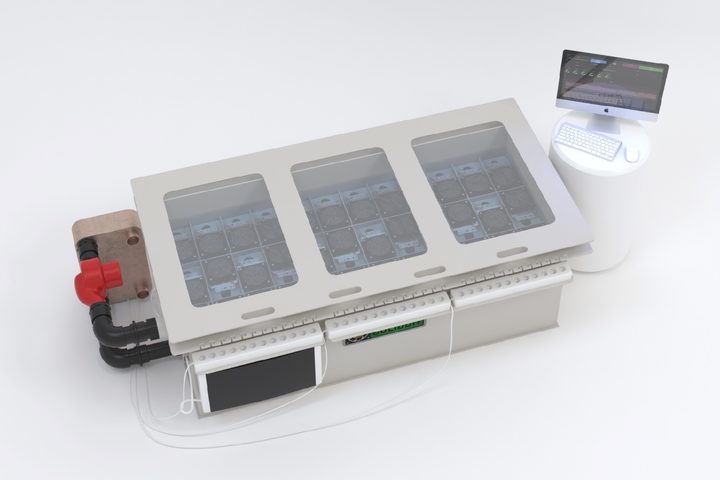
The system they built is able to cool up to 72 kilowatts of heat, coming ready with a full fuse box, Ethernet switch, and Zabbix-based monitoring system attached to it. It can be set up in any household or industrial space that meets the power requirements and has running water for keeping the oil appropriately chilled. As Alexander says, the byproduct of this system is hot water, which leaves the plated heat exchanger at a temperature of around 50 degrees — allowing them to heat the surrounding building and even provide enough hot running water to take showers.
The setup is located in Russia, where the pair of cryptocurrency masterminds have been working on their innovation lab since leaving previous jobs in the financial sector. “Cryptocurrency revealed to be the perfect platform for an exciting new direction with tremendous potential for growth that provides life-changing digital solutions, so we gathered our savings, converted them into crypto, quit our jobs and never looked back,” Aksenov told us.
At present, he said that the pair is working on a brand new immersion-cooled concept, although no further details are ready to be shared.
The only thing about this that sucks? That the pair is no longer working in conventional finance. After all, these kind of out-of-the-box thinkers are exactly what the financial system needs. Still, finance’s loss is cryptocurrency’s (and, presumably, this pair’s) gain.