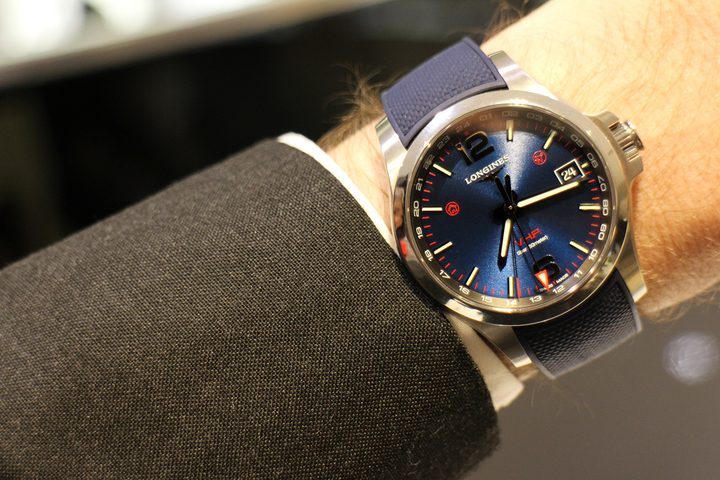
Let’s be clear right from the start. Longines hasn’t made a smartwatch. Its watches are by no means reliant on a mobile device to operate, nor do they require one to augment functionality. But the forthcoming Conquest V.H.P. GMT uses some very impressive technology to increase its time-telling accuracy, and takes advantage of the humble smartphone to make life a little easier. Remember, it’s not a smartwatch, but it is a smart watch.
Precise time until 2399
The V.H.P. acronym in the watch’s name stands for Very High Precision, a title earned by the Conquest’s accuracy — it’ll lose or gain less than five seconds per year, a massive achievement for an analog watch, and a considerable improvement over the plus or minus 10 seconds Longines managed in the original 1980s watch from which the new range is inspired. There are three components inside the Conquest’s exclusive ETA quartz movement that take much of the credit for this accuracy — an integrated circuit (IC), a sensor that detects the position of the hands, and a motor to shift the hands when needed.


This is where it gets very clever, because due to these components the watch knows when the time is wrong and automatically readjusts, a task enhanced by the perpetual calendar, which is pre-programmed with dates and times until the year 2399. It knows every day, every leap year, and every change to come until after you and I are long gone.
Watches can lose time when they’re get absorb any type of shock — like when you accidentally bump it on a wall. Longines Gear Position Detection system (GPD) utilizes the IC and the motor to check and readjust the time, ensuring it’s always correct. It not only registers shocks, but every 72 hours at 3am — a time chosen because the watch most likely isn’t being used — the IC checks the position of the hands, and if they’re out of sequence, it instructs the motor to move them to the correct time. It does this without being connected to a phone, or any instruction from you, and it’s really impressive.
Conquest V.H.P. GMT uses some very impressive technology to increase its accuracy.
Aside from shocks, magnetic fields that we encounter everyday can have an effect on the watch hand position, but the Conquest’s sensor can detect magnetic fields that may alter the time. Rather than recheck the time, the IC commands the motor to stop the hands moving completely, then once the magnetic field has been removed, it restarts the hands and zips forward to the correct time. How long will the Conquest stop time? Far longer than you’ll want to be in the vicinity of a magnetic field strong enough to trip the system.
How about adjusting the time yourself? This is a common requirement for travelers hopping between time zones. The Longines Conquest V.H.P. GMT has a “smart crown,” which makes changing the time by exactly an hour very simple indeed. Pull the crown out to the first position, and give it a solid flick in one direction, and the hour hand moves speedily around the face, before settling on a time precisely one hour ahead (or back) from where it started. No fiddling around to get it right, and no fear of suddenly having a watch that’s several minutes fast or slow. If precise adjustments are needed, just move the crown slowly. It’s a wonderfully tactile, and a superbly-engineered feature.
Connected app
What if you’re traveling far, and you need to adjust the time by several hours? Longines turns to the smartphone and a companion app, but it doesn’t rely on a Bluetooth connection to transfer data. It’s called Flash Setting and it’ll be part of a future version of the Conquest V.H.P. GMT, and in the app, you set home time and away time, and once this is done the app asks to send this information to the watch. Take a look at the watch dial in the pictures. There is a tiny pinhole at the top of the number 1 at the 12H position. This hides a sensor that reads light shot from the smartphone camera’s flash on the app’s command, which prompts the watch to reset the time to the away location.
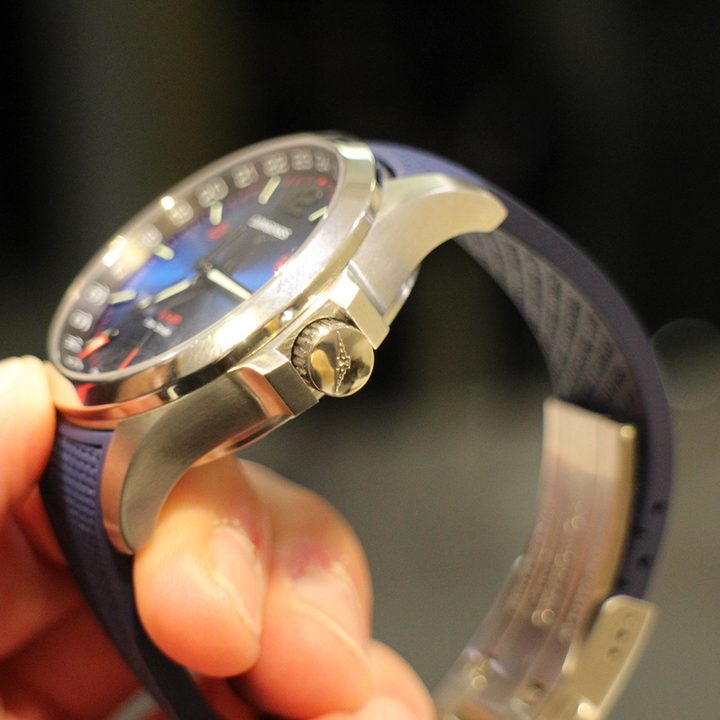
It’s cool use of available technology, without going overboard and adding superfluous features, or changing the character of such an attractive timepiece. We love systems that genuinely make life easier, especially when they do so in a technically impressive but easily accessible way. Smartwatches are often too complicated, and some mechanical watches can be complicated too. The Longines Conquest V.H.P. GMT Flash Setting simplifies an often used feature and gives the choice of using a smartphone to make it even easier again; but doesn’t make it mandatory.
The Conquest V.H.P. GMT truly earns the name Very High Precision.
The Conquest V.H.P. GMT’s autonomy is guaranteed to operate without interference for five years. When the battery — specially produced by experts Renata — reaches the end of its life, it resets the hands to the 12 o’clock mark, and you have six months to get the watch serviced and the battery replaced. Provided the battery is removed and replaced on the same day during this time, the Conquest V.H.P. will automatically set the right time and date, without you or the engineer doing anything at all. While the GMT version is the only member of the Conquest family that works with the app, the other Conquest V.H.P models have the same degree of accuracy.
The Conquest V.H.P. GMT truly earns the name Very High Precision. Accuracy is a valued commodity in the watch world, and maintaining time is a mark of a high quality, beautifully-made timepiece. We particularly liked the stainless steel model with the carbon blue face and blue rubber strap, although many other combinations will be available. The watch is also sensibly sized with either a 41mm case or 43mm case.
When the watch goes on sale during the fall, prices start at around $1,300 depending on the features, size, and color. A reasonable price for a Swiss watch that goes to extraordinary lengths to tell the precise time, and will do so, with the correct maintenance, for at least the next 360 years.