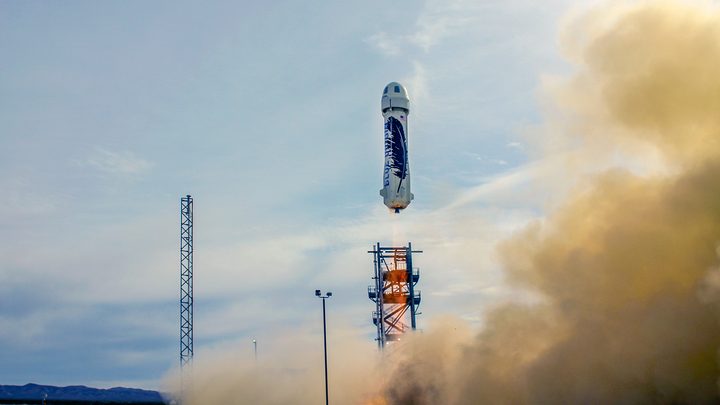
Look out, SpaceX. You may not be the belle of the ball in the industry forever. This week, Blue Origin, the rocket company founded by Jeff Bezos, announced that its new rocket engine would have the capacity to launch “100 full missions,” as per CEO Bob Smith. And while it has yet to begin any commercial operations, that could soon change. The BE-4 engine is well on its way to becoming a rocket engine to contend with, and is slated to send the New Glenn orbital launch vehicle into space.
As Smith told CNBC’s Morgan Brennan at the 34th Space Symposium at Colorado Springs, Colorado, the BE-4 engine has proven that it “works, and works well.” The company recently tested the engine for almost two minutes at about 75 percent of full power. Thus far, Blue Origin seems pleased by how hardy the engine is. Indeed, the rocket was designed to be reused, which is part of why production has taken a longer stretch of time.
New test video of Blue’s 550K lbf thrust, ox-rich staged combustion, LNG-fueled BE-4 engine. The test is a mixture ratio sweep at 65% power level and 114 seconds in duration. Methane (or LNG) has proved to be an outstanding fuel choice. @BlueOrigin #GradatimFerociter pic.twitter.com/zWV0jWXIvx
— Jeff Bezos (@JeffBezos) March 13, 2018
As Smith noted, “… We’ve spent … over seven years developing this engine to make it reusable,” Smith said. “This engine will actually perform 100 starts — 100 full missions that we’d actually be able to go do.”
The BE-4 was preceded by the BE-3 engine, which Smith says “was designed with the same kind of principles.” This engine managed to launch the New Shepard rocket, which successfully deployed an unmanned capsule back in December. In keeping with the reusability principle, the New Shepard rocket was launched a total of five times without ever removing the BE-3 engine. The BE-4, then, is really “just a five times larger” version of the same thing.
“We’re excited about the commercial opportunities that’s going to give us: when we fly it on New Glenn and when we hopefully get selected by United Launch Alliance for its vehicle, Vulcan, as well,” Smith said. That particular alliance is a partnership between Boeing and Lockheed Martin, and the two companies are currently determining what engine will be chosen to send its next-generation rocket into space.
“We certainly are demonstrating all the technical characteristics that they need, for their vehicles,” Smith said. “But we’re going to offer it to whoever else will come out and say they need a new engine.”
Even if Blue Origin doesn’t manage to land the United Launch Alliance deal, the company is still looking to send tourists to space before the end of 2018 on its existing New Shepard rocket. But of course, safety will be key, and Smith says that launch will only take place when the company is fully ready. “We want to make sure it’s completely safe for our passengers,” Smith said.