1. Home
  2. Wearables
  3. Emerging Tech
  4. Virtual Reality
  5. News

A sensor-packed exosuit lets you fly a drone by pretending to be one

Add as a preferred source on Google
FlyJacket: An Upper Body Soft Exoskeleton for Immersive Drone Control

“Don’t just fly the drone; be the drone” sounds like the kind of quasi-philosophical line you would hear in one of The Matrix or Star Wars movies. In fact, it perfectly encapsulates a new project developed by researchers at Switzerland’s École Polytechnique Fédérale de Lausanne (EPFL). They created a new drone control system which allows users to pilot drones by, essentially, pretending to be one.

Recommended Videos

OK, so stretching out your arms like wings and pitching or rolling your body may be a little bit embarrassing in public, but this could make drone piloting more intuitive than ever.

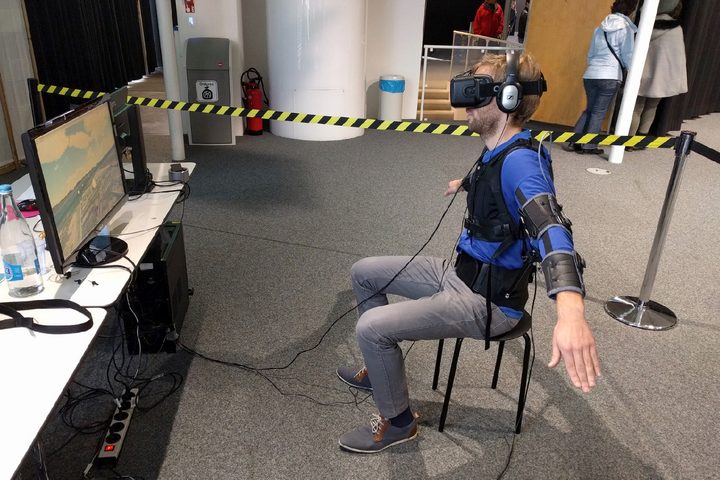
“In order to enhance the interaction between human and drone by making their control more natural and intuitive, we developed an exosuit, called the FlyJacket, which allows user to control a drone with upper body movements,” Carine Rognon, a researcher on the project from EPFL’s Laboratory of Intelligent Systems, told Digital Trends. “The user is wearing [an] exosuit and virtual reality goggles. The torso inclination, recorded with an inertial measurement unit embedded in the exosuit, is translated into drone command. As people tend to intuitively fly with the arm spread out, we included a passive arm support to the exosuit to prevent arm fatigue.”
EPFL

The FlyJacket experience begins when a person puts on the superhero-style suit. Once they are wearing it, Rognon says that most users quickly grasp the relationship between their own body and control of the drone.

“As the drone control is very intuitive, the user is directly immersed in the flight and can directly start to explore the environment,” she said. “You quickly feel as if you are the drone. The immersion is deepened by the fact that the interaction with the drone is direct as is doesn’t pass through a physical tool, such as when using a joystick. In addition, as people use their full upper body and not only their fingertips, they have kinesthetic and vestibular feedback due to their change of upper-body position.”

While this is still a research project at present, the team (led by EPFL’s Professor Dario Floreano) hope to turn the exosuit into a commercially available product. Currently, they are working to improve the immersion of the experience by implementing tactile feedback inside the FlyJacket to render the sensation of flying. This is being carried out in collaboration with the Collaborative Haptics and Robotics in Medicine (CHARM) Lab at Stanford University, a laboratory specializing in haptics rendering.

A paper describing the project was recently published in the IEEE Robotics and Automation Letters journal.

Luke Dormehl
I'm a UK-based tech writer covering Cool Tech at Digital Trends. I've also written for Fast Company, Wired, the Guardian…
Apple’s new Upgrade plan won’t punish missed payments with restrictions, but three strikes could end your lease
Restricted Mode remains in iOS 27 beta, but Apple says it won’t be used for Upgrade payment defaults
Computer, Electronics, Laptop

Apple recently announced its new Apple Upgrade leasing plan, which lets customers pay monthly for an iPhone, iPad, Mac, or Apple Watch through Klarna. The program replaces the long-running iPhone Upgrade Program and expands the option beyond phones for the first time.

However, code discovered by 9to5Mac in an iOS 27 beta raised concerns about what could happen if someone fell behind on payments. The new App Managed Features system appeared capable of checking a customer’s payment status and placing a financed device into Restricted Mode.

Read more
Nothing’s first proper smartwatch could be the wrist candy Android needs
Nothing wants to put some personality back on your wrist
Wristwatch, Arm, Body Part

Just like how smartphones have settled into a familiar routine, smartwatches have also become quite predictable. But Nothing might be planning on shaking things up for wearables. A tipster claims the company is preparing its first smartwatch under the main Nothing brand. The unnamed wearable will reportedly launch in September, cost less than $300 in the US, and initially reach a limited number of markets.

Its design is also said to carry the “typical Nothing DNA” that has helped the company’s phones and audio gear stand apart. Right after this, Nothing co-founder Akis Evangelidis joined the conversation with a separate, cryptic post. It adds some company-side smoke to the leak, although Nothing has yet to announce the watch or reveal any hardware details formally.

Read more
Google could soon let you unlock your Pixel Watch with your phone
An in-development feature could flip the current Watch Unlock feature, letting an authenticated phone unlock the watch automatically.
Google Pixel Watch 4 in black in the hand

If you've set up a PIN on your Pixel Watch, you already know the prompt that shows up every time you slip it back on your wrist. It's a useful security measure, but entering a PIN on that small screen multiple times a day gets old fast. A new report suggests Google may be working on a way to let you skip it.

Watch Unlock in reverse

Read more