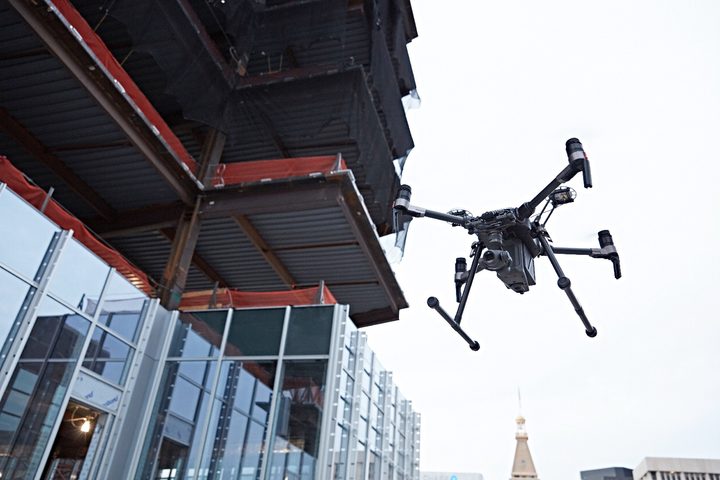
You just robbed a liquor store and now you’re making a break for it, confident that you avoided being caught on any cameras which could be used to identify you in court. Things are looking good until suddenly there is the whir of rotor blade above you; too quiet to be a helicopter, but too loud and purposeful to be a ceiling fan in some nearby apartment. You glance upward and suddenly, bursting through the low cloud cover, a police drone bears down on you, using its 4K cameras to record incriminating video footage which is instantly streamed to all officers nearby.
OK, so we’re getting a bit ahead of ourselves — but maybe not quite as far as you imagine. Announced this week, world-leading drone company DJI and connected law enforcement company Axon have teamed up to sell DJI drones to law enforcement agencies around the globe. The Axon Air program offers international law enforcers DJI’s Phantom 4 Pro and Matrice 210 drones, alongside guidance on how these can be employed as a valuable crime-fighting or public safety tool.
“A lot of people have questions about what exactly a police department would want a drone for,” Adam Lisberg, North American corporate communication director for DJI Technology, told Digital Trends. “The uses are many, and many of them are quite remarkable — from monitoring large crowds to surveying traffic crash scenes to documenting crime scenes to search and rescue operations. [In the U.K., police recently used a drone to] spot a semiconscious man in peril on the edge of a cliff. Because of that, they were able to get him to safety. It’s an important tool for law enforcement, whose value is becoming more and more clear.”
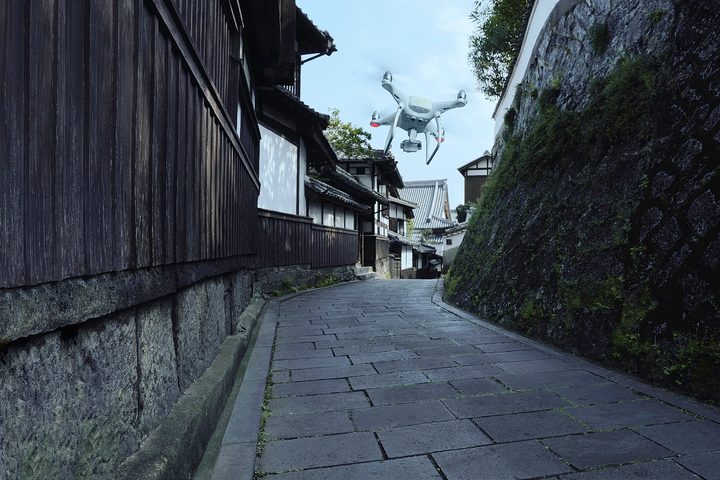
Police drones aren’t a completely new thing. In the U.S. alone, more than 900 public safety agencies use drones as part of their job. What this partnership does, however, is to link DJI’s highly respected drone technology with Axon’s connected data network and Evidence.com services — a platform that is already used by law enforcement for data management, chain-of-custody controls, and more.
So does this mean that police drones will become more visible on a day-to-day basis? “That’s a good question, and it’s one I don’t think anyone knows the answer to yet,” Lisberg continued. “Is it something that you’ll only see, say, above a crime scene or major incident or will you see them constantly on patrol? I imagine that police departments will try a variety of approaches in using them and see what ends up working best in terms of resources. Departments will work with their local communities to [figure out the right approach] for their jurisdictions. We don’t know the answer, but we’re really excited to see what it turns out to be.”