  1. Home
  2. Emerging Tech
  3. News

This remote control robot promises to destroy a tank from three miles away

Add as a preferred source on Google
MBDA and Milrem

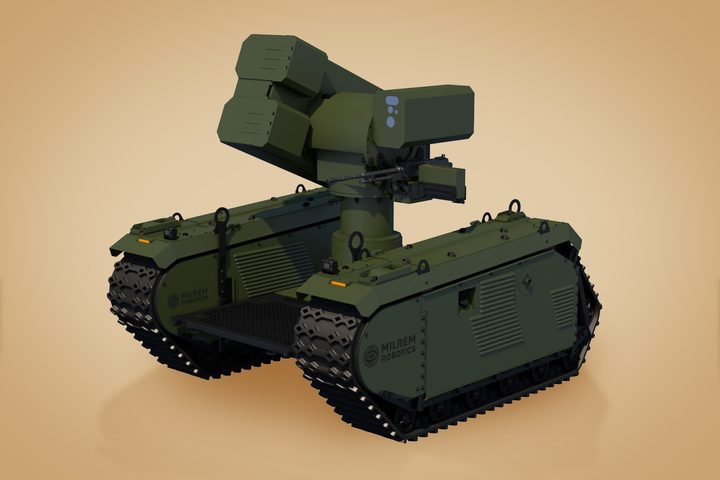
When it comes to cutting-edge tech, for every one project that makes its way into our homes as a consumer-facing product, there are likely several equally (or more) innovative projects designed exclusively for military use. While we won’t ever hear about all of them, we’ve heard enough to have previously written about everything from gun-toting drones to self-guided bullets and robot insect spies. Now, an Estonian defense company called Milrem has teamed up with European missile manufacturer MBDA to create a new unmanned ground vehicle (UGV) that combines a robotics platform called THeMIS with an anti-tank missile capable of taking out enemy tanks at a range of up to 3 miles.

The remote control vehicle can be equipped with up to four anti-tank missiles, each designed to penetrate 39.3 inches of hardened steel armor plating. Oh, and it can carry 1,650 pounds and be kitted out with a robot arm or .50 caliber machine gun to provide cover fire if need be.

Recommended Videos

“This system will be based on our THeMIS UGV and MBDA’s IMPACT anti-tank system,” Gert Hankewitz, export director for Milrem, told Digital Trends. “At the moment, it is in [the] concept stage. The main idea is the whole reason we have developed the THeMIS: To help or replace soldiers on the battlefield.”

The proposed anti-tank UGV has two main selling points. One is that it will keep soldiers safely away from enemy fire. Secondly, it increases the chance of troops being able to successfully destroy enemies’ heavy equipment. This is because humans give off a heat signature thatg is very difficult to mask, making it more difficult for them to sneak up on enemies without being recognized using thermal imaging technology. But this heat signature is easier to conceal with a UGV — meaning that enemies won’t be able to easily detect the anti-tank weapon before it can get close enough to launch its missiles.

“[THeMIS is] the first fully modular hybrid UGV on the market,” Hankewitz said. “UGVs are mostly designed for one specific purpose, such as IED [explosive] clearing. However, the THeMIS is designed so the same UGV can be used for different tasks, so you can carry different weapon systems — UAV platforms, IED detection and de-mining kits, simple soldiers backpacks, ammunition, and other gear. This approach significantly reduces the life cycle costs of complex unmanned systems.”

Since this project is still in the research and development stage, Hankewitz said there is not yet a publicly announced release date. As to possible deployment, he noted that: “We would like to see them used by NATO forces and other friendly defense forces around the world.”

Luke Dormehl
I'm a UK-based tech writer covering Cool Tech at Digital Trends. I've also written for Fast Company, Wired, the Guardian…
A new AI model wants self-driving cars to think before they swerve
Forget guessing games, this self-driving AI actually shows its work.
Self driving car

Self-driving cars have gotten pretty good at driving. The harder problem is teaching them to drive safely in situations nobody planned for. We have heard horror stories of self-driving cars, behaving erratically in emergency situations, often times delaying first responders from reaching the scene.

A team at Seoul National University, led by professor Jun Won Choi from the Department of Electrical and Computer Engineering, thinks they have cracked part of that puzzle with a new AI model called SafeDrive. The research was recently selected as a highlight paper at CVPR 2026, a distinction that goes only to roughly 3% of all submissions.

Read more
An AirPods-sized mini lab could help catch disease markers in minutes
Meet VPodDuo, an AirPods-sized molecular testing gadget
VPodDuo Mini Medical Device

Home testing could eventually become a lot more convenient. Researchs at the at the University of Illinois Urbana-Champaign has developed the VPodDuo, a pocket-sized fluorescence reader designed to measure sensitive molecular tests outside a conventional laboratory.

Its housing is roughly comparable in size and shape to an AirPods charging case, while Bluetooth connectivity sends results directly to a smartphone. Meaning, you might not have to wait in line anymore.

Read more
Your future AR glasses might finally stop making the real world look weird
Researchers have developed a new display technique that keeps virtual objects realistic without dimming the real world.
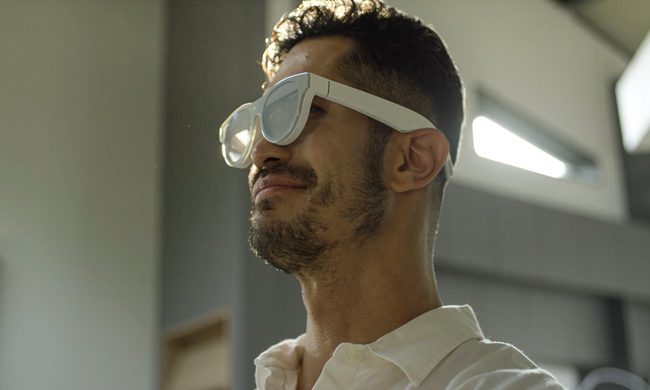
Samsung AR Glasses

One of the biggest promises of augmented reality is blending digital objects seamlessly into the real world. Ironically, today's AR glasses often make the real world harder to see. Researchers at the Shibaura Institute of Technology (SIT) in Japan, led by Assistant Professor Xiaodan Hu in collaboration with Dr. Yan Zhang and Professor Xubo Yang from Shanghai Jiao Tong University in China, and Professor Kiyoshi Kiyokawa from Japan's Nara Institute of Science and Technology, have developed a new AR display technique that aims to make virtual objects look realistic without reducing visibility of the real world. The study was published in IEEE Transactions on Visualization and Computer Graphics.

The biggest AR problem isn't virtual objects; it's everything around them

Read more