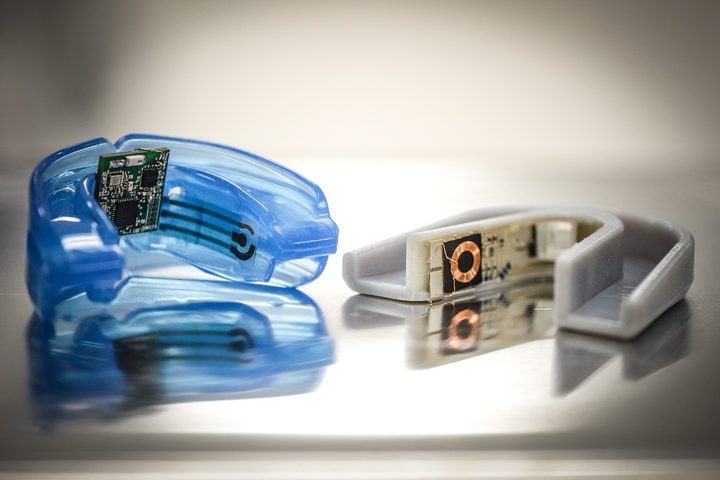
Xerox Parc, the legendary research and development center, is probably best known to readers as the research lab that Steve Jobs visited in the late 1970s, getting his first glimpse at the graphical user interface concept he later made famous with the Mac. But Parc has been involved in plenty of other innovative research projects over the years — and its latest is no different. Working with flexible hybrid electronics group NextFlex and the University of California, San Diego, Xerox’s Parc development lab has created a smart mouthguard biosensor which can detect early signs of dehydration, exhaustion, and mental engagement levels, based on nothing more than a sample of your saliva.
The sensor is made from electronic plastic foil and is designed to fit into an ordinary mouthguard for use in everything from workouts to military missions. It does this by analyzing the lactate and glucose naturally found in saliva and is able to send this information to a connected smartphone in close to real time.
“The electrochemical sensor system is fabricated on a small, flexible plastic foil that is mounted on a mouthguard,” David Schwartz, Parc’s manager of Energy Devices and Systems, told Digital Trends. “Sensing is through chronoamperometry, an established electrochemical measurement technique, based on enzymatic oxidation of target species. Chronoamperometry is known to have high sensitivity, specificity, and capability for quantification of analyte concentrations.”
The printed sensor electrodes in the mouthguard are replaceable and interchangeable with electrodes sensitive to other analytes including glucose, uric acid, and more. The electronics are protected from the saliva by an encapsulant, and the batteries are wirelessly rechargeable, which allows the battery electrodes to be completely enclosed.
“The background on the project is that there was some proof-of-concept work already completed with rigid circuit boards, and the question to be answered was, ‘How could you create a form factor that someone would fit comfortably into a person’s mouth so that they would actually wear it?’” Jason Marsh, NextFlex’s director of technology, told us. “Parc developed the sensor and conducted small-scale integration on a prototype. NextFlex’s capability is to take the prototype and scale it to be manufacturable in higher volumes.”
With a proof of concept demonstrated, both parties are now keen to commercialize the technology. The next step of this will likely involve fabricating multiple units for in-mouth testing.
Along with the concussion-diagnosing mouthguard we wrote about earlier, it seems that this is the decade when this otherwise innocuous piece of sports equipment gets smart.